Definition and Meaning of Graph Paper
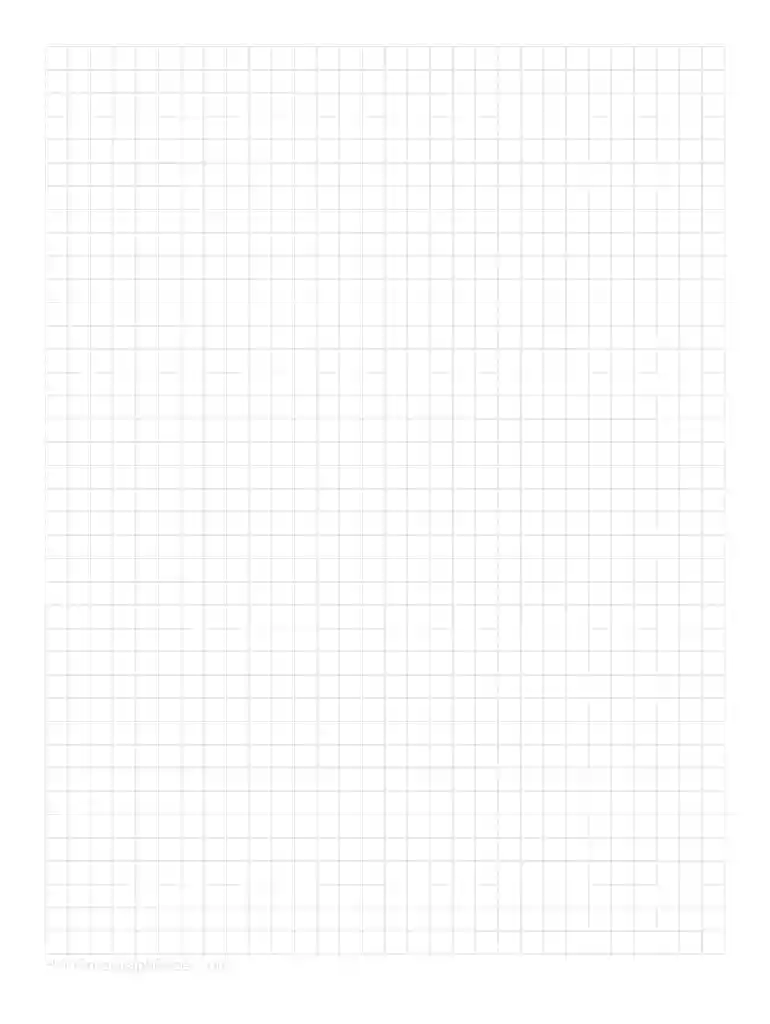
Graph paper is a type of writing paper printed with fine lines arranged in a regular grid pattern, which serves as a guide for plotting graphs, drawing curves, and crafting complex engineering drafts. It is commonly used in mathematics and science to create graphs of functions or experimental data, and in art for creating detailed drawings. Each sheet typically features a square grid, although other line arrangements exist, such as triangular or hexagonal grids. The standard form of graph paper is composed of small squares that provide a reference for plotting data points.
Types of Graph Paper:
- Standard: Features equal squares, often one centimeter or one millimeter on each side.
- Semi-logarithmic: Useful for data that spans several orders of magnitude.
- Logarithmic: Allows plotting of exponential or logarithmic data.
- Polar coordinate paper: Used for plotting in polar coordinates.
How to Use Graph Paper
Using graph paper involves aligning your data, drawings, or plots within the grid for precision and organization.
Steps for Effective Use:
- Alignment: Position your data points or lines accurately with the grid to ensure even spacing.
- Plotting Data: Begin at a defined origin point if plotting graphs or data.
- Drawing and Sketching: Use the grid to maintain proportions and symmetry in technical or artistic drawings.
- Labeling: Clearly label axes, data points, or sections for clarity in communication.
Practical Tips:
- Use a pencil for easy corrections.
- Frequently check alignment with the grid to maintain accuracy.
- Utilize the grid for scaling dimensions in design projects.
How to Obtain Graph Paper
Graph paper can be easily accessed through various means, depending on user preference and needs.
Sources:
- Physical Purchase: Available at office supply stores and school bookstores.
- Online Printing: Websites like PrintFreeGraphPaper.com offer free printable graph paper forms in various sizes and grids.
- Software Tools: Digital applications that generate customizable graph paper, suitable for virtual use.
Considerations:
- Choose the type best suited for your task, be it standard for general purposes or specialized for specific applications.
- Ensure paper quality matches your toolset requirements (e.g., pencil, pen, or marker).
Who Typically Uses Graph Paper
Graph paper caters to a diverse audience ranging from students to professionals.
Professional Sectors:
- Education: As an essential tool in teaching complex mathematical concepts.
- Engineering: For drafting designs and models.
- Economics and Business: To illustrate data trends and financial forecasts.
Key Elements of Graph Paper
Graph paper's utility is defined by its key elements, which guide users in various tasks.
Fundamental Elements:
- Grid Lines: The backbone of graph paper, providing structure and reference points.
- Axes: Origin points where horizontal and vertical lines intersect, important for plotting graphs.
- Margins: Space around the edges of the paper, often used for notes or labeling.
- Line Thickness: Variations can exist, where thicker lines may denote primary counting intervals (e.g., every five or ten units).
Examples of Using Graph Paper
Graph paper serves multiple purposes across various disciplines.
Educational Examples:
- Plotting the trajectory of a thrown object to study physics principles.
- Creating detailed architectural sketches for a classroom project.
Professional Examples:
- Engineers drafting an electrical circuit schematic.
- Economists visualizing consumer trends over time using semi-logarithmic graph paper.
Art and Design Examples:
- Drafting a scale drawing for an art project.
- Designing knitting or cross-stitch patterns with precision.
Digital vs. Paper Version
Choosing between digital and paper graph paper depends on user needs and project specifics.
Paper Graph Paper:
- Tangibility: Offers a tactile experience, useful for hands-on activities.
- Portability: Easily carried without devices.
- Limited Tools: Restricted to physical drawing implements.
Digital Graph Paper:
- Customizable Grids: Select from various grid types and sizes tailored to specific needs.
- Integration: Easily incorporates digital data for seamless plotting and sharing.
- Versatility: Adjust grids without printing for dynamic project requirements.
Versions or Alternatives to Graph Paper
While traditional graph paper remains popular, alternatives and versions cater to specific fields and needs.
Specialty Alternatives:
- Isometric Graph Paper: Used for 3D sketches and isometric views in engineering.
- Dot Grid Paper: Offers flexibility with minimal distraction, popular in bullet journaling.
- Engineering Paper: Green-tinted with a heavier grid used for professional calculations and designs.
Electronic Platforms:
- Software like Microsoft Excel or Google Sheets offers dynamic grid capabilities for digital data plotting and analysis.
- CAD software provides advanced graphing and drawing tools for technical purposes.
Choosing the right type of graph paper or its digital alternatives depends on specific project goals, user preference, and task requirements.