Guide to procedures in employment equality and pension cases 2026

Get Form
guide to procedures in employment equality and pension cases Preview on Page 1

Here's how it works

01. Edit your form online
Type text, add images, blackout confidential details, add comments, highlights and more.

02. Sign it in a few clicks
Draw your signature, type it, upload its image, or use your mobile device as a signature pad.

03. Share your form with others
Send it via email, link, or fax. You can also download it, export it or print it out.

How to use or fill out guide to procedures in employment equality and pension cases

Form edit decoration
9.5
Ease of Setup
DocHub User Ratings on G2
9.0
Ease of Use
DocHub User Ratings on G2
  1. Click ‘Get Form’ to open it in the editor.
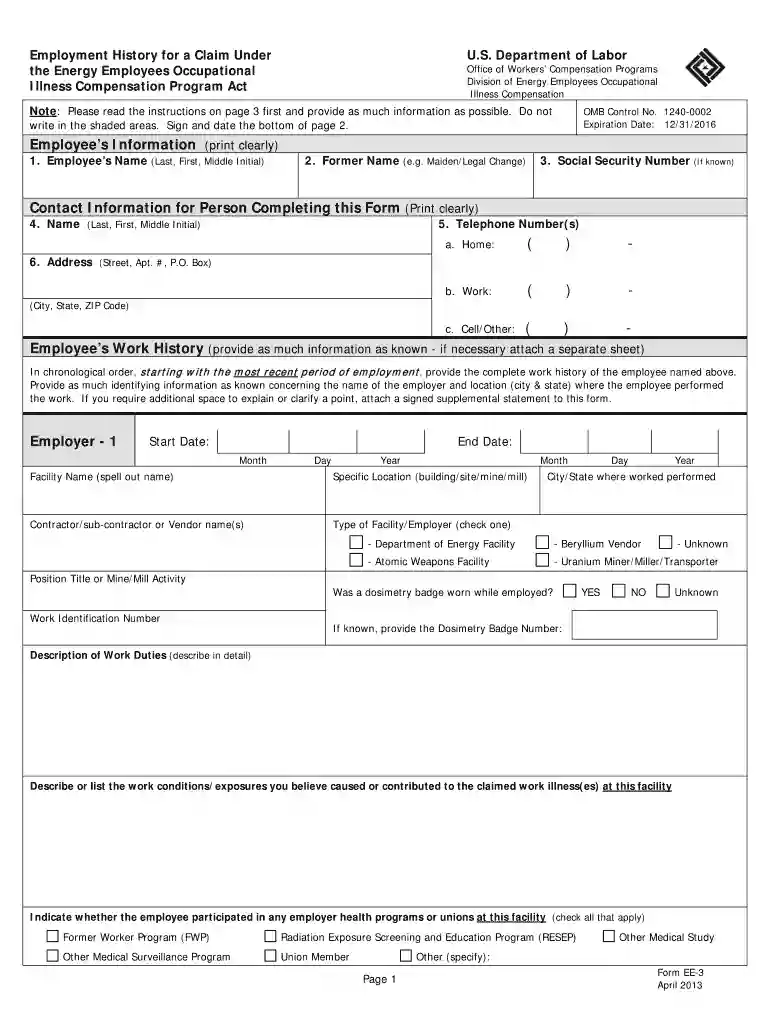
  2. Begin by filling out the Employee’s Information section. Clearly print the employee's name, former name, and Social Security Number if known.
  3. Next, provide the contact information for the person completing the form. Include their name, telephone numbers, and address.
  4. In the Employee’s Work History section, list all periods of employment chronologically. Start with the most recent job and include details such as facility name, location, type of employer, position title, and dosimetry badge information.
  5. For each employer listed, describe work duties and any conditions that contributed to claimed illnesses. Indicate participation in health programs or unions as applicable.
  6. Finally, complete the Declaration section by signing and dating the form to affirm accuracy.

Start using our platform today to streamline your document editing and form completion for free!

See more guide to procedures in employment equality and pension cases versions

We've got more versions of the guide to procedures in employment equality and pension cases form. Select the right guide to procedures in employment equality and pension cases version from the list and start editing it straight away!
Versions Form popularity Fillable & printable
2013 4.8 Satisfied (115 Votes)
be ready to get more

Complete this form in 5 minutes or less

Get form

Got questions?

We have answers to the most popular questions from our customers. If you can't find an answer to your question, please contact us.
Contact us
The Workplace Relations Commission (WRC) is the body responsible for deciding on discrimination claims in Ireland in the first instance. The WRC deals with both employment and service/goods related claims. Gender discrimination claims have the option of going to the Circuit Court.
Bases (protected groups) under EEO are race, color, national origin, religion, age, sex (gender), sexual orientation, physical or mental disability, and reprisal.
The Equal Status Acts 2000-2018 (the Acts) prohibit discrimination in the provision of goods and services, accommodation and education. They cover the nine grounds of gender, marital status, family status, age, disability, sexual orientation, race, religion, and membership of the Traveller community.
These Acts aim to protect individuals from certain kinds of discrimination, harassment and sexual harassment that can happen in the workplace.
The Acts outlaw discrimination in work-related areas such as pay, vocational training, access to employment, work experience and promotion.

Security and compliance

At DocHub, your data security is our priority. We follow HIPAA, SOC2, GDPR, and other standards, so you can work on your documents with confidence.

Learn more
ccpa2
pci-dss
gdpr-compliance
hipaa
soc-compliance

People also ask

Under the Equality Act 2010, there are 9 protected characteristics which are; age, disability, gender reassignment, marriage and civil partnership, pregnancy and maternity, race, religion or belief, sex, and sexual orientation.
Types of discrimination (protected characteristics) age. gender reassignment. being married or in a civil partnership. being pregnant or on maternity leave. disability. race including colour, nationality, ethnic or national origin. religion or belief. sex.

Related links