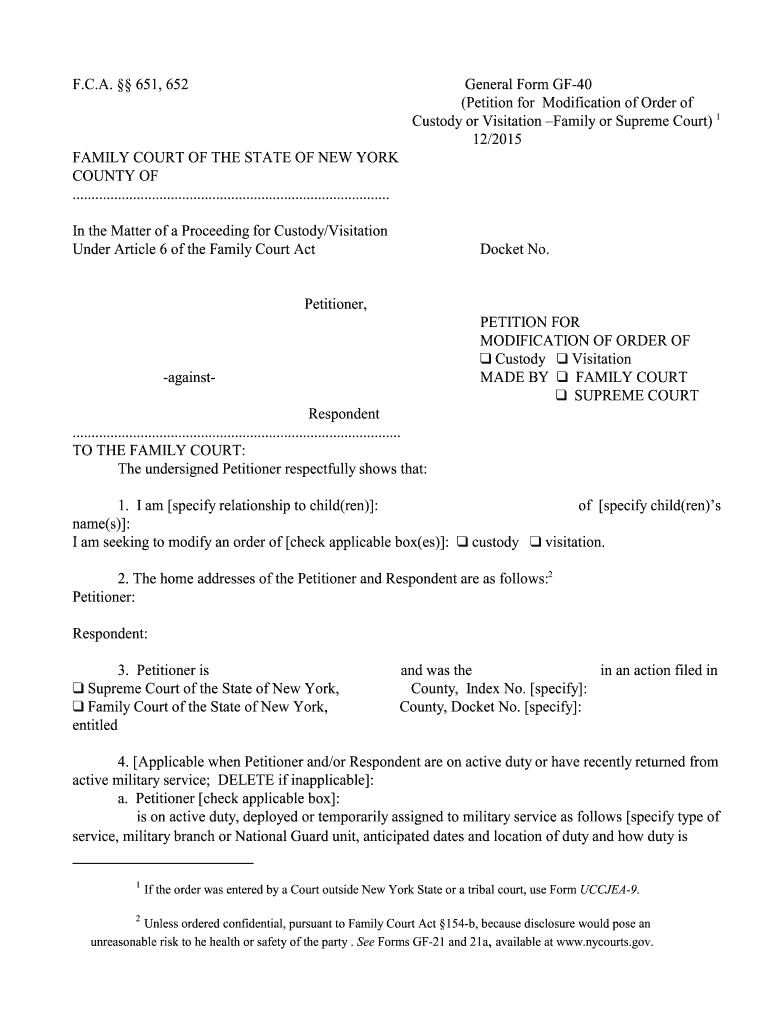
Page 1 of 5 F.C.A.651, 652 General Form 40 Custody/Visitation ... 2026

Get Form
652 form Preview on Page 1

Here's how it works

01. Edit your 652 form online
Type text, add images, blackout confidential details, add comments, highlights and more.
02. Sign it in a few clicks
Draw your signature, type it, upload its image, or use your mobile device as a signature pad.
03. Share your form with others
Send it via email, link, or fax. You can also download it, export it or print it out.

How to use or fill out Page 1 of 5 F.C.A.651, 652 General Form 40 Custody/Visitation ... with our platform

Form edit decoration
9.5
Ease of Setup
DocHub User Ratings on G2
9.0
Ease of Use
DocHub User Ratings on G2
  1. Click ‘Get Form’ to open it in the editor.
  2. Begin by specifying your relationship to the child(ren) in the designated field. This is crucial for establishing your standing in the custody or visitation matter.
  3. Next, enter the names of the child(ren) affected by this petition. Ensure accuracy as this information is vital for court records.
  4. Fill in the home addresses for both the Petitioner and Respondent. This section helps the court understand where each party resides.
  5. Indicate whether you are filing under Family Court or Supreme Court by checking the appropriate box. This determines which court will handle your case.
  6. If applicable, provide details regarding military service for either party, including deployment dates and how it may affect custody arrangements.
  7. Complete any additional sections that apply to your situation, such as previous judgments or orders related to custody or visitation.

Start using our platform today to streamline your document editing and form completion process for free!

See more Page 1 of 5 F.C.A.651, 652 General Form 40 Custody/Visitation ... versions

We've got more versions of the Page 1 of 5 F.C.A.651, 652 General Form 40 Custody/Visitation ... form. Select the right Page 1 of 5 F.C.A.651, 652 General Form 40 Custody/Visitation ... version from the list and start editing it straight away!
Versions Form popularity Fillable & printable
2016 4.9 Satisfied (50 Votes)
2015 4.2 Satisfied (42 Votes)
2009 4.3 Satisfied (180 Votes)
be ready to get more

Complete this form in 5 minutes or less

Get form

Got questions?

We have answers to the most popular questions from our customers. If you can't find an answer to your question, please contact us.
Contact us
Custody Battle Blunders: Top 10 Mistakes To Avoid Negative Speech About The Other Parent. Seeking Sympathy From The Child. Poor Communication With The Other Parent. Unjustifiably Withholding Access With The Other Parent. Misrepresenting Substance Abuse. Separating Siblings In Blended Families.
Declaration Under Uniform Child Custody Jurisdiction and Enforcement Act (UCCJEA) (FL-105) Give the court important information about the children you have with your spouse or domestic partner. The court considers this information before making child custody and visitation orders.
In California, Full custody is awarded when the court determines that one parent is unfit or that shared custody would be harmful to the child. Judges consider evidence of domestic violence, neglect, substance abuse, or an unstable living situation when making custody decisions.
With full custody, the non-custodial parent may still be able to visit and spend time with their child. The frequency and length often depend on their agreement with the custodial parent.
Emotions: The inability of parents to consistently control their emotions, and avoid emotional decision making, is the most common mistake we see in child custody cases. The reason: it is such an easy mistake to make, and so pervasive in all aspects of the case.

Security and compliance

At DocHub, your data security is our priority. We follow HIPAA, SOC2, GDPR, and other standards, so you can work on your documents with confidence.

Learn more
ccpa2
pci-dss
gdpr-compliance
hipaa
soc-compliance
be ready to get more

Complete this form in 5 minutes or less

Get form

People also ask

A mother who has failed to properly care for, support, or guide the child, a mother who has neglected or abused the child, or a mother who abuses drugs/alcohol is deemed by the court as an unfit mother. A court can pronounce a mother unfit if it is convinced by the evidence presented by the other spouse.
Conclusion. In most custody battles, the winner is the parent who can best demonstrate that they serve the childs best interests. While mothers still win more cases overall, the gap has narrowed as fathers play a greater role in raising their children.