







Definition and Purpose of the KMP Form
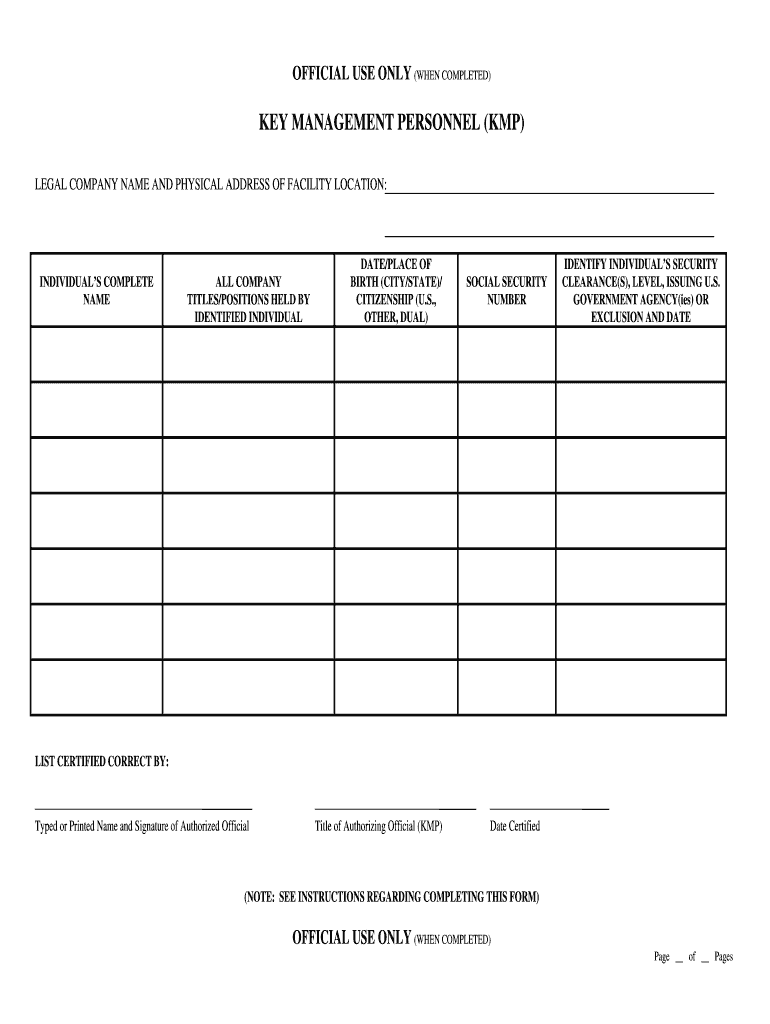
The KMP form, or Key Management Personnel form, collects essential information about individuals holding significant management roles within a company. It is predominantly used in corporate environments to ensure compliance with regulatory requirements regarding the disclosure of key personnel data. This form is crucial for organizations applying for licenses, participating in government contracts, or needing to verify the credentials of their management team to stakeholders or regulatory bodies.
Key details typically included in the KMP form encompass:
- Personal information such as name and date of birth.
- Job titles and professional responsibilities.
- Citizenship and residency status.
- Social security number for identification purposes.
- Security clearance information where applicable.
The completion of this form typically requires certification by an authorized official, ensuring accuracy and accountability throughout the information collection process.
How to Obtain the KMP Form
The KMP form can be obtained through several methods, depending on the organization’s requirements and the platform they choose to use. Here are the primary avenues for acquiring the form:
-
Official Organization Websites: Many organizations will have the KMP form available for download directly from their official websites, often in a dedicated section for compliance or personnel documentation.
-
Human Resources Departments: Within many companies, the HR department may have standardized templates for the KMP form that they can provide upon request. This is especially common in larger corporations with established compliance protocols.
-
Regulatory Agencies: Certain regulatory bodies may provide downloadable versions of the KMP form specific to their compliance requirements. This is particularly relevant for firms working with government contracts or engaged in industries with stringent oversight.
-
Document Preparation Services: Various online services specialize in preparing and processing business forms, including the KMP. These platforms can offer users the ability to fill out the form online, ensuring compliance with legal standards.
-
Email Requests: Some organizations allow personnel to request the KMP form via email, facilitating a quick process to access this vital document.
Steps to Complete the KMP Form
Filling out the KMP form requires careful attention to detail to ensure all necessary information is accurately reported. Follow these steps for effective completion:
-
Gather Required Information: Before starting, collect all personal and professional details for each key personnel member. This includes full names, job titles, dates of birth, and relevant identification numbers such as social security numbers.
-
Complete Each Section: Proceed to fill out each section of the form clearly and legibly. Pay special attention to mandatory fields that may require additional documentation.
-
Verify Accuracy: After completing the form, double-check all information for accuracy. Ensure names are spelled correctly and that dates are formatted appropriately.
-
Signature and Certification: The form must be signed by a designated official within the organization, certifying that the information provided is accurate and complete.
-
Submit the Form: Follow the submission guidelines as specified by the organization or regulatory body. Be mindful of submission deadlines to ensure compliance.
-
Keep a Copy: Retain a completed copy of the KMP form for your records, as it may be required for future reference or audits.
Important Terms Related to the KMP Form
Understanding the terminology associated with the KMP form enhances compliance and communication among stakeholders. Key terms include:
-
Key Management Personnel (KMP): Individuals who have significant influence over the strategic direction, management, and policies of an organization, typically including executives and senior management.
-
Compliance: The act of adhering to established rules, regulations, and guidelines applicable within one's industry or profession.
-
Security Clearance: A designation allowing an individual to access classified information pertinent to their job responsibilities.
-
Certification: A formal statement by a qualified individual affirming the accuracy and legitimacy of the information provided on the form.
-
Disclosure Requirements: Legal mandates necessitating the reporting of certain information regarding key personnel, ensuring transparency and accountability in organizational operations.
Examples of Using the KMP Form
The KMP form is vital in various practical scenarios, enhancing both compliance and corporate governance. Here are some examples of its application:
-
Government Contracts: A company bidding for government contracts may need to submit the KMP form to demonstrate the credentials and qualifications of its key management team.
-
Financial Institutions: Banks and other financial organizations often require the KMP form to assess the integrity and capacity of leadership when considering loan applications.
-
Publicly Traded Companies: Entities listed on stock exchanges may be obligated to file the KMP form to disclose key personnel information to investors, promoting transparency regarding management capabilities.
-
Licensing Applications: When applying for specific licenses to operate in regulated industries, businesses must often submit the KMP form to verify the experience and qualifications of their management.
-
Mergers and Acquisitions: During mergers or acquisition processes, potential buyers may require the completion of a KMP form from the target company to evaluate the management team’s experience and strategic vision.
Potential Challenges in Completing the KMP Form
Completing the KMP form may present various challenges that can impact the accuracy and submission process:
-
Information Accuracy: Ensuring that all data is accurate, especially concerning dates and numbers, is vital to avoid compliance issues.
-
Understanding Regulations: The need for alignment with specific regulatory requirements can complicate the completion if personnel are not familiar with the required standards.
-
Data Privacy Concerns: Providing sensitive personal information such as social security numbers may raise data protection concerns; therefore, organizations must implement strategies to safeguard this information.
-
Timeliness: Completing the form under tight deadlines, especially in an organizational context, can lead to rushed submissions, potentially resulting in errors.
-
Legitimate Signatures: Ensuring the proper authority certifies the document can complicate the process if designated officials are unavailable.
Addressing these challenges upfront aids in the seamless completion and submission of the KMP form.




