




01. Edit your fillable 2020 w 3 form online
Type text, add images, blackout confidential details, add comments, highlights and more.

Type text, add images, blackout confidential details, add comments, highlights and more.

Draw your signature, type it, upload its image, or use your mobile device as a signature pad.

Send it via email, link, or fax. You can also download it, export it or print it out.
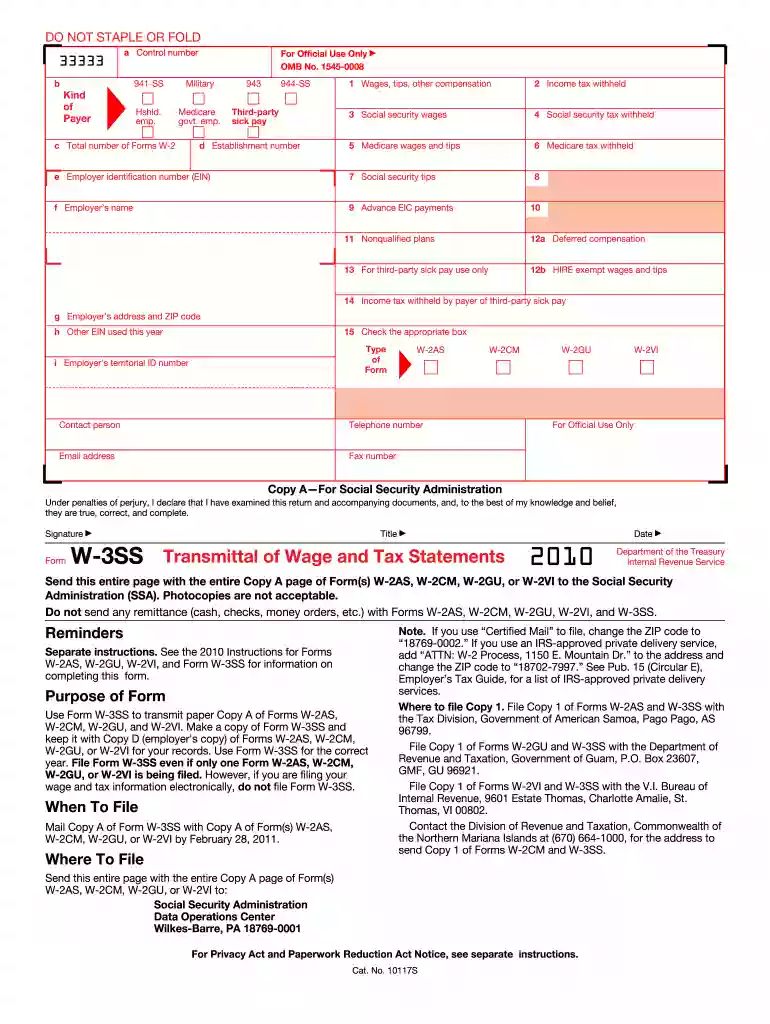
The W-3 form is a transmittal form that compiles and summarizes all the W-2 forms issued by an employer. Officially known as the "Transmittal of Wage and Tax Statements," this form reports the total earnings, social security wages, Medicare wages, and withholding for all employees. The 2010 version of the W-3 fillable form served the same fundamental purpose, ensuring accuracy in reporting employee income and taxes withheld, while also facilitating the Social Security Administration's processing of wage data.
Employers are required to compile and submit the W-3 form alongside all W-2 forms to the Social Security Administration (SSA). The form provides a high-level overview of total wage and tax data, serving as a consolidation report for individual employee earnings. Here is how to appropriately use the form:
Successfully completing the W-3 2010 fillable form involves several important steps:
Electronic filing is the preferred method for submitting both W-2 and W-3 forms to the SSA, offering precision and convenience.
Using the W-3 2010 fillable form is essential for several reasons:
The W-3 form is primarily used by employers across various industries that issue W-2s to report employee earnings. This includes:


Meeting the filing deadline for the W-3 form is crucial to avoid penalties:
Failing to file the W-3 form on time or submitting incorrect information can result in penalties:
Employers can choose between electronic filing or traditional mail submission:
To facilitate W-3 form completion, several software solutions offer compatibility and integration to help employers:
We've got more versions of the fillable 2020 w 3 form form. Select the right fillable 2020 w 3 form version from the list and start editing it straight away!
| Versions | Form popularity | Fillable & printable |
|---|---|---|
| 2025 | 4.7 Satisfied (44 Votes) | |
| 2024 | 4.8 Satisfied (30 Votes) | |
| 2023 | 4.8 Satisfied (40 Votes) | |
| 2022 | 4.3 Satisfied (23 Votes) | |
| 2021 | 4.8 Satisfied (89 Votes) | |
| 2020 | 4.3 Satisfied (167 Votes) | |
| 2019 | 4.4 Satisfied (209 Votes) | |
| 2018 | 4.2 Satisfied (108 Votes) | |
| 2017 | 4.3 Satisfied (101 Votes) | |
| 2016 | 4.3 Satisfied (164 Votes) | |
| 2015 | 4.4 Satisfied (670 Votes) | |
| 2014 | 4 Satisfied (53 Votes) | |
| 2013 | 4 Satisfied (49 Votes) | |
| 2012 | 4 Satisfied (59 Votes) | |
| 2011 | 4 Satisfied (50 Votes) |
Electronic document signing requires a software solution that complies with data protection and eSignature standards. DocHub is a great tool for that, because it fulfills all the above mentioned requirements. Whatever method you like to sign your W 3 2010 fillable form in DocHub, your electronic signature will be legally binding and court-admissible.
With a swift editing platform like DocHub, you do not need anything but a web browser and internet connection to edit your W 3 2010 fillable form on the internet quickly. Add your file or get the relevant form in DocHub’s catalog, open our editor with one click, and finish it electronically. To edit your forms at any time, register a free profile with DocHub.
At DocHub, your data security is our priority. We follow HIPAA, SOC2, GDPR, and other standards, so you can work on your documents with confidence.
Instructions for Form W-3 (PR), Transmittal of Wage and Tax Statements Instructions for Forms W-2AS, W-2GU, W-2VI, and W-3SS, 2010. Instruction W-2CRead more
Credits Start Date. End Date. Days . Times. Repeating. Course. Ex: American History Ex: HIST 2010 - 03. Ex: 3. Ex: 1/17/13. Ex: 5/10/13. M W 9-11. Ex: Y/N. ✓.Read more
This page is an archive of past discussions. Do not edit the contents of this page. If you wish to start a new discussion or revive an old one, please do so onRead more


