




01. Edit your what is a w3 online
Type text, add images, blackout confidential details, add comments, highlights and more.

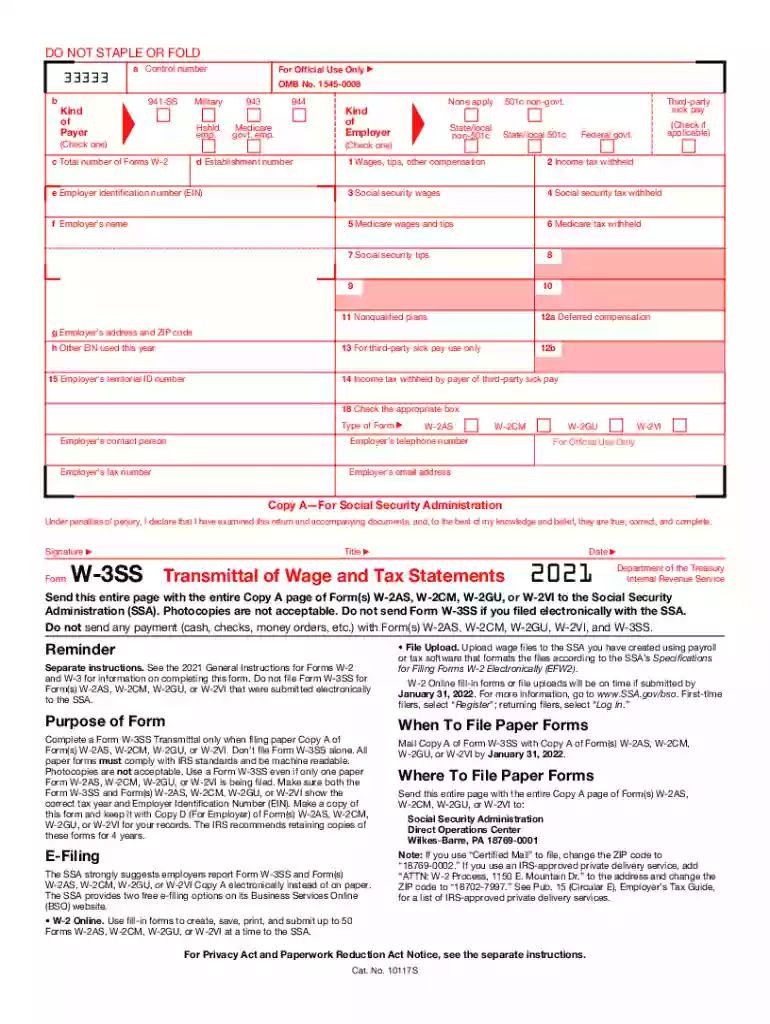
Type text, add images, blackout confidential details, add comments, highlights and more.

Draw your signature, type it, upload its image, or use your mobile device as a signature pad.

Send whats a w 3 via email, link, or fax. You can also download it, export it or print it out.
The W-3 form, also known as the Transmittal of Wage and Tax Statements, is an IRS form used to transmit wage and tax information. It serves as a summary document accompanying Forms W-2 that employers submit to the Social Security Administration (SSA). The W-3 form includes total earnings, Medicare and Social Security wages, and federal income tax withheld. It is essential for ensuring accurate reporting and that employee tax data are accurately processed for Social Security benefits.
To use the W-3 form effectively, employers must compile the information from all W-2 forms issued to their employees. This includes total wages paid, taxes withheld, and any corrections needed for errors found on W-2 forms. The W-3 form must match the sum of all W-2 forms. Employers submit this form to the SSA, which verifies the accuracy and ensures the SSA's records align with the IRS data.
Employers can obtain the W-3 form from multiple sources. The IRS website provides downloadable PDF formats of the form, which can be printed and used for manual submission. Additionally, taxpayers can request physical copies from the IRS or access the form electronically through tax preparation software such as TurboTax or QuickBooks, which often includes templates to streamline the process.
The W-3 form holds significant legal importance as it fulfills employers' obligations under the U.S. tax code. It ensures that all information regarding employee earnings, tax withholding, and social security contributions is reported to the SSA, thus protecting both employer and employee from legal discrepancies. The accurate filing of the W-3 form safeguards against potential audits and fines.
The IRS provides comprehensive guidelines for filling out the W-3 form, ensuring compliance with federal requirements. Employers must adhere to these guidelines to avoid errors which could result in penalties. These include instructions on data accuracy, submission timelines, and the electronic filing process using the SSA's Business Services Online.
Employers must submit the W-3 form by January 31 of the year following the tax year being reported. This deadline aligns with the W-2 form submission. Late submissions can result in penalties, so it's crucial to adhere to this timeline to stay compliant with federal regulations.
Failing to file the W-3 form or filing with incorrect information may lead to significant penalties. The IRS imposes fines based on the size of the business and the extent of non-compliance. These penalties underscore the importance of accuracy and punctuality when completing and submitting the W-3 form.
We've got more versions of the what is a w3 form. Select the right what is a w3 version from the list and start editing it straight away!
| Versions | Form popularity | Fillable & printable |
|---|---|---|
| 2025 | 4.7 Satisfied (44 Votes) | |
| 2024 | 4.8 Satisfied (30 Votes) | |
| 2023 | 4.8 Satisfied (40 Votes) | |
| 2022 | 4.3 Satisfied (23 Votes) | |
| 2021 | 4.8 Satisfied (89 Votes) | |
| 2020 | 4.3 Satisfied (167 Votes) | |
| 2019 | 4.4 Satisfied (209 Votes) | |
| 2018 | 4.2 Satisfied (108 Votes) | |
| 2017 | 4.3 Satisfied (101 Votes) | |
| 2016 | 4.3 Satisfied (164 Votes) | |
| 2015 | 4.4 Satisfied (670 Votes) | |
| 2014 | 4 Satisfied (53 Votes) | |
| 2013 | 4 Satisfied (49 Votes) | |
| 2012 | 4 Satisfied (59 Votes) | |
| 2011 | 4 Satisfied (50 Votes) |
Managing your forms with DocHub this way is very easy after you have downloaded its extension for Google Chrome. Go to the Chrome Web Store and install DocHub - Sign PDF from Gmail to obtain it. Give our tool access to your Google account, and then open an email containing w3 2021 as an attachment and point to the file with your cursor - the DocHub extension key will automatically appear there. Click on it to open your document in our editor. Make any required edits, complete the blanks, and click Sign to create your legally-binding eSignature.
You can easily complete, modify, and even eSign your 3 form 2021 utilizing DocHub. Create a new account and begin your free trial. After that, you can add the file with the form and simply make all the required edits. No need to print on paper or use a third-party application to sign it, as you can place your electronic signature on your document faster via DocHub.
At DocHub, your data security is our priority. We follow HIPAA, SOC2, GDPR, and other standards, so you can work on your documents with confidence.
May 2, 2017 Do not use these forms to report wages subject to U.S. income tax withholding. Instead, use Form W-2 to show U.S. income tax withheld. TreatmentRead more
Information about Form W-3, Transmittal of Wage and Tax Statements (Info Copy Only), including recent updates, related forms, and instructions on how to
Jan 26, 2024 Do not use these forms to report wages subject to U.S. income tax withholding. Instead, use Form W-2 to show U.S. income tax withheld. For.Read more


