




01. Edit your tn divorce papers pdf online
Type text, add images, blackout confidential details, add comments, highlights and more.

Type text, add images, blackout confidential details, add comments, highlights and more.

Draw your signature, type it, upload its image, or use your mobile device as a signature pad.

Send tn divorce papers pdf download via email, link, or fax. You can also download it, export it or print it out.
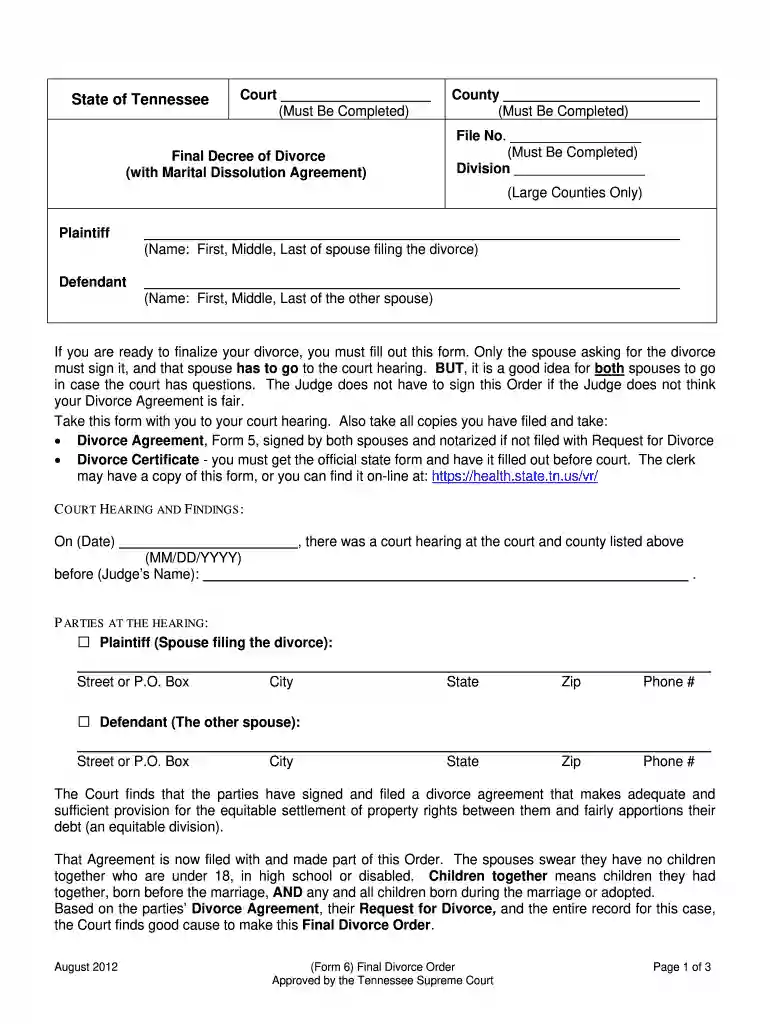
The TN decree, formally known as the Final Decree of Divorce in Tennessee, serves as a vital legal document that delineates the conclusion of a marriage. This decree summarizes the terms of the dissolution, including any agreements reached regarding marital properties, debts, and other relevant issues. This document is essential for both parties to legally finalize their separation and outlines the terms that must be adhered to post-divorce.
Marital Dissolution Agreement: The decree encapsulates the agreements reached between spouses, particularly concerning the division of assets and liabilities. It validates any agreements made in a marital dissolution agreement, ensuring that both parties are clear on the financial obligations and rights post-divorce.
Confirmation of No Minor Children: The decree states that there are no minor children involved in the marriage. This detail is significant as it simplifies the divorce process, reducing the need for child custody arrangements and support calculations.
Name Changes: If either spouse wishes to revert to a previous surname post-divorce, the decree provides a section where this request can be documented, ensuring that the name change is legally recognized.
Alimony Agreement: The decree may outline any alimony arrangements, detailing the amount, duration, and terms under which payments will occur. This is crucial for ensuring financial stability for the lower-earning spouse after the divorce.
Court Costs: The document often specifies which party is responsible for any court costs incurred during the divorce process. This can influence the financial settlement and budget for future expenses related to the divorce.
File Divorce Papers: The process begins with filing TN divorce papers, which can be initiated online or through appropriate local court offices.
Attend the Divorce Hearing: Although only the filing spouse needs to attend, both spouses should ideally present for clarity and mutual agreement. During the hearing, the judge will review the details outlined in the marital dissolution agreement if applicable.
Obtain the Decree: After the hearing, the court will issue the Final Decree of Divorce. This document must be kept safe, as it serves as legal proof of the dissolution and the agreements therein.
Understanding the legal implications of a TN decree is crucial.
Legally Binding: The agreements made within the decree are enforceable by law. If either party fails to comply with the terms, they can face legal repercussions, including consequences enforced by the court.
Public Record: Divorce decrees in Tennessee are public records. This means that they can be accessed by third parties, which may influence personal privacy and future relationships.
Are Divorce Records Public in Tennessee? Yes, divorce records, including the TN decree, are generally public. This transparency allows for accountability but also necessitates caution for individuals concerned about privacy.
What if Changes are Needed? If circumstances change post-divorce, such as relocation or changes in financial situation, it may necessitate modifications to the original decree regarding alimony or property division. Parties may need to go back to court to request these changes.
Obtaining TN divorce papers, including the TN decree, can often be done through free online resources. Forms are frequently available for download in PDF format. Having access to these forms can simplify the process of initiating a divorce without incurring excessive legal fees.
Navigating the process of divorce in Tennessee requires careful attention to the details outlined in the decree. Each aspect—from asset division to personal name changes—plays a crucial role in ensuring both parties can move forward post-divorce. Understanding the implications and requirements can help facilitate a smoother transition during what is typically a challenging time.
We've got more versions of the tn divorce papers pdf form. Select the right tn divorce papers pdf version from the list and start editing it straight away!
At DocHub, your data security is our priority. We follow HIPAA, SOC2, GDPR, and other standards, so you can work on your documents with confidence.
The decree required the state to spend $75 million a year over 10 years to help increase diversity in Tennessees colleges and universities.Read more
The consent decree entered June 30 by the US District Court for the Eastern District of Tennessee required TVA to invest an estimated $3 billion to $5 billionRead more


