




01. Edit your cdcr form 2189 online
Type text, add images, blackout confidential details, add comments, highlights and more.

Type text, add images, blackout confidential details, add comments, highlights and more.

Draw your signature, type it, upload its image, or use your mobile device as a signature pad.

Send cdcr form 2189 pdf download via email, link, or fax. You can also download it, export it or print it out.
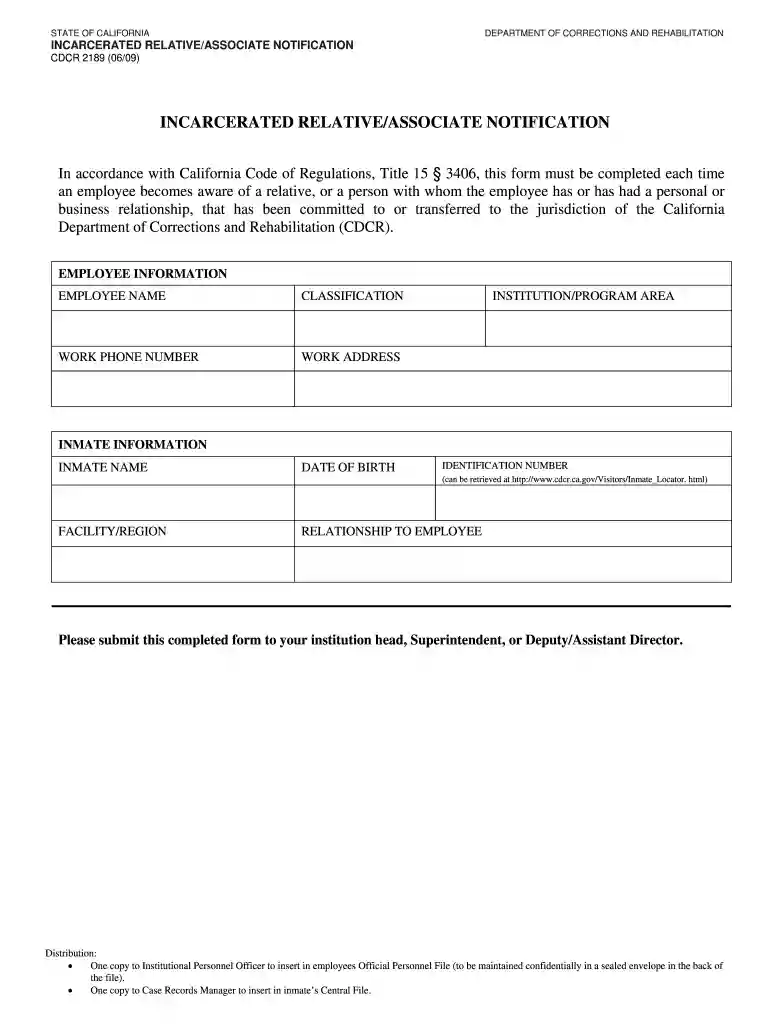
The form CDCR 2189 is a crucial document utilized by employees of the California Department of Corrections and Rehabilitation (CDCR) to formally notify the department when a relative or associate is incarcerated. This form ensures that the department maintains accurate and confidential records concerning its employees’ relationships with incarcerated individuals. The completion of this form is mandatory for all CDCR employees with relevant connections to ensure compliance with ethical and legal standards.
The primary purpose of the CDCR 2189 is to facilitate transparent communication within the department in regards to personal relationships that may impact professional duties. It allows employees to disclose these relationships proactively, promoting accountability and ethical conduct. Here are noteworthy aspects of its importance:
To access the CDCR 2189, employees can follow these steps:
This process ensures that employees have the latest version of the form and understand the protocols for its usage.
Completing the form requires careful attention to detail to ensure that all information is correctly reported. Here are the steps involved:
Employees using the CDCR 2189 must be aware of the legal implications of the information they disclose:
The CDCR 2189 contains several critical sections that collect specific types of information:
Each component must be filled out with precision to meet departmental expectations for record-keeping.
The primary users of the CDCR 2189 are employees of the CDCR, including:
Understanding who utilizes this form ensures that it is completed by the appropriate personnel, reinforcing its intent and purpose.
A few scenarios depicting the typical use of the CDCR 2189 include:
Each of these examples highlights the form’s role in ensuring proper reporting practices within the department and adheres to ethical standards.
The CDCR 2189 serves an essential function within the California Department of Corrections and Rehabilitation by promoting transparency and ethical standards among staff. Understanding its purpose, the process for obtaining it, completing it correctly, and ensuring compliance with departmental policies are vital for all employees within the organization. Form CDCR 2189 not only formalizes necessary disclosures but also protects the integrity of the department and its employees.
We've got more versions of the cdcr form 2189 form. Select the right cdcr form 2189 version from the list and start editing it straight away!
| Versions | Form popularity | Fillable & printable |
|---|---|---|
| 2009 | 4.8 Satisfied (152 Votes) |
At DocHub, your data security is our priority. We follow HIPAA, SOC2, GDPR, and other standards, so you can work on your documents with confidence.
Oct 26, 2017 CDCR/ City of Delano - BC - college courses for inmates. 01/17 PC Order Form Turnitin anti-plagiarism software $5,271.20 08/01/2014Read more
Maintain Use of Force Review files, individual inmate files, inmate death files, 837 Incident Package logging, CDCR. 2189 Incarcerated Relative/AssociateRead more


