107 174 2026

Get Form
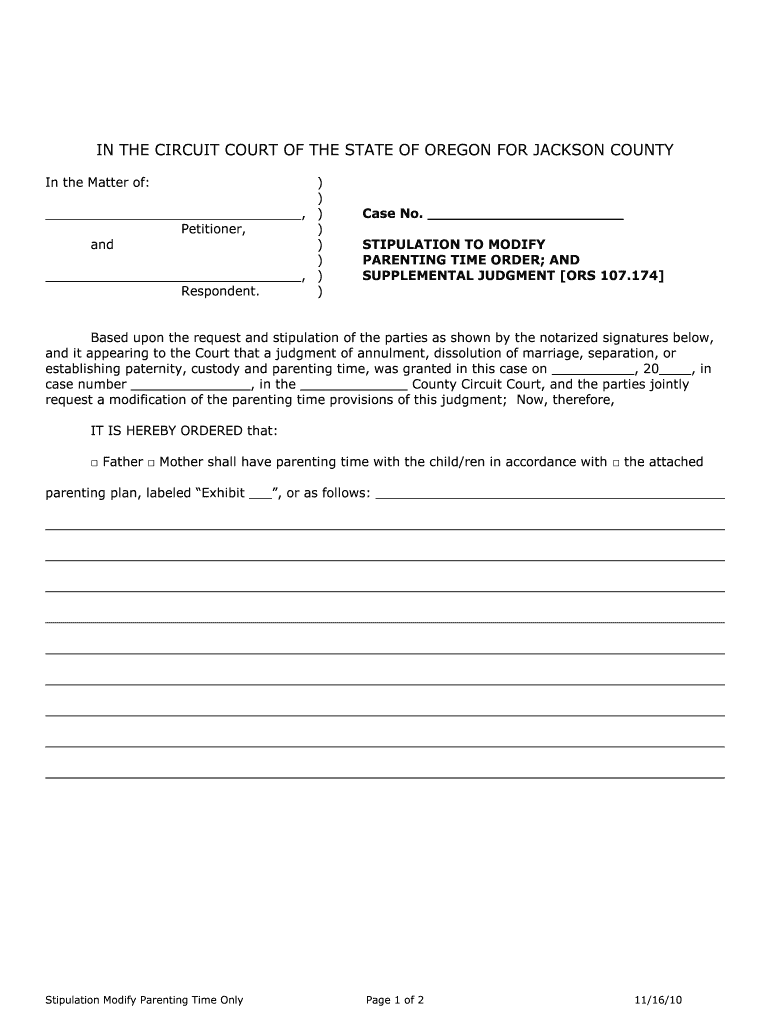
ors 107 174 Preview on Page 1

Here's how it works

01. Edit your ors 107 174 online
Type text, add images, blackout confidential details, add comments, highlights and more.
02. Sign it in a few clicks
Draw your signature, type it, upload its image, or use your mobile device as a signature pad.
03. Share your form with others
Send it via email, link, or fax. You can also download it, export it or print it out.

How to use or fill out 107 174 with our platform

Form edit decoration
9.5
Ease of Setup
DocHub User Ratings on G2
9.0
Ease of Use
DocHub User Ratings on G2
  1. Click ‘Get Form’ to open the 107 174 document in the editor.
  2. Begin by entering the case number at the top of the form. This is essential for identifying your case in court.
  3. In the section labeled 'Petitioner' and 'Respondent', fill in the names of both parties involved in the modification request.
  4. Specify whether it is the Father or Mother who will have parenting time, and indicate if there is an attached parenting plan by checking the appropriate box.
  5. Complete any additional provisions regarding moving distances between parents, ensuring you check either option based on your situation.
  6. Both parties must sign and date the document at the bottom. Ensure that all signatures are notarized as required.
  7. Finally, complete the Certificate of Document Preparation section, indicating whether assistance was received in preparing this form.

Start using our platform today to easily fill out and manage your documents online for free!

See more 107 174 versions

We've got more versions of the 107 174 form. Select the right 107 174 version from the list and start editing it straight away!
Versions Form popularity Fillable & printable
2010 4.8 Satisfied (162 Votes)
be ready to get more

Complete this form in 5 minutes or less

Get form

Got questions?

We have answers to the most popular questions from our customers. If you can't find an answer to your question, please contact us.
Contact us
Administrative grievances filed by federal employees involve various types of employment disputes. For example, an administrative grievance can involve a challenge to a disciplinary action (example: Letter of Warning, Suspension), a performance action, a re-assignment or other employment issue.
Unfair treatment may include (but is not limited to) the following types of specific behavior: denying a training opportunity afforded to other workers; withholding information needed to perform ones job; segregating disfavored workers from others; spreading lies or rumors about an employee;
However, the basic definition of employee misconduct is any behavior, action, or decision that breaches the established rules, policies, or expectations of a federal employer. Fortunately, misconduct generally does not include things like simple accidents.
On May 15, 2002, President Bush signed the Notification and Federal Employee Anti-discrimination and Retaliation Act (No FEAR Act), which increases Federal agency accountability for acts of discrimination or reprisal against employees.
All employees, except for the President and Vice President, are prohibited from: (1) using their official authority or influence to affect the result of an election; (2) soliciting, accepting, or receiving political contributions from any person; (3) being candidates in partisan elections; (4) soliciting or

Security and compliance

At DocHub, your data security is our priority. We follow HIPAA, SOC2, GDPR, and other standards, so you can work on your documents with confidence.

Learn more
ccpa2
pci-dss
gdpr-compliance
hipaa
soc-compliance
be ready to get more

Complete this form in 5 minutes or less

Get form

People also ask

Current and former federal employees, including probationary employees, and applicants for federal employment can file a written complaint with the U.S. Office of Special Counsel. Complaint forms are available on the Web at .osc.gov. Employees do not need attorneys to file a complaint.
No Fear Act Notice 107-174, Summary. In support of this purpose, Congress found that agencies cannot be run effectively if those agencies practice or tolerate discrimination. Public Law 107-174, Title I, General Provisions, section 101(1).

Related links