deq facts Preview on Page 1

Montana pollution prevention form 2026

Here's how it works

  • 01. Edit your deq facts online

    Type text, add images, blackout confidential details, add comments, highlights and more.

  • 02. Sign it in a few clicks

    Draw your signature, type it, upload its image, or use your mobile device as a signature pad.

  • 03. Share your form with others

    Send facts deq via email, link, or fax. You can also download it, export it or print it out.

How to use or fill out Montana Pollution Prevention Form with our platform

Form edit decoration
9.5
Ease of Setup
DocHub User Ratings on G2
9.0
Ease of Use
DocHub User Ratings on G2
  1. Click ‘Get Form’ to open the Montana Pollution Prevention Form in the editor.
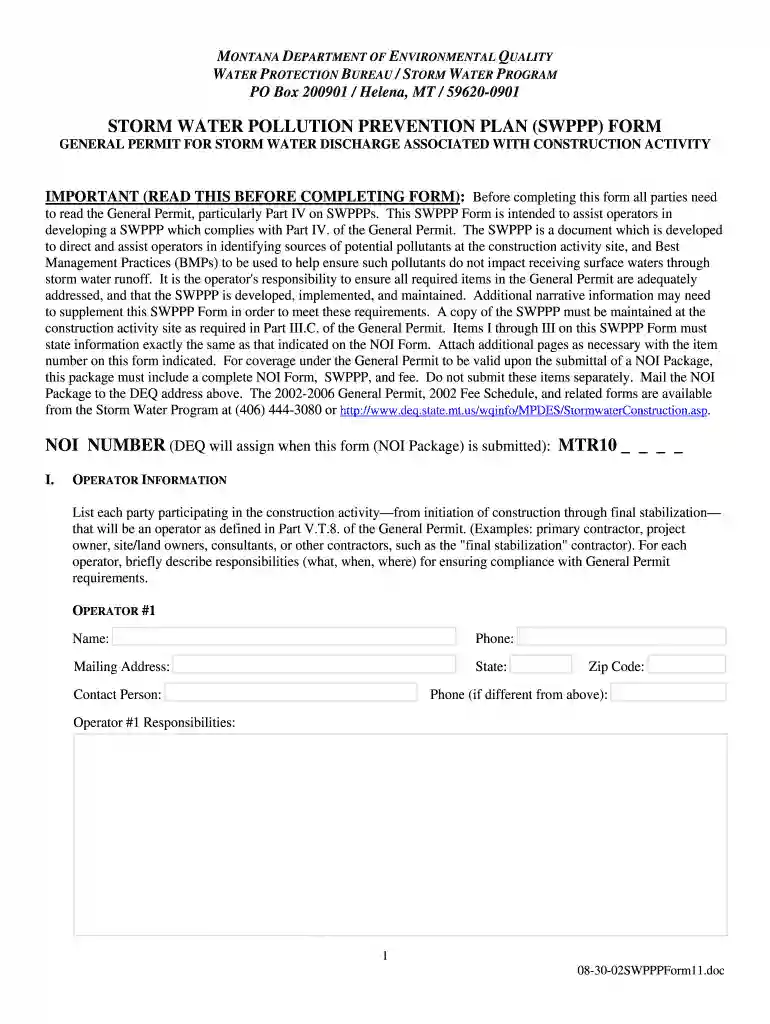
  2. Begin by filling out the Operator Information section. List each party involved in the construction activity, including their responsibilities. Ensure that all details match those on the NOI Form.
  3. In Section II, indicate which operator is responsible for achieving 'final stabilization' and submitting the 'Notice of Termination.' This ensures clarity on roles.
  4. Proceed to Section III and provide detailed information about the construction activity, including its name, address, county, and estimated dates for start and completion.
  5. Complete Section IV by addressing general SWPPP requirements. Include information about site maps, erosion control measures, and any potential pollutants associated with your project.
  6. Finally, review Section VI for certification. Ensure all operators sign and date the form accurately to validate your submission.

Start using our platform today to easily fill out your Montana Pollution Prevention Form online for free!

See more deq facts versions

We've got more versions of the deq facts form. Select the right deq facts version from the list and start editing it straight away!

VersionsForm popularityFillable & printable
20024.9 Satisfied (201 Votes)

be ready to get more

Complete this form in 5 minutes or less

Got questions?

We have answers to the most popular questions from our customers. If you can't find an answer to your question, please contact us.

The Napa Countywide Stormwater Pollution Prevention Program (NCSPPP) is a joint effort of Napas cities, towns and unincorporated areas to: Comply with State and Federal regulations. Preserve beneficial uses of local waterways.
NPDES Program Overview As authorized by the Clean Water Act, the National Pollutant Discharge Elimination System (NPDES) permit program controls water pollution by regulating point sources that discharge pollutants into waters of the United States.
The NPDES system requires a permit before any pollutant can be discharged from a point source into a water of the United States. Discharging a pollutant from a point source into a water of the United States without a valid NPDES permit is a violation of the CWA.
Montana Pollutant Discharge Elimination System (MPDES) permits regulate wastewater discharges by limiting the quantities of pollutants to be discharged.
The purpose of the MONTANA ENVIRONMENTAL POLICY ACt (MEPA)1 is to declare a state policy that will encourage productive and enjoyable harmony between humans and their environment, to protect the right to use and enjoy private property free of undue government regulation, to promote efforts that will prevent, mitigate2,

Security and compliance

At DocHub, your data security is our priority. We follow HIPAA, SOC2, GDPR, and other standards, so you can work on your documents with confidence.

People also ask

The NPDES permit program, created in 1972 by the Clean Water Act (CWA), helps address water pollution by regulating point sources that discharge pollutants to waters of the United States.

Related links

Storm Water Pollution Prevention Plan (SWPPP) Form

READ THIS BEFORE COMPLETING FORM: The Form SWPPP is intended to assist operators in developing a SWPPP which complies with Part 3 of the General Permit forRead more

Learn more
MONTANA POLLUTION PREVENTION PROGRAM

The MTP2 Program is dedicated to helping the states small businesses, local governments and citizens use progressive, integrated pollution prevention (P2)Read more

Learn more
EPA

Authorities should take steps to ensure that major pollution sources are effectively controlled and that plans are in place to improve sediment conditions and.Read more

Learn more
If you believe that this page should be taken down, please follow our DMCA take down process here