




01. Edit your form 8833 online
Type text, add images, blackout confidential details, add comments, highlights and more.

Type text, add images, blackout confidential details, add comments, highlights and more.

Draw your signature, type it, upload its image, or use your mobile device as a signature pad.

Send it via email, link, or fax. You can also download it, export it or print it out.
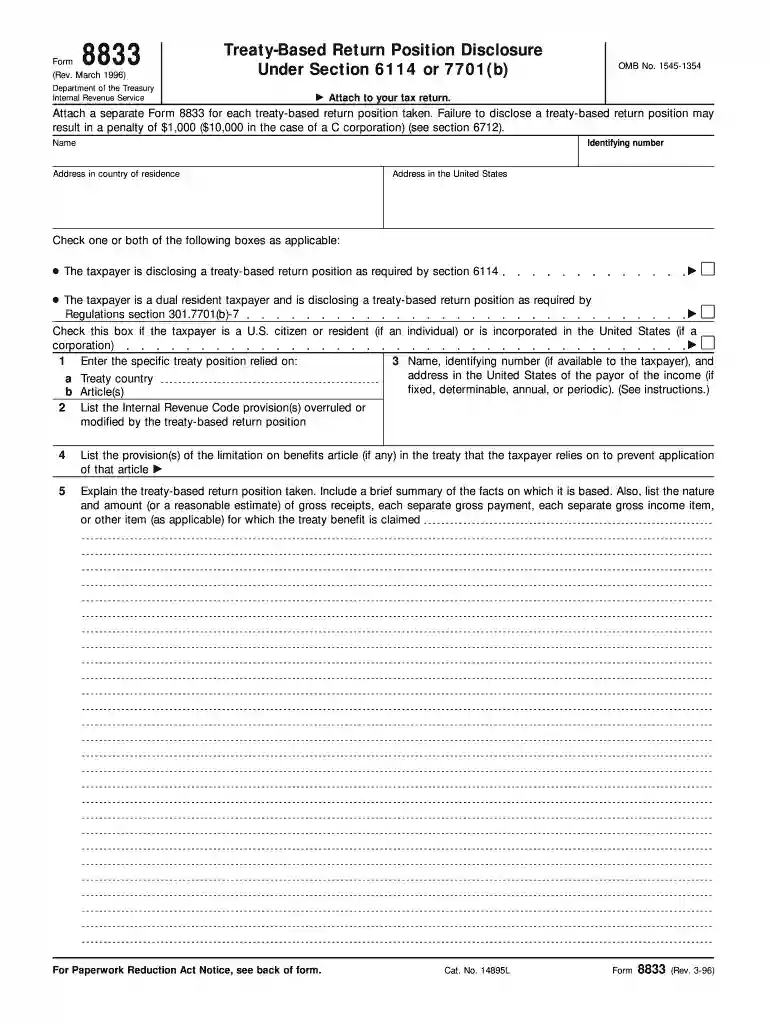
IRS Form 8833, titled "Treaty-Based Return Position Disclosure Under Section 6114 or 7701(b)," is a document required by the Internal Revenue Service for taxpayers to disclose treaty-based return positions. This form plays a critical role in international tax matters as it enables taxpayers, including U.S. citizens and dual-resident taxpayers, to claim benefits from international tax treaties. It includes details like the specific treaty position, relevant Internal Revenue Code provisions, and essential information about the income involved.
The 1996 fillable version of IRS Form 8833 serves as a crucial tool for taxpayers seeking to document their treaty-related claims electronically. The fillable form simplifies the process by allowing users to input their data directly into the form fields digitally, eliminating the need for handwriting. Taxpayers can download the form, fill it out on their computer, and either print it out for mailing or submit it electronically, depending on IRS submission guidelines.
Obtain the Form: Download the IRS Form 8833 fillable 1996 version from a reliable source such as DocHub.
Enter Taxpayer Information: Fill in personal details such as name, taxpayer identification number, and address.
Treaty and Position Details: Specify the tax treaty involved and outline the specific treaty-based return position you are claiming.
Income Details: Document the types and amounts of income affected by the treaty position.
Sign and Date the Form: Ensure that the form is signed and dated by the taxpayer or their authorized representative.
Review and Submit: Double-check all entries for accuracy before submitting the form as directed by IRS filing instructions.
Taxpayer Identification Information: This section requires basic personal data, including social security number or employer identification number.
Treaty Position Explanation: A detailed explanation of the treaty-based position must be included, outlining how the treaty modifies tax liabilities.
Income Type and Source: Information regarding the income that is subject to treaty provisions, including amounts and sources, is critical.
Code and Treaty Articles: Identifying relevant sections of the Internal Revenue Code and specific articles of the treaty in question is mandatory.
Taxpayers eligible to use IRS Form 8833 include:


Failure to file IRS Form 8833, when required, can lead to substantial penalties. Taxpayers may face a $1,000 penalty for individuals or a $10,000 penalty for corporates for not filing the form or for failing to include all necessary information. This penalty underscores the importance of compliance with IRS regulations regarding treat-based return positions.
While completing IRS Form 8833, certain documents should accompany the form to ensure accurate representation of one’s tax position:
IRS Form 8833 must be filed along with the taxpayer's annual tax return. For calendar-year taxpayers, returns are typically due on April 15. However, extensions or different fiscal years may affect this deadline. It's critical for taxpayers to verify and abide by these dates to avoid penalties.
Consider a dual-resident taxpayer, Jane, living in both Canada and the U.S. Jane earns investment income from Canadian sources. She uses IRS Form 8833 to claim treaty benefits, specifying that her Canadian income is exempt from U.S. tax under the U.S.-Canada tax treaty provisions. By doing so, she adheres to the tax compliance requirements while minimizing her tax liability.
Accurate completion of IRS Form 8833 is guided by:
Following Instructions: IRS provides comprehensive guidelines that outline the necessary information and structure of the form.
Direct Submission: Forms can be submitted electronically or via mail, in line with IRS procedural recommendations.
Understanding these guidelines ensures taxpayers provide sufficient information to support their treaty-based return positions completely and accurately.
IRS Form 8833 is predominantly used by:
By knowing who needs to use this form, taxpayers can adequately assess their reporting responsibilities concerning treaty-based return positions.
We've got more versions of the form 8833 form. Select the right form 8833 version from the list and start editing it straight away!
| Versions | Form popularity | Fillable & printable |
|---|---|---|
| 2022 | 4.7 Satisfied (58 Votes) | |
| 2021 | 4.8 Satisfied (177 Votes) | |
| 2020 | 3.9 Satisfied (27 Votes) | |
| 2017 | 4.4 Satisfied (240 Votes) | |
| 2013 | 4.2 Satisfied (57 Votes) | |
| 2012 | 4.4 Satisfied (588 Votes) | |
| 2006 | 4 Satisfied (20 Votes) | |
| 2000 | 4.3 Satisfied (34 Votes) | |
| 1996 | 4 Satisfied (45 Votes) | |
| 1993 | 4 Satisfied (29 Votes) |
At DocHub, your data security is our priority. We follow HIPAA, SOC2, GDPR, and other standards, so you can work on your documents with confidence.
IRS Form 8833, IRS8833, Form Level, Yes. 2109. 2110, IRS Form 8858 Schedule M General Dependency Small (attachment not identified on the form or instructions)Read more
Dec 16, 2024 Direct File is a permanent option to file individual federal tax returns onlinefor freedirectly and securely with the IRS starting in 2025.Read more


