




01. Edit your 8833 form turbotax online
Type text, add images, blackout confidential details, add comments, highlights and more.

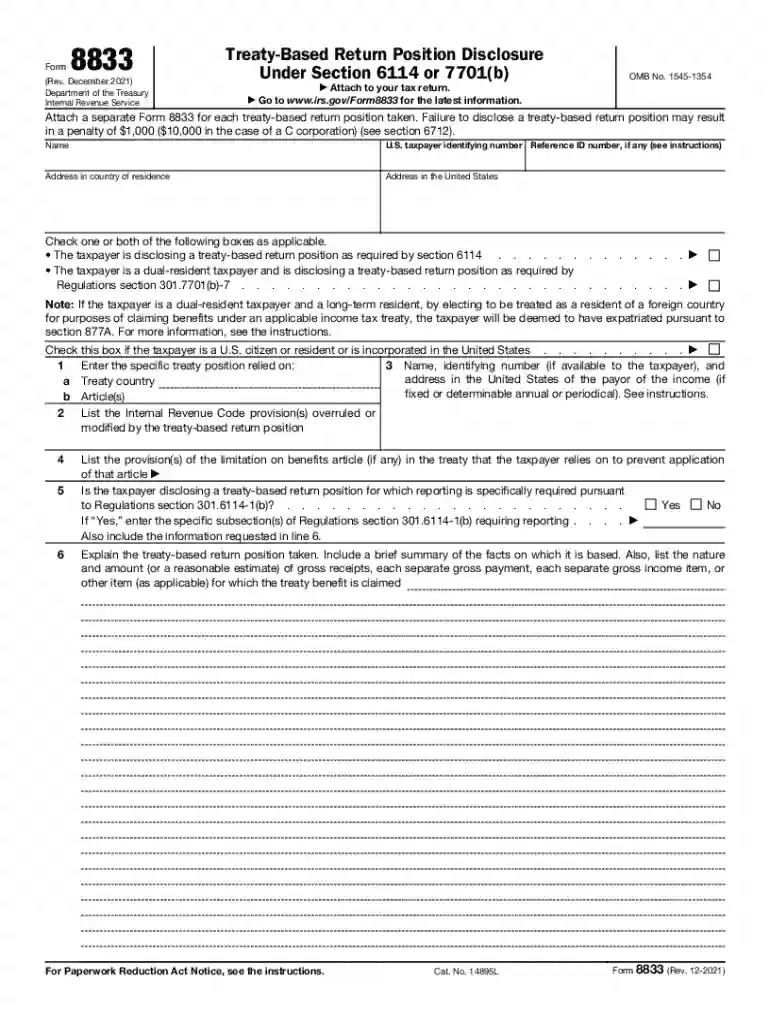
Type text, add images, blackout confidential details, add comments, highlights and more.

Draw your signature, type it, upload its image, or use your mobile device as a signature pad.

Send 8833 turbotax via email, link, or fax. You can also download it, export it or print it out.
Form 8833, known as the Treaty-Based Return Position Disclosure, serves a crucial role for U.S. taxpayers who are claiming benefits under international tax treaties. This form is mandated by sections 6114 and 7701(b) of the Internal Revenue Code. Essentially, it enables taxpayers to disclose treaty-based positions that potentially affect their tax responsibilities in the United States. Such disclosure is vital because tax treaties can modify or negate usual U.S. tax provisions, leading to reduced rates or exemptions. Understanding its purpose helps taxpayers to properly align their tax filings with applicable international agreements.
Not every U.S. taxpayer needs to file Form 8833. It is primarily required when taxpayers, both individual and corporate, take a position that a tax treaty alleviates their U.S. tax obligations. Dual-resident taxpayers—those considered residents under two countries' laws—often need to file this form to clarify which country’s rules are being followed. Generally, individuals and entities benefiting from reduced tax rates on dividends, interest, royalties, or other income under treaty provisions should consider filing. Recognizing who is obligated to submit this form ensures compliance and capitalizes on international tax relief opportunities.


Taxpayers can easily access Form 8833 through the official IRS website. It is available as a downloadable PDF, which can be printed and filled out manually or completed digitally. Tax preparation software like TurboTax or QuickBooks can also facilitate obtaining and filling out the form. Ensuring you have the latest version of Form 8833 is essential, as tax laws and treaties can evolve, necessitating updates to the form itself.
Filing Form 8833 requires attention to specific details. Follow these steps:
Completing each step diligently can prevent misunderstandings and lead to a smoother filing process.
Understanding the terminology in Form 8833 is vital:
Familiarity with these terms can ease comprehension and accurate completion of the form.
According to IRS guidelines, Form 8833 must be attached to the taxpayer's tax return. It is critical to ensure its accuracy and completeness, as errors or omissions may prompt the IRS to revoke treaty benefits or impose penalties. Detailed guidance is provided by the IRS in their instructions for Form 8833, which includes clarification on exceptions to the filing requirement, such as certain de minimis amounts and some personal service income scenarios.
Form 8833 should be submitted concurrently with the applicable tax return to avoid penalties. The typical deadline aligns with the regular tax filing dates—April 15 for individual taxpayers unless an extension is granted. Corporate entities follow the respective corporate tax return deadlines. Timely filing alongside the tax return is essential for the application of treaty positions.
Non-compliance with filing requirements for Form 8833 can result in significant penalties. The IRS may impose a fine up to $1,000 for individuals and up to $10,000 for corporations failing to submit the form or providing inaccurate information. Moreover, such non-disclosure can lead to the loss of claimed treaty benefits, retroactively applying domestic tax laws. Understanding these penalties emphasizes the importance of proper form completion and filing.
We've got more versions of the 8833 form turbotax form. Select the right 8833 form turbotax version from the list and start editing it straight away!
| Versions | Form popularity | Fillable & printable |
|---|---|---|
| 2022 | 4.7 Satisfied (58 Votes) | |
| 2021 | 4.8 Satisfied (177 Votes) | |
| 2020 | 3.9 Satisfied (27 Votes) | |
| 2017 | 4.4 Satisfied (240 Votes) | |
| 2013 | 4.2 Satisfied (57 Votes) | |
| 2012 | 4.4 Satisfied (588 Votes) | |
| 2006 | 4 Satisfied (20 Votes) | |
| 2000 | 4.3 Satisfied (34 Votes) | |
| 1996 | 4 Satisfied (45 Votes) | |
| 1993 | 4 Satisfied (29 Votes) |
At DocHub, your data security is our priority. We follow HIPAA, SOC2, GDPR, and other standards, so you can work on your documents with confidence.
Mar 30, 2026 Taxpayers use this form to make the treaty-based return position disclosure required by Internal Revenue Code section 6114.Read more
INSTRUCTIONS FOR COMPLETING FORM 8833. Complete the name, U.S. taxpayer identifying number, and address boxes. Put a checkmark in the box to the right ofRead more
Jan 1, 1996 The Model 8833-300 Termaline Load Resistor is designed as a low reflection and nonradiating termi- nation for coaxial transmission lines.


