




01. Edit your turbotax 8833 online
Type text, add images, blackout confidential details, add comments, highlights and more.

Type text, add images, blackout confidential details, add comments, highlights and more.

Draw your signature, type it, upload its image, or use your mobile device as a signature pad.

Send 8833 form via email, link, or fax. You can also download it, export it or print it out.
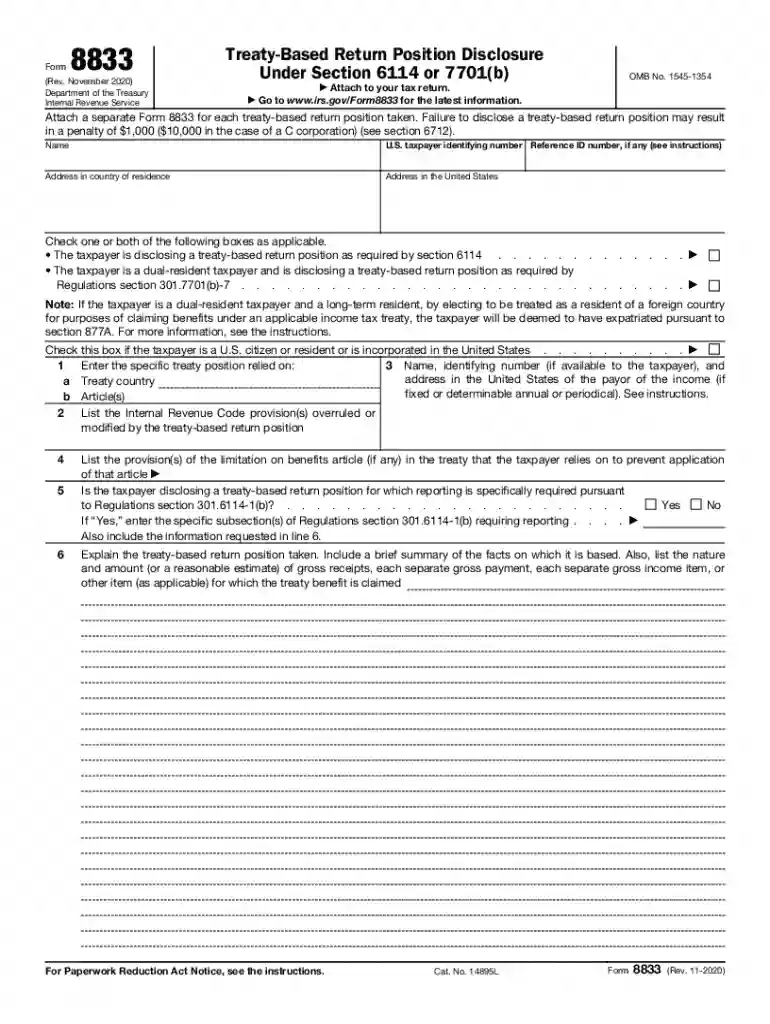
Form 8833 is a specific tax form used by U.S. taxpayers to report treaty-based return positions as stipulated by sections 6114 and 7701(b) of the Internal Revenue Code. This form is essential for taxpayers, including dual-resident individuals, who intend to claim benefits under international tax treaties. The primary purpose of Form 8833 is to disclose the taxpayer's position concerning treaty benefits and ensure compliance with IRS regulations. Failure to do so can lead to penalties, making it critical for accuracy in filing.
Understanding how to use Form 8833 involves knowing when and why to file it. Taxpayers are required to submit this form when they are claiming tax treaty benefits that modify their taxable income. To use the form effectively, individuals should:
Completing Form 8833 requires careful attention to detail:
A few key terms are crucial for properly completing Form 8833:
Using Form 8833 legally involves adhering to all IRS guidelines and accurately reporting treaty benefits. Taxpayers must ensure that their claimed treaty positions are substantiated by proper documentation. The form must be filled with genuine and accurate information while adhering to the filing timelines. Additionally, understanding the limitations of treaty claims is necessary to avoid any misinterpretations or legal issues.
The IRS provides specific guidelines to ensure uniformity in filing Form 8833. Taxpayers are advised to:
Failure to comply with the requirements associated with Form 8833 can result in significant penalties. Taxpayers who do not adequately disclose treaty positions, or who inaccurately fill out the form, may be subjected to fines. The IRS may impose penalties starting at $1,000 per instance of non-disclosure. Persistent non-compliance can result in further legal actions, emphasizing the need for meticulousness in filing.
Different taxpayer scenarios necessitate the use of Form 8833:


Compiling the necessary documents is essential when preparing Form 8833:
Having these documents ready ensures a smoother filing process and reduces the risk of discrepancies during IRS evaluations.
We've got more versions of the turbotax 8833 form. Select the right turbotax 8833 version from the list and start editing it straight away!
| Versions | Form popularity | Fillable & printable |
|---|---|---|
| 2022 | 4.7 Satisfied (58 Votes) | |
| 2021 | 4.8 Satisfied (177 Votes) | |
| 2020 | 3.9 Satisfied (27 Votes) | |
| 2017 | 4.4 Satisfied (240 Votes) | |
| 2013 | 4.2 Satisfied (57 Votes) | |
| 2012 | 4.4 Satisfied (588 Votes) | |
| 2006 | 4 Satisfied (20 Votes) | |
| 2000 | 4.3 Satisfied (34 Votes) | |
| 1996 | 4 Satisfied (45 Votes) | |
| 1993 | 4 Satisfied (29 Votes) |
At DocHub, your data security is our priority. We follow HIPAA, SOC2, GDPR, and other standards, so you can work on your documents with confidence.
INSTRUCTIONS FOR COMPLETING FORM 8833. Complete the name, U.S. taxpayer identifying number, and address boxes. Put a checkmark in the box to the right ofRead more
Form 8833 must be used by taxpayers to make the treaty-based return position disclosure required by section 6114 and the regulations thereunder (Regulations.Read more


