




01. Edit your does turbotax support form 8833 online
Type text, add images, blackout confidential details, add comments, highlights and more.

Type text, add images, blackout confidential details, add comments, highlights and more.

Draw your signature, type it, upload its image, or use your mobile device as a signature pad.

Send turbotax 8833 via email, link, or fax. You can also download it, export it or print it out.
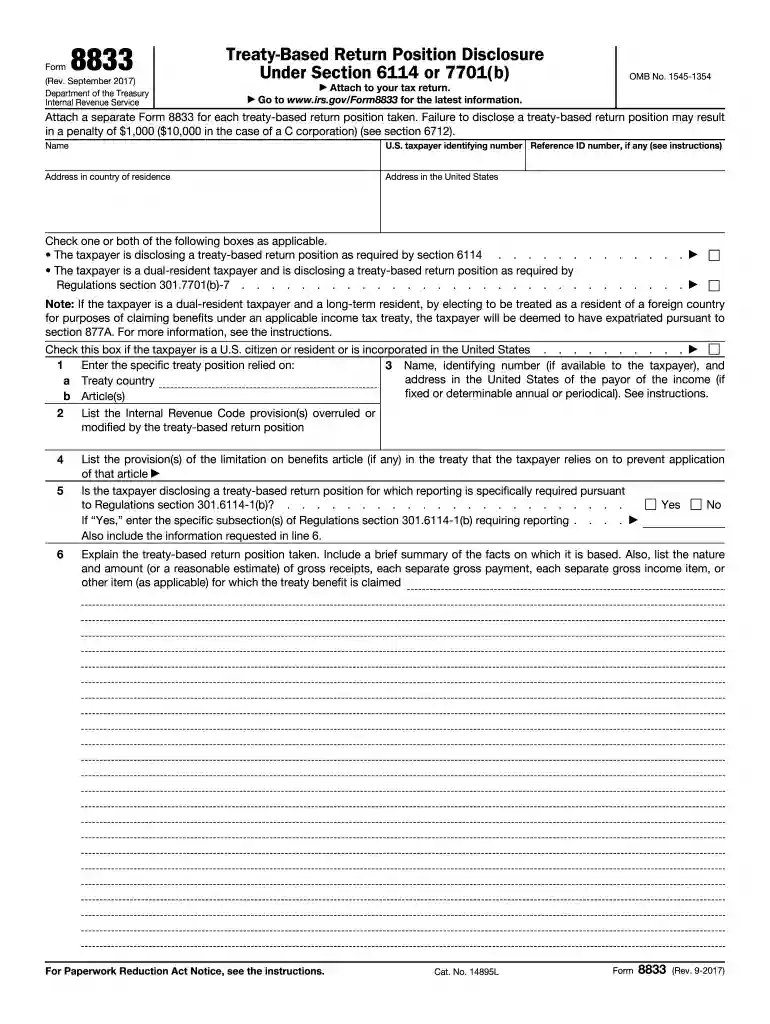
Form 8833, the "Treaty-Based Return Position Disclosure Under Section 6114 or 7701(b)," is a critical document for U.S. taxpayers. It is used to disclose treaty-based return positions that can potentially modify or override standard U.S. tax provisions. By using this form, taxpayers can outline any treaties that influence their tax responsibilities, ensuring transparency and compliance with IRS regulations.
Form 8833 is necessary for general taxpayers and dual-resident taxpayers seeking benefits under an international tax treaty. Its importance lies in the taxpayer's ability to claim specific exemptions or reductions in tax obligations as dictated by the treaty. Understanding its purpose helps taxpayers avoid penalties and ensures that they utilize applicable benefits effectively.
Utilizing Form 8833 involves several key steps. First, taxpayers must determine whether their tax situation is affected by an international tax treaty. Such treaties can offer tax reductions or exemptions, thus influencing the overall tax liability. Next, taxpayers should clearly identify the specific treaty provisions that are applicable to their situation.
Another critical aspect of using Form 8833 is accurately detailing the treaty-based positions. This requires careful analysis and interpretation of the treaty language. It is often beneficial to seek professional tax advice, especially in complex cases, to ensure compliance and optimize benefits.
Identify Treaty Applicability: Start by reviewing any applicable tax treaties between the U.S. and a foreign country that pertain to your situation.
Gather Relevant Information: Collect your tax documents, including foreign income records and any previous filings related to the foreign country.
Complete the Identifying Information: Fill out your personal information, including your name, taxpayer identification number, and address.
Detail the Treaty Position: Clearly articulate the specific treaty-based position you are claiming, citing relevant articles and provisions.
Include Explanations and Attachments: Provide a detailed explanation of how the treaty modifies your tax position and attach any necessary supporting documents.
Review and Submit: Double-check all entries for accuracy and compliance and attach the completed Form 8833 to your tax return.
Form 8833 is primarily used by U.S. taxpayers with international interests. This includes expatriates, foreign nationals living in the U.S., and companies with cross-border activities. Dual-resident taxpayers, who are considered residents of the U.S. and another country, frequently use this form to claim treaty benefits.
Individuals with income sourced from countries with U.S. tax treaties, such as foreign dividends, pensions, or business profits, also commonly file Form 8833. The form is essential for those who want to avoid double taxation and adhere to both domestic and international tax laws.
Understanding the key elements of Form 8833 is crucial for proper completion. These elements include:
Taxpayer Identification Information: Basic details about the taxpayer filing the form.
Disclosure of Treaty-Based Position: A section to describe the treaty provisions being invoked, including detailed citing of specific articles.
Explanation of Treaty Application: Requires an explanation of how the treaty impacts the taxpayer's U.S. tax return.
Supporting Documentation: Attachments and documents that substantiate the claim and should be referenced clearly within the form.
These elements ensure that the IRS can effectively assess the validity and correctness of the disclosed treaty positions.
The IRS provides detailed guidelines for completing Form 8833, which can help taxpayers avoid common errors. These guidelines underscore the need for precise documentation of treaty-based positions, complete and accurate filing, and the importance of meeting filing deadlines.
Taxpayers must meticulously follow IRS instructions for submitting required forms and supporting documents. Moreover, the guidelines emphasize the necessity of maintaining a record for possible future audits or reviews by the IRS.
Form 8833 must be attached to the taxpayer's timely filed income tax return. Adhering to the annual tax deadline, which typically falls on April 15, is crucial unless an extension has been granted. Failing to attach Form 8833 by the deadline can lead to penalties and loss of treaty benefits, affecting the taxpayer's financial obligations.
Exceptions exist for certain circumstances, such as late discovery of treaty eligibility. However, these must be documented and justified thoroughly when filing.
Non-compliance with Form 8833 requirements can result in significant penalties. If a taxpayer fails to file the form when required, the IRS can impose a penalty of $1,000 for individuals and $10,000 for corporations per undisclosed position.
Understanding these penalties is essential to ensure thoroughness and accuracy when using the form. Taxpayers are encouraged to seek professional tax advice to mitigate risks and ensure compliance with international tax obligations.
We've got more versions of the does turbotax support form 8833 form. Select the right does turbotax support form 8833 version from the list and start editing it straight away!
| Versions | Form popularity | Fillable & printable |
|---|---|---|
| 2022 | 4.7 Satisfied (58 Votes) | |
| 2021 | 4.8 Satisfied (177 Votes) | |
| 2020 | 3.9 Satisfied (27 Votes) | |
| 2017 | 4.4 Satisfied (240 Votes) | |
| 2013 | 4.2 Satisfied (57 Votes) | |
| 2012 | 4.4 Satisfied (588 Votes) | |
| 2006 | 4 Satisfied (20 Votes) | |
| 2000 | 4.3 Satisfied (34 Votes) | |
| 1996 | 4 Satisfied (45 Votes) | |
| 1993 | 4 Satisfied (29 Votes) |
At DocHub, your data security is our priority. We follow HIPAA, SOC2, GDPR, and other standards, so you can work on your documents with confidence.
The hungry horror is a unique mercenary armor variant that can be found within the Tower of Minecraft Dungeons. It behaves identically to the renegade armor
Form 8833 must be used by taxpayers to make the treaty-based return position disclosure required by section 6114 and the regulations thereunder (Regulations.Read more


