




01. Edit your form 8833 online
Type text, add images, blackout confidential details, add comments, highlights and more.

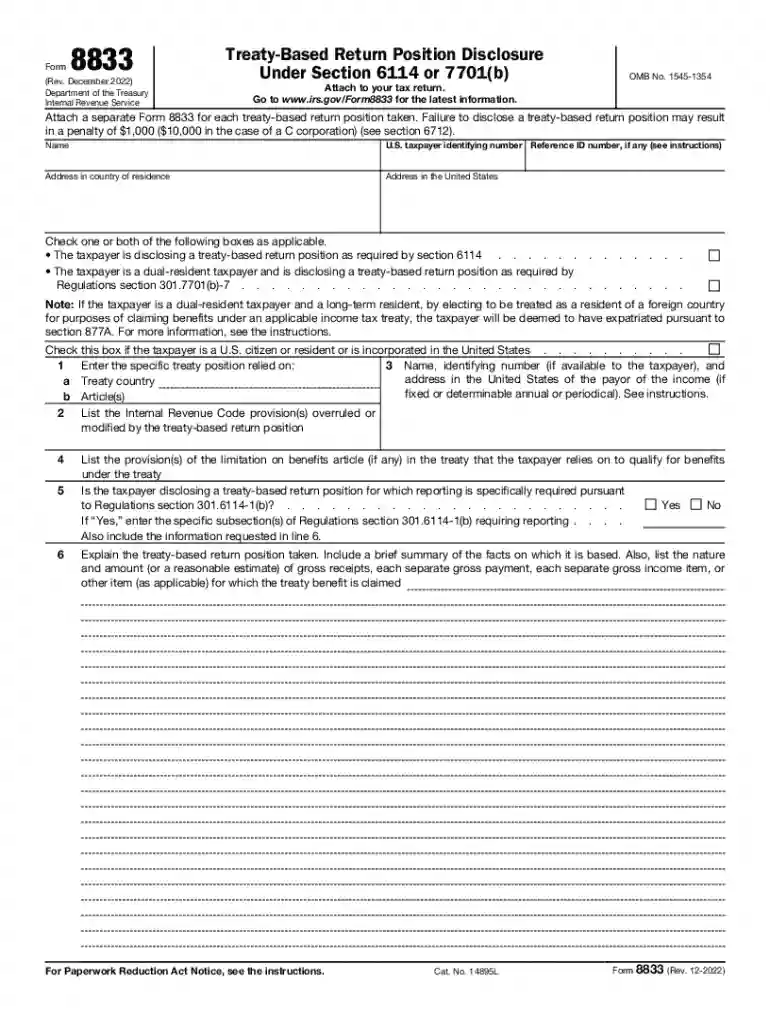
Type text, add images, blackout confidential details, add comments, highlights and more.

Draw your signature, type it, upload its image, or use your mobile device as a signature pad.

Send index match match excel via email, link, or fax. You can also download it, export it or print it out.
Form 8833 is essential for U.S. taxpayers who wish to disclose treaty-based return positions. It serves two key purposes: compliance with sections 6114 and 7701(b) of the Internal Revenue Code and claiming benefits under international tax treaties. The form is vital for taxpayers and dual-resident taxpayers to communicate their intent to apply certain treaty provisions that could affect their tax obligations in the U.S.
Adhering to this requirement ensures transparency with the IRS regarding the use of treaty provisions. Taxpayers failing to disclose treaty-based positions may face substantial penalties. The form requires a clear articulation of the treaty position being claimed, supporting the legitimacy and accuracy of the submitted tax return.
Using Form 8833 is crucial for taxpayers who wish to claim either a tax benefit or exclusion based on an international treaty. To use the form, taxpayers must identify applicable treaty articles and detail how these provisions influence their tax obligations. The requirement to attach Form 8833 to the annual tax return makes it a crucial document, ensuring that taxpayers can justify their claims under applicable treaties.
The form must be submitted with the taxpayer's annual return. Detailed explanations, including references to specific treaty articles and sections of the Code that involve treaty positions, are necessary for compliance. Proper use of Form 8833 helps maintain complete and transparent communication with the IRS.
Identify the Treaty and Provisions:
Complete Personal Information:
Explain the Treaty Position:
Attach Relevant Documents:
Review and Submit:
Eligibility to use Form 8833 mainly includes U.S. taxpayers and dual-resident individuals or entities seeking to apply treaty provisions on their tax obligations. To qualify, one must have a specific treaty position affecting tax liability, where claimable benefits exist under a treaty with the United States.
Taxpayers who believe they are exempt from certain U.S. taxes or those seeking reductions because of international treaties may need to file Form 8833. Additionally, dual-resident taxpayers combining U.S. and foreign residency for tax purposes will find the form essential when claiming treaty-defined benefits. Understanding eligibility is crucial for compliance and maximizing available treaty-based benefits.


Form 8833 comprises specific fields that taxpayers must complete:
Each section of the form demands precise and accurate completion to ensure that the IRS can process the treaty position claim effectively. These key elements form the backbone of Form 8833, directly impacting its approval or rejection.
The IRS issues specific guidelines for completing Form 8833, primarily focusing on the accurate reporting of treaty-based positions. These guidelines aim to streamline the disclosure process, ensuring that taxpayers adhere to requirements set by sections 6114 and 7701(b).
The guidelines incorporate instructions on identifying applicable treaties and determining qualification criteria for tax relief based on said treaties. Additionally, the IRS outlines potential penalties for failing to properly complete or submit the form, underscoring the importance of adherence. These guidelines are a critical resource for any taxpayer dealing with international treaties.
Form 8833 must be filed as an attachment to the taxpayer's U.S. federal tax return. As such, it follows the annual tax return submission deadline, typically April 15. Failing to meet this deadline may result in penalties or the inability to apply the desired treaty benefits.
Should extensions be required, taxpayers have the option to file for an extension of time to file their individual income tax returns. However, this extension applies only to the submission of the form and not the payment of any taxes due. Maintaining awareness of these critical dates is essential for successfully utilizing treaty-based claims.
The IRS imposes penalties on taxpayers who fail to submit Form 8833 when mandatory or inaccurately represent their treaty-based return positions. These penalties can be significant, based on the specifics of non-compliance, and may include fines up to $1,000 for individuals or $10,000 for corporations.
Non-compliance may result from failing to submit the form, not adhering to IRS instructions, or inaccurately claiming treaty benefits. Staying informed about these potential penalties encourages taxpayers to complete and submit the form accurately, minimizing financial risk and aiding in maintaining regulatory compliance.
We've got more versions of the form 8833 form. Select the right form 8833 version from the list and start editing it straight away!
| Versions | Form popularity | Fillable & printable |
|---|---|---|
| 2022 | 4.7 Satisfied (58 Votes) | |
| 2021 | 4.8 Satisfied (177 Votes) | |
| 2020 | 3.9 Satisfied (27 Votes) | |
| 2017 | 4.4 Satisfied (240 Votes) | |
| 2013 | 4.2 Satisfied (57 Votes) | |
| 2012 | 4.4 Satisfied (588 Votes) | |
| 2006 | 4 Satisfied (20 Votes) | |
| 2000 | 4.3 Satisfied (34 Votes) | |
| 1996 | 4 Satisfied (45 Votes) | |
| 1993 | 4 Satisfied (29 Votes) |
At DocHub, your data security is our priority. We follow HIPAA, SOC2, GDPR, and other standards, so you can work on your documents with confidence.
Attach a separate Form 8833 for each treaty-based return position taken. Failure to disclose a treaty-based return position may result in a penalty of $1,000 ($Read more
Form 8833 must be used by taxpayers to make the treaty-based return position disclosure required by section 6114 and the regulations thereunder (Regulations.Read more


