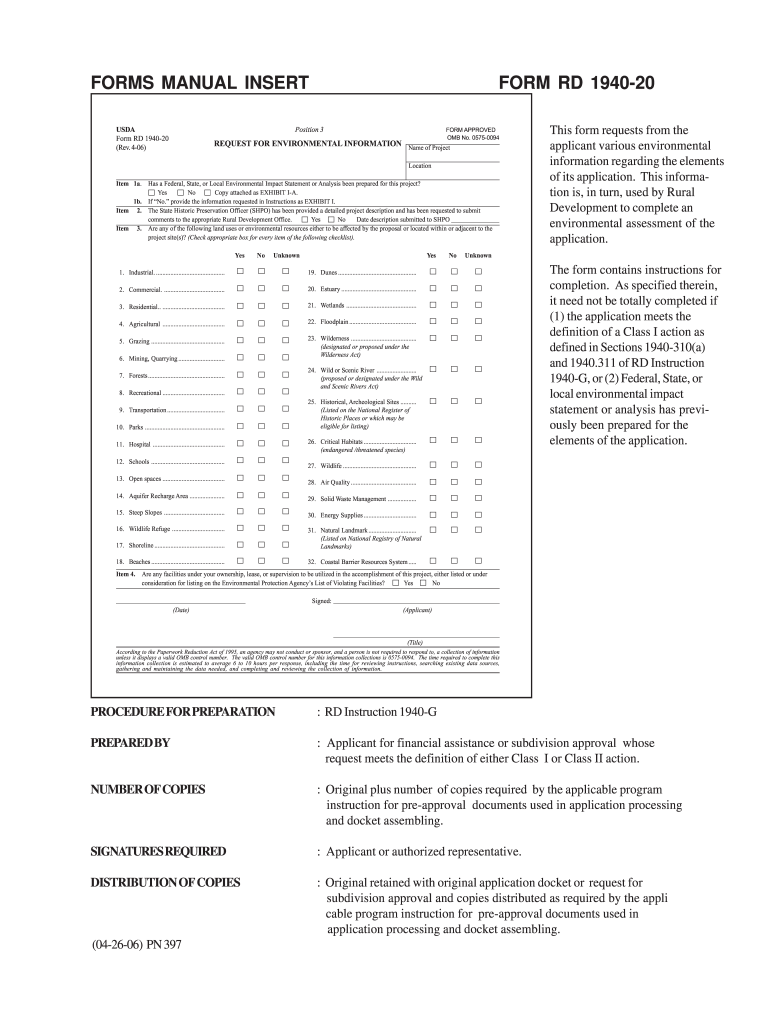
Form rd environmental form 2026

Get Form
10 06 13 Preview on Page 1

Here's how it works

01. Edit your 10 06 13 online
Type text, add images, blackout confidential details, add comments, highlights and more.
02. Sign it in a few clicks
Draw your signature, type it, upload its image, or use your mobile device as a signature pad.
03. Share your form with others
Send it via email, link, or fax. You can also download it, export it or print it out.

How to use or fill out form RD Environmental Form with our platform

Form edit decoration
9.5
Ease of Setup
DocHub User Ratings on G2
9.0
Ease of Use
DocHub User Ratings on G2
  1. Click ‘Get Form’ to open the RD Environmental Form in the editor.
  2. Begin by entering the 'Name of Project' and 'Location' at the top of the form. This information is crucial for identifying your project.
  3. For Item 1a, indicate whether a Federal, State, or Local Environmental Impact Statement has been prepared. If 'No', provide additional information as required in Exhibit I.
  4. In Item 2, confirm if the State Historic Preservation Officer has received a detailed project description. Include the submission date.
  5. Proceed to Item 3, where you will check all applicable land uses or environmental resources that may be affected by your project. Be thorough in your selections.
  6. Complete Item 4 by indicating whether any facilities under your ownership are listed on the EPA’s List of Violating Facilities. Provide a date for this confirmation.
  7. Finally, ensure you sign and date the form at the bottom before submitting it through our platform for processing.

Start filling out your RD Environmental Form online for free today!

See more form rd environmental form versions

We've got more versions of the form rd environmental form form. Select the right form rd environmental form version from the list and start editing it straight away!
Versions Form popularity Fillable & printable
2006 4.8 Satisfied (271 Votes)
be ready to get more

Complete this form in 5 minutes or less

Get form

Got questions?

We have answers to the most popular questions from our customers. If you can't find an answer to your question, please contact us.
Contact us
An Environmental Impact Statement (EIS) is prepared when the lead SEPA agency determines a proposal is likely to have significant adverse environmental impacts. The EIS process is a tool for identifying and analyzing: Probable adverse environmental impacts. Reasonable alternatives.
Specify the project description, including its goals, objectives, nature, scope, timeframe, and other relevant information. Answer Yes-No questions to evaluate the impacts of the proposed project in specific environmental areas. Indicate the overall impact of the project based on the assessment completed.
The purpose of an EIS is to provide a full and fair discussion of significant environmental impacts and to inform the appropriate Agency decision maker and the public of reasonable alternatives to the applicants proposal, the Agencys proposed action, and any measures that would avoid or minimize adverse impacts.
When is an environmental impact assessment required? An environmental impact assessment should accompany planning applications for: developments that are likely to have a significant effect on the environment by virtue of their nature, size or location.
Impact Statements A detailed written statement documenting RDs analysis of the potential environmental impacts of a proposal which has been determined to be a major federal action significantly affecting the quality of the human environment.

Security and compliance

At DocHub, your data security is our priority. We follow HIPAA, SOC2, GDPR, and other standards, so you can work on your documents with confidence.

Learn more
ccpa2
pci-dss
gdpr-compliance
hipaa
soc-compliance
be ready to get more

Complete this form in 5 minutes or less

Get form

People also ask

An EIS outlines the status of the environment in the affected area, provides a baseline for understanding the potential consequences of the proposed project, identifies positive and negative effects for the environment, and offers alternative actions, including inaction, in relation to the proposed project.

Related links