
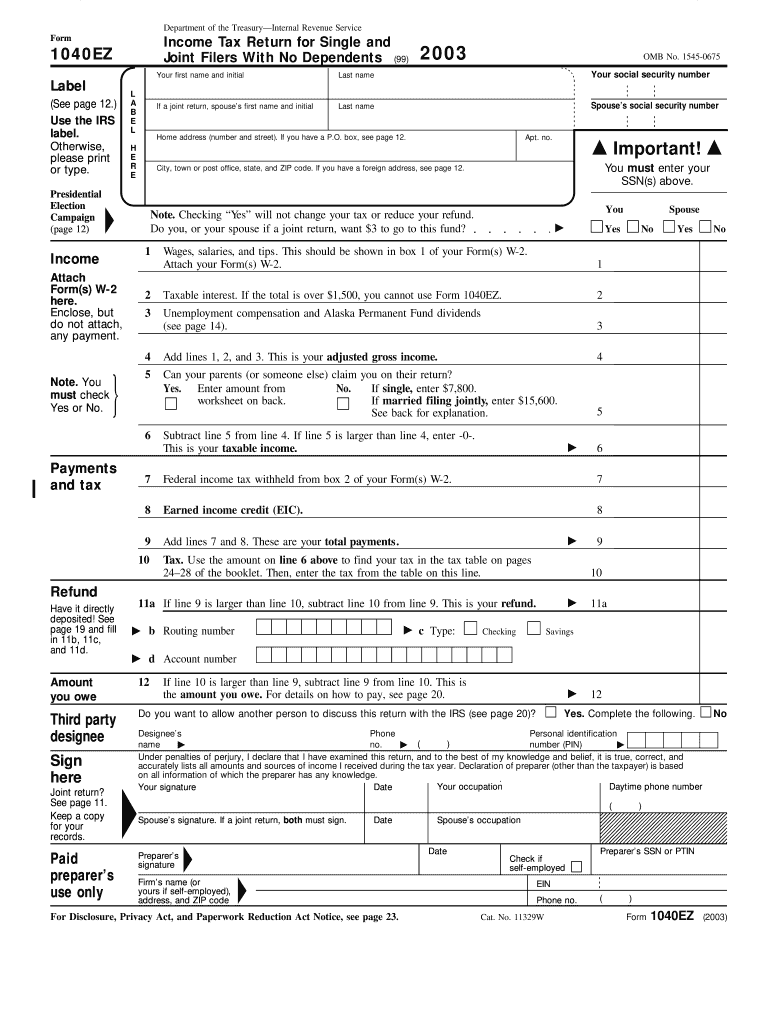







Definition and Purpose of the 1040EZ Form
The 1040EZ Form, issued by the IRS, was a simplified tax document designed for individuals with straightforward tax situations. Specifically, it catered to single or joint filers without dependents, allowing them to report income, calculate taxable amounts, and determine their tax liability or refund efficiently. This form included sections for personal information, sources of income, and tax payments, making it ideal for those with uncomplicated financial backgrounds.
Steps to Complete the Blank 1040EZ 2003 Form
-
Gather Required Information:
- Collect W-2 forms from all employers.
- Gather records of any taxable interest, such as bank statements.
- If applicable, obtain unemployment compensation details.
-
Complete Personal Information:
- Fill in your Social Security Number (SSN) and address.
- Include SSN and details of your spouse if filing jointly.
-
State Income and Adjustments:
- Enter your wages, salaries, and tips.
- Report any taxable interest and unemployment compensation.
- Calculate the Adjusted Gross Income and taxable income using provided schedules.
-
Calculate Tax and Credits:
- Use IRS tables to determine the amount of tax based on your income.
- Account for credits to reduce total tax if applicable.
-
Sign and Date the Form:
- Both you and your spouse need to sign and date the form to validate it.
-
Submit the Form:
- Mail the completed form to the IRS address provided in the instructions or submit it digitally if available.
Who Typically Uses the Blank 1040EZ 2003 Form
The 1040EZ Form was typically used by taxpayers whose financial situations allowed for a simplified tax filing process. This included:
- Single or married couples without dependents.
- Individuals with taxable income below $100,000.
- Taxpayers with interest income under $1,500.
- Filers not claiming any deductions for student loan interest, deductible IRA contributions, or other credits.


Key Elements of the Blank 1040EZ 2003 Form
- Personal Information Section: Essential for identification and contact purposes.
- Income Reporting: Wages and salaries with options for additional income sources.
- Tax Calculation: Utilizes provided tables to calculate liability.
- Payments and Refund Section: Allows direct deposit representations or a check for refunds.
- Signature and Verification: Finalizes the form, ensuring the information provided is accurate.
How to Obtain the Blank 1040EZ 2003 Form
To acquire the 1040EZ Form for the 2003 tax year, taxpayers had a few options:
- IRS Website: Downloadable as a PDF from the official IRS site.
- Local IRS Office: Forms were available at regional IRS offices across the U.S.
- Public Libraries: Many libraries offered tax forms during the filing season.
- Mail: Request physical copies through IRS correspondence during the form's active period.
IRS Guidelines for Filling Out the 1040EZ Form
The IRS provided specific guidelines to assist in smoothly completing the 1040EZ Form:
- Accuracy: Double-check all figures entered to ensure precision.
- Eligibility: Verify that you qualify to use the form based on income and filing status.
- Deadline Compliance: Submit the form by the tax deadline to avoid penalties.
Filing Deadlines and Important Dates
For the 2003 tax year, the FAFSA deadline for submitting the 1040EZ Form was April 15, 2004. Important considerations included:
- Extensions: Available upon request if you could not meet the filing deadline.
- Payment Deadlines: Taxes owed must be paid by the deadline, regardless of extensions, to avoid interest and penalties.
Required Documents for Completing the Form
When preparing to complete the 1040EZ Form, ensure you have:
- W-2 Forms: To report wages and withholding.
- 1099 Forms: If you have additional income like unemployment compensation.
- Identification Documents: Such as a Social Security card or government-issued ID for verification purposes.
Form Submission Methods
Submission options for the 1040EZ included:
- Mail: Traditional filing via postal service to designated IRS addresses.
- E-File: Electronic submission options were available, often through IRS-partnered services.
These options ensured flexibility, catering to both traditional and modern preferences for tax submissions.




