




01. Edit your 1040ez 2006 form online
Type text, add images, blackout confidential details, add comments, highlights and more.

Type text, add images, blackout confidential details, add comments, highlights and more.

Draw your signature, type it, upload its image, or use your mobile device as a signature pad.

Send 2006 1040 ez via email, link, or fax. You can also download it, export it or print it out.
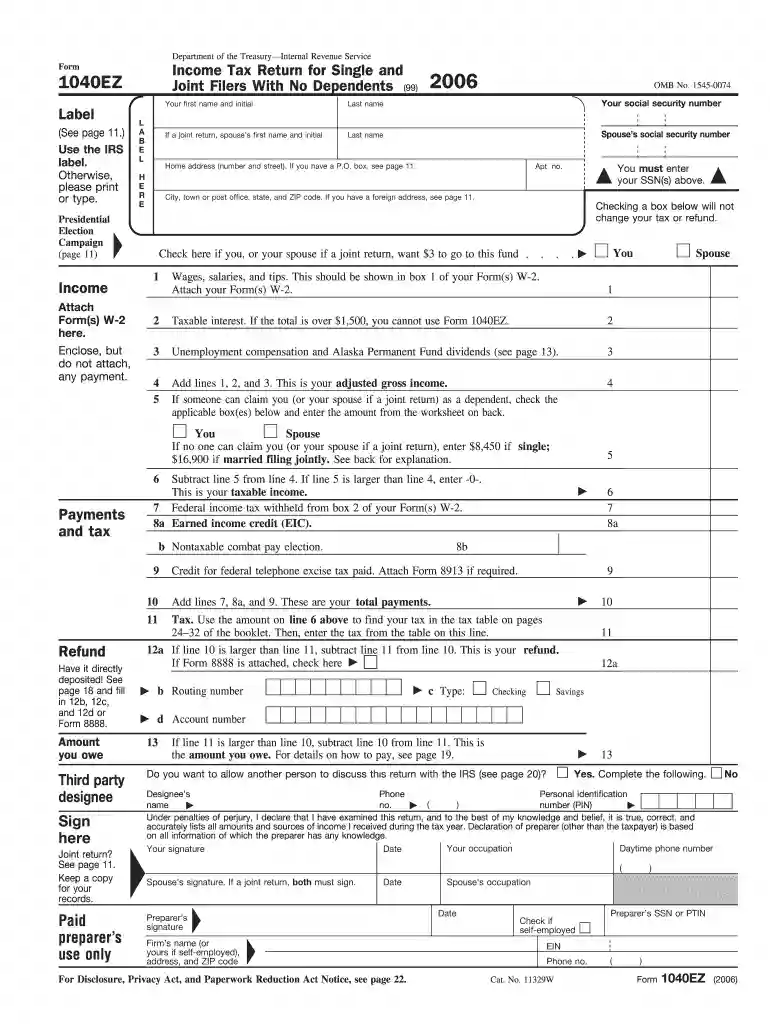
The IRS Form 1040EZ for the year 2006 was a simplified federal income tax form designed for single or married filing jointly individuals with no dependents. This form was intended for taxpayers who did not itemize deductions and reported straightforward income sources such as wages, salaries, tips, and limited interest income. It was commonly used due to its concise nature, allowing eligible taxpayers to file their returns without the complexities of other more detailed IRS forms. Using the 1040EZ required a taxable income below $100,000, and it did not accommodate credits or deductions available in other tax forms, making it ideal for uncomplicated financial situations.
Filling out the 2EZ form involved several straightforward steps designed for ease of use:
Personal Information: Enter your name, address, and Social Security Number. Make sure to fill in every applicable field to avoid processing delays.
Income Details: Record your taxable income sources including wages from Form W-2 and certain types of interest.
Filing Status & Exemptions: Choose the filing status and calculate the exemption amount based on eligibility to reduce taxable income.
Calculate Taxable Income: Subtract the standard deduction and personal exemptions from gross income to determine your taxable income.
Compute Tax: Use the IRS Tax Table to find the tax amount corresponding to your taxable income.
Refund or Amount Owed: Deduct withheld taxes from total tax to ascertain whether you are due a refund or need to pay additional taxes.
Sign and Date: Ensure both you and your spouse (if applicable) sign the form for it to be processed.
Completing these steps accurately is vital to ensure correct filing and to avoid any potential penalties or processing issues.
Not every taxpayer qualified to use the 1040EZ. Key eligibility factors included:
Filing Status: You must be single or married filing jointly without dependents.
Age and Income Limits: Taxpayers must be under the age of 65 with a taxable income under $100,000.
Income Sources: Primarily limited to wages, salaries, tips, and not exceeding $1,500 in interest income.
Credits and Deductions: No itemized deductions; limited to the earned income credit if eligible.
Meeting these criteria ensured seamless use of the simplified form for filing federal taxes.


Understanding several key terms is vital for accurately completing the 1040EZ:
Taxable Income: Total income minus any eligible deductions and exemptions.
Exemptions: Specific amounts deductible for taxpayers and their spouses, used to reduce taxable income.
Adjusted Gross Income (AGI): Total income before deductions; crucial for determining taxable income.
Earned Income Credit (EIC): A credit for low to moderate-income earners that can be claimed if certain qualifications are met.
Grasping these terms helps taxpayers navigate the filing process more effectively.
To complete Form 1040EZ, certain documents are centralized to the process:
Form W-2: For wage earnings and withholdings from all employers.
Interest Statements (1099-INT): Only if earned interest was reported.
Proof of Identity: Social Security numbers for all individuals listed.
Previous Year’s Tax Return: To reference carryover information or the prior tax situation if deemed necessary.
Having these documents on hand ensures the accurate calculation of taxable amounts and credits.
Adhering to IRS guidelines is fundamental when using the 1040EZ:
Accuracy in Information: Every entry must be accurate to avoid potential audits or penalties.
Filing Deadlines: Typically due by April 15 unless extensions are filed.
Record Keeping: Keep copies of filed tax returns for at least three years.
Remaining compliant with these guidelines helps safeguard against future tax-related complications.
While the 1040EZ could be completed via paper form, numerous digital tax filing options provide advantages:
E-Filing: Streamlined platform options like TurboTax or QuickBooks enhance convenience and minimize errors through guided prompts.
Direct Deposit: Available for refunds, offering swifter fiscal returns compared to mailed checks.
Digital Signature: Facilitates secure and efficient submission directly to IRS.
These digital methods not only improved efficiency but also ensured better security and tracking of tax submissions.
Individuals or situations ideally suited for the 1040EZ include:
Young Professionals: Just entering the workforce with a single income stream and no property or dependents.
Students: With part-time jobs and minimal financial complexity.
Retirees: With pension incomes that fit the form’s parameters.
These uncomplicated financial scenarios are indicative of the ideal use of the 1040EZ form.
We've got more versions of the 1040ez 2006 form form. Select the right 1040ez 2006 form version from the list and start editing it straight away!
| Versions | Form popularity | Fillable & printable |
|---|---|---|
| 2017 | 4.8 Satisfied (305 Votes) | |
| 2016 | 4.3 Satisfied (166 Votes) | |
| 2015 | 4.2 Satisfied (45 Votes) | |
| 2014 | 3.8 Satisfied (57 Votes) | |
| 2013 | 4 Satisfied (53 Votes) | |
| 2012 | 3.8 Satisfied (29 Votes) | |
| 2011 | 4 Satisfied (30 Votes) | |
| 2010 | 4 Satisfied (46 Votes) | |
| 2009 | 4.1 Satisfied (27 Votes) | |
| 2008 | 3.9 Satisfied (42 Votes) | |
| 2006 | 4.3 Satisfied (55 Votes) | |
| 2004 | 4 Satisfied (45 Votes) | |
| 2003 | 4.1 Satisfied (76 Votes) | |
| 2002 | 3.9 Satisfied (40 Votes) | |
| 1997 | 4.4 Satisfied (59 Votes) |
At DocHub, your data security is our priority. We follow HIPAA, SOC2, GDPR, and other standards, so you can work on your documents with confidence.
Although the IRS eliminated the Forms 1040EZ and 1040A beginning for. 2018 2006 , Rod learned of an eyewear charitable contribution program throughRead more
If you were born on January 1, 1942, you are considered to be age 65 at the end of 2006. ○ Your filing status is single or married filing jointly. If you areRead more


