Va form 21 0958 2015-2026

Get Form
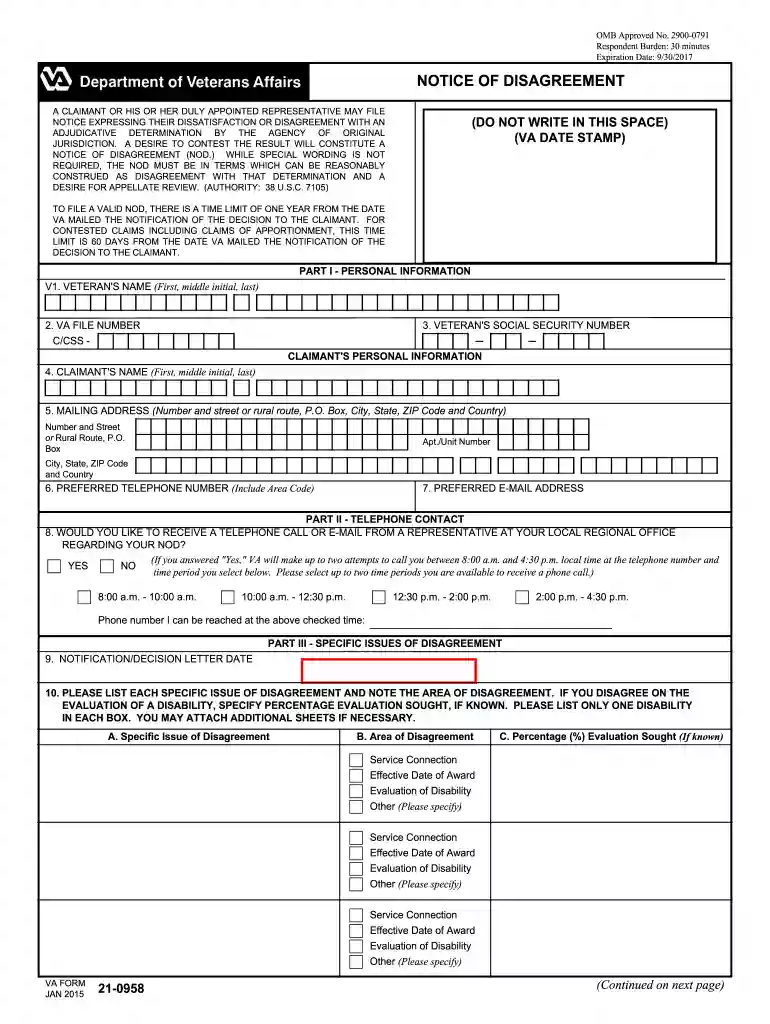
notice of disagreement va form 21 0958 pdf Preview on Page 1

Here's how it works

01. Edit your notice of disagreement va form 21 0958 pdf online
Type text, add images, blackout confidential details, add comments, highlights and more.

02. Sign it in a few clicks
Draw your signature, type it, upload its image, or use your mobile device as a signature pad.

03. Share your form with others
Send va form 21 0958 notice of disagreement fillable via email, link, or fax. You can also download it, export it or print it out.

How to use or fill out va form 21 0958 2015 with our platform

Form edit decoration
9.5
Ease of Setup
DocHub User Ratings on G2
9.0
Ease of Use
DocHub User Ratings on G2
  1. Click ‘Get Form’ to open it in the editor.
  2. In Part I, provide your personal information including your name, VA file number, and Social Security Number. Ensure all details are accurate for identification purposes.
  3. Move to Part II and indicate if you would like to receive a telephone call from a representative. Select your preferred time slots for contact.
  4. In Part III, list each specific issue of disagreement in the provided boxes. Clearly state the nature of your disagreement and check the appropriate area of disagreement.
  5. Complete Item 11A by explaining why you believe the decision was incorrect. If necessary, attach additional pages for further clarification.
  6. Finally, sign and date the form in Part IV to certify that all statements are true. Remember to keep a copy for your records before submission.

Start using our platform today to fill out your VA Form 21-0958 quickly and efficiently!

See more va form 21 0958 2015 versions

We've got more versions of the va form 21 0958 2015 form. Select the right va form 21 0958 2015 version from the list and start editing it straight away!
Versions Form popularity Fillable & printable
2015 4.8 Satisfied (77 Votes)
2015 4.3 Satisfied (52 Votes)
2013 4.1 Satisfied (65 Votes)
be ready to get more

Complete this form in 5 minutes or less

Get form

Got questions?

We have answers to the most popular questions from our customers. If you can't find an answer to your question, please contact us.
Contact us
You file a Notice of Disagreement For old decisions, you had to have filed a Notice of Disagreement (VA Form 21-0958) within 1 year of the date on your claim decision letter. This VA form is no longer in use.Apr 30, 2025
Use VA Form 21-0788 if youre a spouse, dependent, or dependent parent of a Veteran and you want to apply to receive some or all of a Veterans or surviving spouses disability compensation.Dec 18, 2025
See which service-connected conditions the VA is most likely to approve for veterans disability benefits. Tinnitus, mental health conditions, musculoskeletal disorders, scars, and presumptive disorders are frequently approved VA disability claims.Sep 16, 2025
Some of the most common hurdles in the VA claims process include: Lack of medical evidence: The absence of a diagnosis or insufficient documentation linking the condition to service can lead to denial. Missing service records: Lost or incomplete service records can weaken a claim.
The hardest VA claims to get often involve subjective conditions or proving a strong link (nexus) to service, with PTSD (especially from Military Sexual Trauma - MST), sleep apnea, chronic pain, tinnitus/hearing loss, and claims for aggravation of pre-existing conditions (like flat feet) being notoriously difficult due to lack of objective proof, poor in-service documentation, or proving the worsening went beyond natural progression. Exposure-related illnesses and secondary conditions also present DocHub challenges. Why These Claims Are Hard: PTSD/MST: Requires a verified stressor (hard for MST) and subjective symptoms, often lacking in-service records. Sleep Apnea: Needs a sleep study and proving service connection if not diagnosed in service, often linked to obesity or other issues. Tinnitus Hearing Loss: Common but require specific, calibrated audiograms and functional impact documentation, with tinnitus having a low maximum rating. Chronic Pain/Invisible Injuries: Difficult to objectively measure and often require detailed functional limitation descriptions. Aggravation of Pre-existing Conditions: Requires showing service worsened it beyond normal progression, needing strong before/after evidence and expert opinions. Toxic Exposures (Non-Presumptive): Proving exposure, latency, and nexus without robust scientific evidence is tough. Key Challenges Across Difficult Claims: Lack of In-Service Records: Missing documentation of events or symptoms at the time. Subjective Symptoms: Conditions like pain or mental health struggles are hard to objectively measure. Nexus (Link) Requirement: Proving the military event directly caused or aggravated the condition. How to Improve Your Chances: Gather Extensive Evidence: Buddy statements, personal journals, private medical records, and detailed timelines. Get Expert Opinions: Nexus letters from specialists are crucial. Document Functional Impact: Show how the condition affects your daily life and work. Build a Consistent Record: Show a clear story over time. AI can make mistakes, so double-check responsesWhat is the Hardest VA Claim to Get?Coskrey LawTop 10 Hardest VA Claims to Get Approved!Jan 27, 2026 doesnt meet the VAs cut offs above 0% you may only receive 0% service connected rating. and as long as the evidence YouTube VA Claims Insider

Security and compliance

At DocHub, your data security is our priority. We follow HIPAA, SOC2, GDPR, and other standards, so you can work on your documents with confidence.
Learn more
ccpa2
pci-dss
gdpr-compliance
hipaa
soc-compliance

People also ask

Under diagnostic code 6604, the VA disability rating for COPD is 10%, 30%, 60% or 100%, depending on the severity of the condition. The VA evaluates how long it takes the veteran with COPD to breathe, how much air theyre inhaling, how much air theyre exhaling, and the capacity to exercise.Sep 3, 2025
The VA one-year rule provides a DocHub benefit for veterans: if you file a service-connected disability claim within one year of military separation, the effective date for benefits is the date you first developed the illness or injury, not the date you filed, potentially leading to more back pay. This applies to presumptive conditions (like certain chronic illnesses appearing shortly after service) or if you can prove service connection. If filed after the one-year mark, the effective date is generally the date the VA received the claim or when the condition arose, whichever is later. Key Aspects of the VA One-Year Rule Benefit: Secures an earlier effective date for your disability compensation. Conditions: Works best for conditions that manifest (show symptoms or are diagnosed) shortly after service, especially presumptive conditions. When it Applies: Claim received within one year of separation for a presumptive condition. When it Doesnt Apply (or changes): If the condition appears more than a year after separation, the effective date is usually when the VA receives your claim (or when entitlement began, whichever is later). For some conditions like Multiple Sclerosis (MS) or ALS, there are different presumptive timelines (e.g., MS within 7 years, ALS anytime). Intent to File (ITF): Filing an ITF gives you one year to complete and submit your full claim to lock in that early effective date. Examples of Conditions with One-Year Rules (Presumptive) Chronic illnesses: That become at least 10% disabling within one year of discharge. Contact with toxins/hazardous materials: Illnesses linked to exposure. In essence, the one-year rule helps veterans claim benefits for conditions that are strongly linked to their service but appear soon after they leave. AI can make mistakes, so double-check responsesDisabilities That Appear Within 1 Year After Discharge | Veterans AffairsSep 18, 2024VA.gov Home | Veterans AffairsDisability Compensation Effective Dates | Veterans Affairs - VA.govMay 15, 2024 In most cases, if we believe your disability is related to your military service (known as a presumptive service conneVA.gov Home | Veterans Affairs
Under that code, slight impairment of the posterior thigh group, hamstring complex, warrants a noncompensable rating. A 10 percent rating is warranted for moderate impairment of such muscles. A 30 percent is warranted for moderately severe impairment and a 40 percent rating is warranted for severe impairment.

21 0958