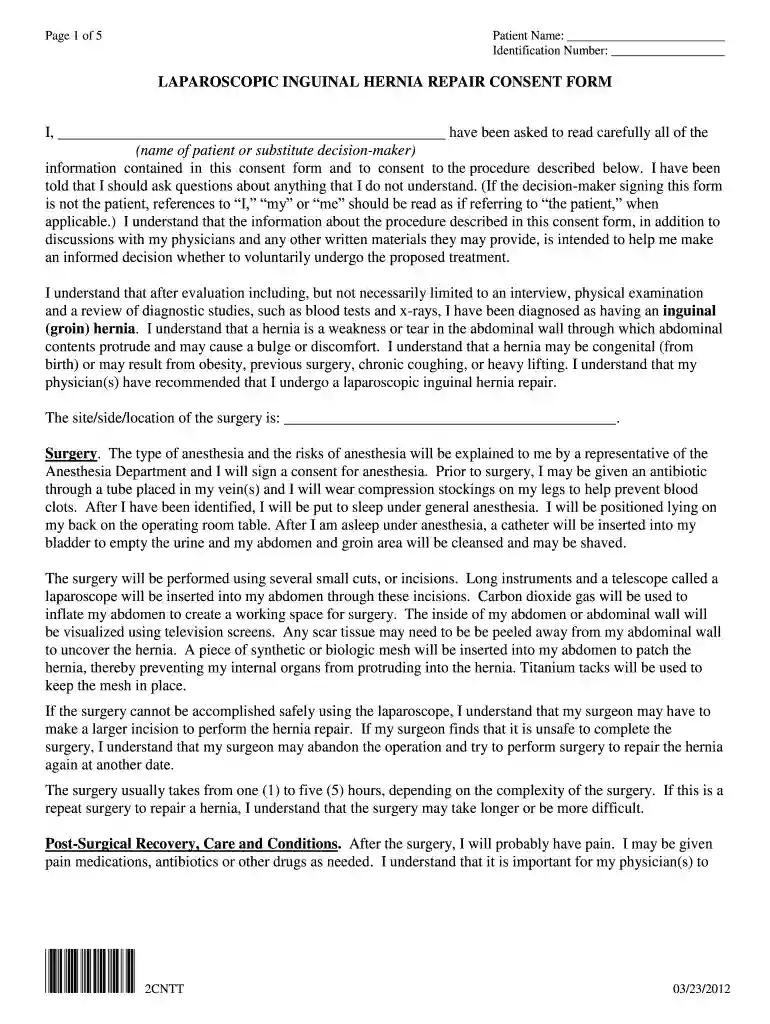
Inguinal consent form sample 2026

Get Form
hernia consent Preview on Page 1

Here's how it works

01. Edit your hernia consent online
Type text, add images, blackout confidential details, add comments, highlights and more.

02. Sign it in a few clicks
Draw your signature, type it, upload its image, or use your mobile device as a signature pad.

03. Share your form with others
Send hernia consent form via email, link, or fax. You can also download it, export it or print it out.

How to use or fill out inguinal consent form sample with DocHub

Form edit decoration
9.5
Ease of Setup
DocHub User Ratings on G2
9.0
Ease of Use
DocHub User Ratings on G2
  1. Click ‘Get Form’ to open the inguinal consent form sample in our editor.
  2. Begin by entering the Patient Name and Identification Number at the top of the form. This information is crucial for identifying the patient.
  3. Read through the consent details carefully. Ensure you understand each section, especially regarding the procedure, risks, and alternatives. If you have questions, feel free to ask your healthcare provider.
  4. Fill in your name or that of a substitute decision-maker where indicated. This confirms who is consenting to the procedure.
  5. Specify the site/side/location of surgery in the designated field. Accurate information here is essential for surgical planning.
  6. Review and acknowledge all risks associated with surgery as outlined in the document. Make sure you are comfortable with this information before proceeding.
  7. Sign and date at the bottom of the form, ensuring all blanks are filled prior to signing. This finalizes your consent.

Start using our platform today to easily fill out your inguinal consent form sample for free!

See more inguinal consent form sample versions

We've got more versions of the inguinal consent form sample form. Select the right inguinal consent form sample version from the list and start editing it straight away!
Versions Form popularity Fillable & printable
2012 4.8 Satisfied (145 Votes)
be ready to get more

Complete this form in 5 minutes or less

Get form

Got questions?

We have answers to the most popular questions from our customers. If you can't find an answer to your question, please contact us.
Contact us
1) I have read and understood the information contained here; 2) I have been informed about the Procedure and the potential risks, benefits, alternatives and the risk of those alternatives; 3) I authorize and consent to the performance of the Procedure as described; and 4) I authorize and direct that any Specimen
What are the symptoms of an inguinal hernia? A bulge in your groin area on either side of your pubic bone. A feeling of pressure or heaviness in your groin. Pain in your groin, especially when straining, lifting, coughing or bending over.
An inguinal hernia is a bulge that occurs in your groin region, the area between the lower part of your abdomen and your thigh. Inguinal hernias occur because of a weakening of the muscles in the lower abdomen. Three layers protect the intestines inside the lower abdomen.
With the fingers placed over the femoral region, the external inguinal ring, and the internal ring, have the patient cough. A palpable bulge or impulse located in any one of these areas may indicate a hernia.
Transection of round ligament is then recommended, at least 1 cm proximal the deep ring in order avoid injury of genital branch of the genitofemoral nerve at this location. Rule 6: In large or inguino-scrotal hernias, it is recommended to transect and abandon the distal hernia sac within the .

Security and compliance

At DocHub, your data security is our priority. We follow HIPAA, SOC2, GDPR, and other standards, so you can work on your documents with confidence.

Learn more
ccpa2
pci-dss
gdpr-compliance
hipaa
soc-compliance
be ready to get more

Complete this form in 5 minutes or less

Get form

People also ask

A hernia is a sac formed by the lining of the abdominal cavity (peritoneum). The sac comes through a hole or weak area in the strong layer of the belly wall that surrounds the muscle. This layer is called the fascia.

Related links