




01. Edit your phq9 and gad7 online
Type text, add images, blackout confidential details, add comments, highlights and more.

Type text, add images, blackout confidential details, add comments, highlights and more.

Draw your signature, type it, upload its image, or use your mobile device as a signature pad.

Send phq9 gad7 via email, link, or fax. You can also download it, export it or print it out.
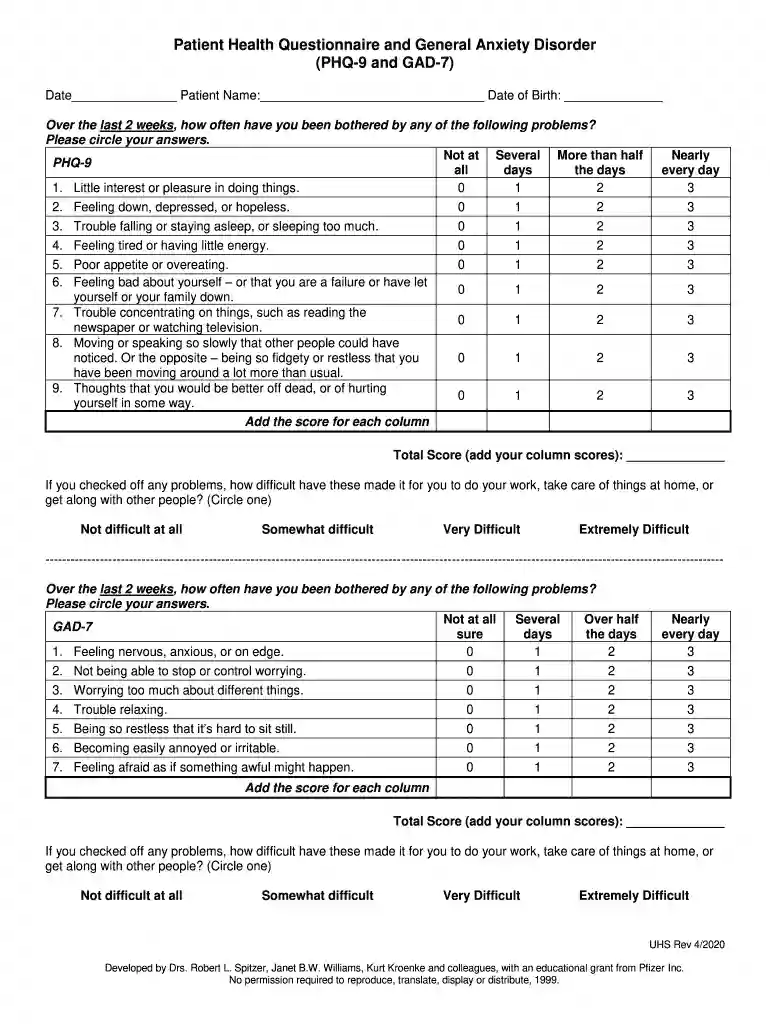
The PHQ-9 and GAD-7 word document comprises two standardized assessment tools developed for evaluating mental health conditions related to depression and anxiety. The Patient Health Questionnaire (PHQ-9) includes nine questions focused on depression symptoms, while the Generalized Anxiety Disorder (GAD-7) features seven questions pertaining to anxiety. Patients complete these questionnaires based on their experiences over the past two weeks, marking their responses on a scale from zero (not at all) to three (nearly every day). The total scores from both questionnaires are calculated to determine the severity of the conditions, guiding further assessment or treatment options. These formularies play a crucial role in mental health diagnostics and can greatly influence the management of a patient's care.
Using the PHQ-9 and GAD-7 word document is straightforward but requires careful attention to detail for effective outcomes.
Filling Out the Questionnaire: Patients should complete each question, reflecting accurately on their symptoms over the past two weeks. Responses correspond to frequency indicators that range from "not at all" to "nearly every day."
Calculating Scores: Once completed, tally the scores for both sections:
Interpreting Results: Use the calculated scores to gauge the severity:
Next Steps: Depending on the total scores, healthcare professionals can determine whether further diagnostic procedures or treatment plans are necessary.
Completing these steps accurately ensures that the document serves its purpose effectively, informing both the patient and the healthcare provider.
Obtaining the PHQ-9 and GAD-7 word document is a simple process that can be accomplished through several methods:
Official Sources: The most reliable way is to access the official versions from established mental health organizations or institutions that specialize in psychiatric evaluation. They often provide downloadable formats in various document types.
Healthcare Provider: Patients can request a hard copy or digital version from their healthcare provider. Many clinicians have easy access to these documents and can offer assistance in filling them out correctly.
Online Platforms: Websites dedicated to mental health resources, like the American Psychological Association, often host these assessment tools in various formats, including Word document templates. Search for the “PHQ-9 GAD-7 word document” to find user-friendly options.
These channels ensure that patients and healthcare professionals have access to the necessary forms for mental health assessment.
Completing the PHQ-9 and GAD-7 word document requires methodical steps to capture an accurate assessment of mental health:
Download the Document: Ensure you have the latest version of both the PHQ-9 and GAD-7 forms in Word format.
Read Instructions Careful: Review any accompanying instructions to understand the scoring system clearly.
Answer Questions Honestly: Go through each question and provide the most accurate reflection of your experiences over the last two weeks.
Calculate Scores: After completing both questionnaires, total your responses. For the PHQ-9, sum the points from each answered section. For the GAD-7, follow the same procedure.
Interpret the Results: Use the classification scales to understand the severity of depression and anxiety as determined by your scores, and be prepared to discuss these results with your healthcare professional.
Following these organized steps allows for an effective assessment process, assisting in diagnosing mental health conditions accurately.
Understanding the specific terminology associated with the PHQ-9 and GAD-7 is essential for proper utilization of the word document:
Depression: A mood disorder characterized by persistent feelings of sadness or a lack of interest and pleasure in previously enjoyable activities.
Anxiety: A psychological condition marked by feelings of tension, worry, and physical changes such as increased blood pressure.
Score Interpretation: The method by which the results from the questionnaires are interpreted to classify severity levels of mental health conditions.
Assessment Tool: Any standardized questionnaire or instrument utilized to evaluate an individual’s mental health status.
Healthcare Provider: A professional trained to assess mental health conditions and offer advice or treatment based on results.
These terms aid in facilitating a clearer understanding of the PHQ-9 and GAD-7 assessments, contributing to better communication between patients and healthcare professionals.
The PHQ-9 and GAD-7 word document contains several key elements essential for conducting a thorough mental health assessment:
Structured Format: The questionnaires are clearly structured, allowing for straightforward responses that lead to numerical scoring.
Scoring System: Each question is calibrated for a scoring system that quantifies symptom severity, important for assessing treatment necessity.
User Instructions: Clear instructions guide the patient on how to complete the forms effectively, ensuring that responses are both comprehensive and relevant.
Diagnostic Utility: The key purpose of these assessments is to facilitate the identification of depression and anxiety, leading to appropriate management strategies.
Follow-Up Recommendations: Many versions of the document may include sections or prompts for follow-up discussions with healthcare providers, emphasizing the importance of reviewing the results.
These elements make the PHQ-9 GAD-7 word document a valuable resource in mental health care, promoting consistent evaluation practices across clinical settings.
We've got more versions of the phq9 and gad7 form. Select the right phq9 and gad7 version from the list and start editing it straight away!
| Versions | Form popularity | Fillable & printable |
|---|---|---|
| 2020 | 4.1 Satisfied (59 Votes) |
At DocHub, your data security is our priority. We follow HIPAA, SOC2, GDPR, and other standards, so you can work on your documents with confidence.


