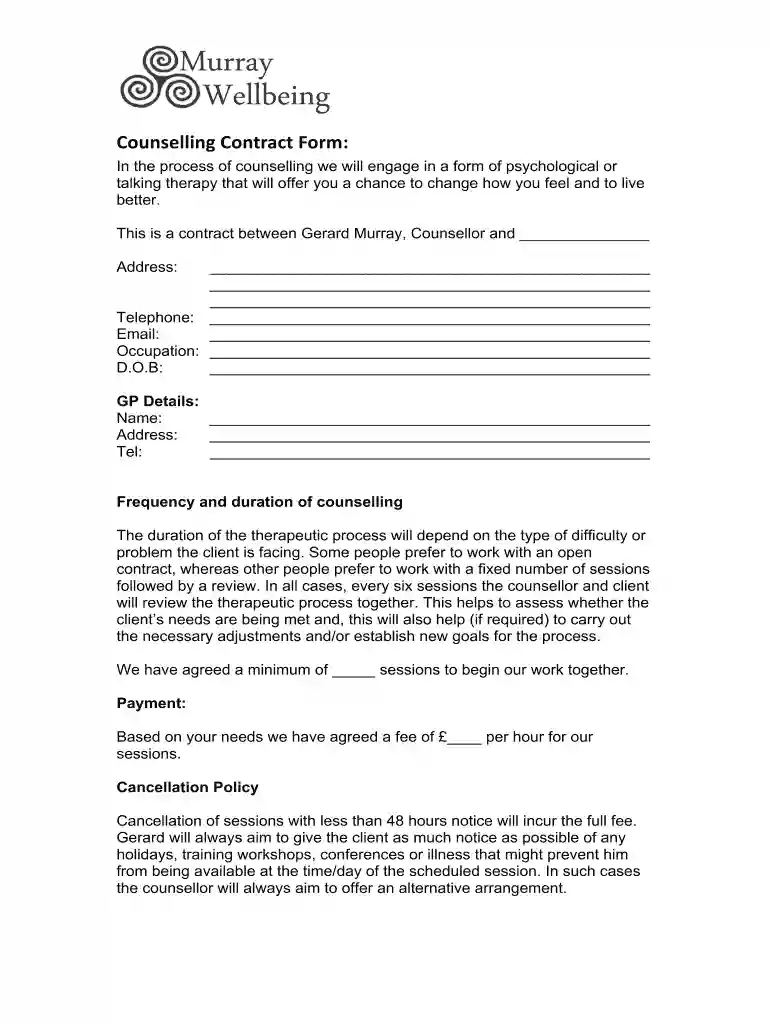
Counselling contract form 2026

Get Form
counselling contract template Preview on Page 1

Here's how it works

01. Edit your counselling contract template online
Type text, add images, blackout confidential details, add comments, highlights and more.

02. Sign it in a few clicks
Draw your signature, type it, upload its image, or use your mobile device as a signature pad.

03. Share your form with others
Send counselling contract template word via email, link, or fax. You can also download it, export it or print it out.

Definition and Meaning of the Counselling Contract Form

A counselling contract form is a formal document that outlines the terms and conditions of the therapeutic relationship between a counsellor and their client. The purpose of this contract is to establish a clear understanding of expectations, responsibilities, and boundaries throughout the counselling process. The contract typically includes elements such as session frequency, payment policies, confidentiality agreements, and the process for handling complaints. By formalizing these aspects, both the client and counsellor can work collaboratively within a structured framework, promoting trust and clarity.

Key components of the counselling contract include:

  • Session Frequency: The number of sessions per week or month and the duration of each session.
  • Payment Details: Information regarding fees, payment schedules, and accepted payment methods.
  • Cancellation Policy: Guidelines on how much notice must be provided for cancellations or rescheduling appointments.
  • Confidentiality Agreements: Clarification on the limits of confidentiality, who can access client information, and under what circumstances disclosure may occur.
  • Record-Keeping Practices: Information about how client records are maintained and the duration for which they are kept.

This contract is essential for ensuring both parties understand their rights and responsibilities, thereby fostering a supportive therapeutic environment.

Key Elements of the Counselling Contract Form

A well-structured counselling contract form encompasses various key elements that are critical for both the counsellor and the client. Understanding these elements helps ensure a smooth and effective counselling process.

Essential Components

  1. Client Information: Basic details about the client, including name, contact information, and any pertinent background relevant to the counselling process.
  2. Counsellor’s Credentials: Information about the counsellor's qualifications, experience, and any relevant certifications.
  3. Nature of Services: A clear description of the services being provided, such as individual therapy, group counselling, or family sessions.
  4. Consent to Treatment: A statement that confirms the client's consent to participate in therapy and acknowledgment of the nature of those services.
  5. Termination of Services: Details about how and when either party can terminate the counselling relationship, including any necessary notice requirements.

Additional Considerations

  • Emergency Procedures: Information about what to do in case of a crisis or emergency situation that may arise during the counselling process.
  • Rights and Responsibilities: An outline of the rights of both the client and the therapist, ensuring both parties understand what is expected of them.
  • Feedback Mechanism: Options for clients to provide feedback about their experience and any necessary changes to improve the service.

Incorporating these elements fosters transparency and establishes a professional and nurturing environment, conducive to effective therapy.

Steps to Complete the Counselling Contract Form

Completing a counselling contract form is a straightforward process that involves specific steps to ensure all necessary information is accurately provided.

  1. Gather Information: Before beginning, collect all relevant personal details and background information needed for the form, including contact details and any pertinent medical or psychological history.
  2. Review Contract Elements: Familiarize yourself with the key elements of the contract. Make sure you comprehend every section, particularly regarding confidentiality and cancellation policies.
  3. Fill in the Form: Carefully input all required information into the designated fields of the form, ensuring accuracy and clarity in your responses.
  4. Consult with the Counsellor: If there are any sections that are unclear, discuss them with your counsellor to gain a better understanding before finalizing the contract.
  5. Sign and Date: Both the client and the counsellor should sign and date the form, indicating mutual agreement to the outlined terms. Keep a copy for your records.
  6. Submit the Form: Depending on the counsellor's preference, submit the completed form electronically or in person.

By following these steps, clients can ensure that they are thoroughly prepared for their therapy sessions and that all administrative aspects are formally addressed.

Importance of the Counselling Contract Form

The counselling contract form serves several crucial purposes within the therapeutic context, cementing the foundation of the counselling relationship.

Benefits of Establishing a Contract

  • Clarity: It provides clear guidelines regarding the expectations of both parties, reducing the potential for misunderstandings.
  • Trust: Establishing a formal agreement fosters trust, as clients know their counsellor is bound by confidentiality and ethical practices.
  • Accountability: Both the client and the therapist can hold each other accountable concerning the agreed-upon terms, enhancing the professional nature of the relationship.
  • Structure: The contract serves as a structured framework that guides the counselling process, allowing both parties to navigate therapy more effectively.

By highlighting its importance, clients can understand that this document is not merely a formality but a fundamental part of enhancing therapeutic effectiveness and stability.

Examples of Using the Counselling Contract Form

There are various situations in which a counselling contract form is utilized, and these examples underscore its practical applications within the therapeutic process.

Scenario Illustrations

  • Individual Therapy: In a one-on-one setting, a counselling contract clarifies the therapist's approach, session frequency, and payment arrangements, allowing the client to prepare appropriately.
  • Group Counselling: For group sessions, a contract delineates the rules regarding confidentiality among members, helping to establish a safe environment for sharing personal experiences.
  • Family Therapy: In family counselling, the contract can specify the roles and expectations of each family member participating, fostering cooperation and understanding among all involved.

These examples illustrate that the counselling contract form adapts to various therapeutic contexts, supporting an organized and respectful atmosphere in which clients can engage meaningfully.

See more counselling contract form versions

We've got more versions of the counselling contract form form. Select the right counselling contract form version from the list and start editing it straight away!
Versions Form popularity Fillable & printable
2016 4.8 Satisfied (91 Votes)
be ready to get more

Complete this form in 5 minutes or less

Get form

Got questions?

We have answers to the most popular questions from our customers. If you can't find an answer to your question, please contact us.
Contact us
The basic elements required for the agreement to be a legally enforceable contract are: mutual assent , expressed by a valid offer and acceptance ; adequate consideration ; capacity ; and legality .
In TA practice, therapist distinguishes three kinds of contracts: business contract, treatment contract and working agreements (Woolams and Brown, 1978). A business contract outlines boundaries between a client and a therapist and makes explicit what can be expected.
Key elements in a counselling contract include confidentiality agreements, payment terms, session duration, scope of practice, limitations of liability, and termination clauses.
Contract Types Comparison Party 1 offers Bilateral Services or goods that are of value to the other party Unilateral Services or goods that the other party requested, usually in an open request Implied Services or goods Express Anything9 more rows Jan 26, 2022
10 Different Types of Contracts Type of ContractEveryday Use Implied Contracts Common in everyday transactions like dining out. Express Contracts Standard in formal business agreements. Simple Contracts Used for straightforward services or transactions. Unconscionable Contracts Often challenged in court for fairness.10 more rows Jul 18, 2024

Security and compliance

At DocHub, your data security is our priority. We follow HIPAA, SOC2, GDPR, and other standards, so you can work on your documents with confidence.

Learn more
ccpa2
pci-dss
gdpr-compliance
hipaa
soc-compliance
be ready to get more

Complete this form in 5 minutes or less

Get form

People also ask

General features. Justinian identifies four types of real contract contracts in re (in a thing) mutuum, commodatum, depositum and pignus. Common to all four was an agreement, and the delivery of a res corporalis. They are in contrast to consensual and inominate contracts.
Clearly define fees and payment terms to prevent misunderstandings. The contract should: List the cost per session, considering the therapists experience, qualifications, location, market rates, and any extra services like emergency support. You can also include your policy on sliding scale fees here.
Real estate leases for longer than one year. Contracts for over a certain amount of money (depending on the state) Contracts that will last longer than the life of the party performing the contract. A transfer of personal property at the death of the party performing the contract.

counselling contract