
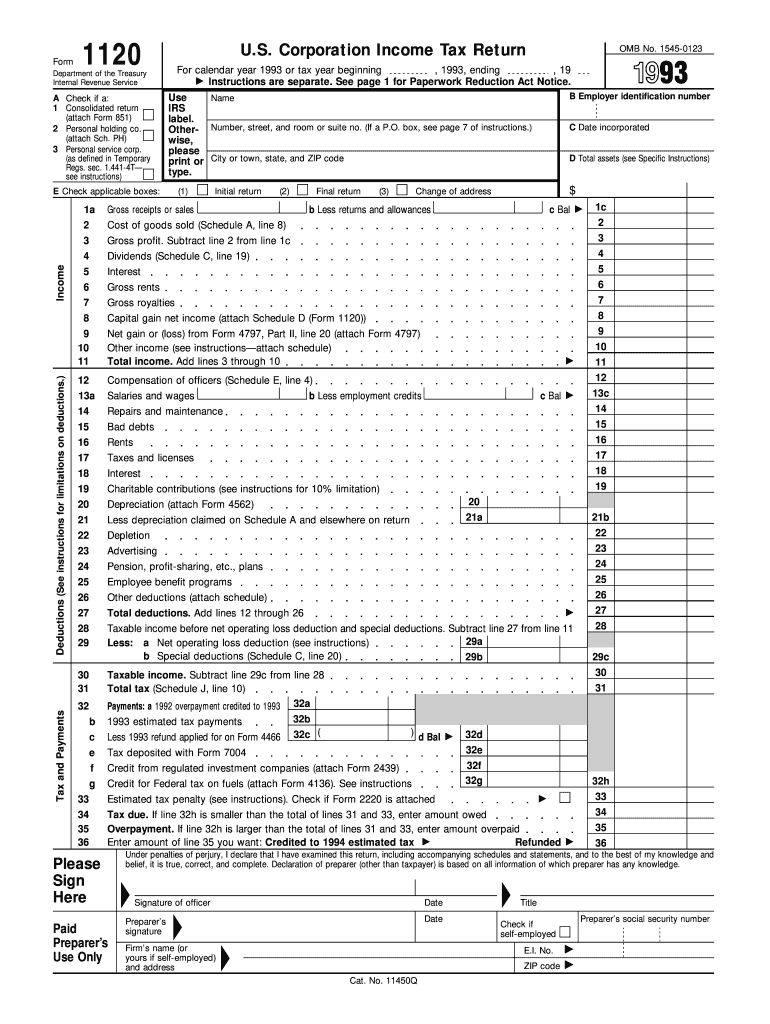







Definition and Purpose of the 1993 Form 1120
The 1993 Form 1120, also known as the U.S. Corporation Income Tax Return, is a critical document used by corporations to report their income, deductions, and tax liabilities to the Internal Revenue Service (IRS). This form is essential for complying with federal tax laws and ensuring accurate financial reporting. Corporations are required to file Form 1120 for each tax year, detailing their financial activities, which include total income, business expenses, and any applicable credits or deductions. Proper completion of this form is crucial to avoid potential penalties and ensure lawful tax reporting.
Key Elements of the 1993 Form 1120
Understanding the major sections of the 1993 Form 1120 is vital for accurate filing. The primary components include:
- Gross Receipts and Sales: Indicates the total revenue generated by the corporation during the tax year.
- Cost of Goods Sold (COGS): Details expenses related directly to the production of goods sold by the corporation, which impacts gross profit calculations.
- Dividends and Deductions: Includes dividends received and allowable business deductions, such as marketing and operational expenses, depreciation, and employee compensation.
- Tax Computation: Offers a breakdown of the taxable income calculations and applicable tax rates to determine total tax liability.
- Schedules: Various schedules are required for specific reporting needs like compensation of officers, reconciliation of income per books with income per return, and analysis of unappropriated retained earnings per books.
Steps to Complete the 1993 Form 1120
Filing the 1993 Form 1120 requires a methodical approach to capture all necessary information:
- Gather Required Documents: Include income statements, balance sheets, details of business expenses and deductions, and supporting documentation for any tax credits claimed.
- Calculate Total Income: Add up all revenue sources to establish the gross income.
- Determine Deductible Expenses: Itemize allowable business expenses and subtract from gross income to calculate the corporation's taxable income.
- Complete Relevant Schedules: Fill out required schedules that correspond to sections relevant to your corporation's financial activities.
- Compute Tax Liability: Use the taxable income to calculate the corporation's tax using the appropriate corporate tax rate.
- Submit the Form: Once completed, the form can be submitted to the IRS via mail or, in some cases, electronically through approved e-filing systems.
IRS Guidelines for the 1993 Form 1120
Adhering to IRS guidelines is crucial when completing the 1993 Form 1120. These guidelines ensure compliance and minimize the risk of errors:
- Ensure Accuracy: Double-check all calculations and entered data for accuracy.
- Follow Instructions: Consult the IRS instructions for Form 1120 to understand specific requirements and avoid common pitfalls.
- Include All Schedules: Attach all necessary schedules and forms to support the entries in the 1120 form.
- Maintain Records: Keep detailed records and copies of all documents submitted in case of an IRS audit or inquiry.
Filing Deadlines and Important Dates
Timely submission of the 1993 Form 1120 is mandatory to avoid late filing penalties:
- Regular Deadline: Corporations must typically file by the 15th day of the third month following the end of the corporation's tax year. For a calendar year filer, this would be March 15th.
- Extensions: Corporations can request an extension by filing Form 7004, granting an additional six months to submit the return.
- Payment Deadlines: Any taxes owed are due by the original filing deadline, regardless of any extension for filing the return.
Penalties for Non-Compliance
Failure to properly file the 1993 Form 1120 can result in various penalties:
- Late Filing Penalty: Imposed on returns submitted after the deadline without an approved extension.
- Late Payment Penalty: Applies when taxes are not paid by the due date, accruing interest on unpaid amounts.
- Accuracy-Related Penalties: Assessed for substantial underreporting of income or negligence in filing.
Corporations are encouraged to file accurately and on time to mitigate these risks.
Software Compatibility with Form 1120
Utilizing tax software can streamline the preparation and filing of the 1993 Form 1120:
- Available Platforms: Many software solutions like TurboTax and QuickBooks offer functionality to handle tax preparation for Form 1120.
- E-Filing Compatibility: These software packages offer electronic filing options, reducing errors and facilitating faster IRS processing.
- Features: Typically include built-in calculators, error-checking tools, and support for filing extensions to simplify the filing process.
Business Entity Types that Use Form 1120
The 1993 Form 1120 is mainly used by C corporations, but other entities may also qualify under specific circumstances:
- C Corporations: The primary users of Form 1120 to report their federal income taxes.
- Certain Close Corporations: Small businesses that opt to file as C corporations.
- LLCs and Partnerships: Though these entities typically use different forms, those electing to be taxed as corporations may need to file Form 1120.
Understanding the requirements for each entity type is essential for proper filing and compliance.




