




01. Edit your form online
Type text, add images, blackout confidential details, add comments, highlights and more.

Type text, add images, blackout confidential details, add comments, highlights and more.

Draw your signature, type it, upload its image, or use your mobile device as a signature pad.

Send it via email, link, or fax. You can also download it, export it or print it out.
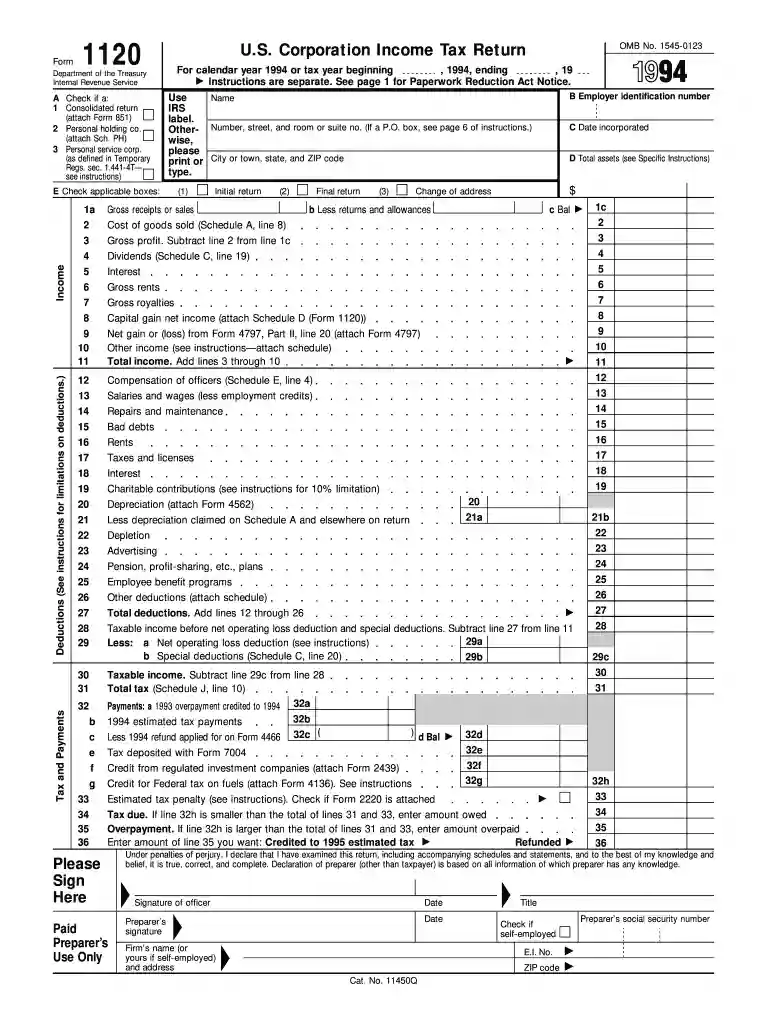
Form 1120, also known as the U.S. Corporation Income Tax Return, is a critical document that corporations are required to file annually with the Internal Revenue Service (IRS). The 1994 version of this form is used for reporting a corporation's income, deductions, and tax computations for that specific tax year. The form provides essential financial data used by the IRS to assess tax liabilities.
Corporations must provide detailed information across various sections, including income, expenses, dividends, and compensation of officers. This structured format ensures consistent reporting across different corporate entities, facilitating accurate tax assessments.
Corporations use this form to document their financial activities from the year 1994, including revenue streams, expenditures, and taxable income. Here are the basic steps involved in utilizing this form:
Obtaining an older tax form like the 1994 Form 1120 requires specific steps:
The IRS provides specific guidelines to ensure that Form 1120 is completed accurately:
For the 1994 Form 1120, the standard filing deadline for corporate taxes typically falls on March 15, unless another date is stipulated due to special circumstances. Extensions may be requested for corporations requiring additional time to gather documentation or manage complex financial details.
Corporations failing to file Form 1120 on time can face significant penalties. These can include:
Maintaining timely and accurate submissions of this form is crucial to avoid costly penalties and maintain good standing with tax authorities.
We've got more versions of the 1994 form 1120 form. Select the right 1994 form 1120 version from the list and start editing it straight away!
| Versions | Form popularity | Fillable & printable |
|---|---|---|
| 2025 | 4.4 Satisfied (37 Votes) | |
| 2024 | 4.6 Satisfied (32 Votes) | |
| 2023 | 4.2 Satisfied (33 Votes) | |
| 2022 | 4.8 Satisfied (59 Votes) | |
| 2021 | 4.8 Satisfied (80 Votes) | |
| 2020 | 4.3 Satisfied (37 Votes) | |
| 2019 | 4.4 Satisfied (228 Votes) | |
| 2018 | 4.3 Satisfied (133 Votes) | |
| 2017 | 4.3 Satisfied (98 Votes) | |
| 2016 | 4.4 Satisfied (267 Votes) | |
| 2015 | 4.3 Satisfied (34 Votes) | |
| 2014 | 4.2 Satisfied (35 Votes) | |
| 2014 | 4 Satisfied (59 Votes) | |
| 2013 | 4 Satisfied (42 Votes) | |
| 2013 | 4.8 Satisfied (25 Votes) |
At DocHub, your data security is our priority. We follow HIPAA, SOC2, GDPR, and other standards, so you can work on your documents with confidence.
Form 1120 (1994). Cost of Goods Sold (See instructions.) 1. Inventory at beginning of year. 1. 2. Purchases. 2. 3. Cost of labor. 3. 4. Additional section 263ARead more
(1994) interpreted the lack of evidence for biodegradation of MTBE as evidence that MTBE would not biologically degrade in ground water. This report supportedRead more
Apr 17, 2026 Corporate income tax return of 1954 for the United States National Bank. The return includes all necessary schedules.


