






Understanding Quadratic Equations and Their Forms
Quadratic equations can be expressed in multiple forms, primarily the standard form and the vertex form. The standard form is given as ( ax^2 + bx + c ), where ( a ), ( b ), and ( c ) are constants. In contrast, the vertex form is represented as ( a(x-h)^2 + k ), where ( (h, k) ) is the vertex of the parabola. Converting from standard form to vertex form facilitates easier analysis of a quadratic's characteristics, such as the direction of the parabola and its vertex.
Importance of Converting Between Forms
Converting quadratic equations allows for streamlined problem-solving and enhances comprehension of graphical features. This transformation is significant for different applications:
- Graphical Representation: The vertex form makes it easier to graph a quadratic function, as it directly reveals the vertex.
- Maximum or Minimum Values: Identifying the vertex allows students to quickly determine whether the function has a maximum or minimum value.
- Applications in Real Life: Many real-world scenarios modeled by quadratic equations benefit from understanding both forms, such as projectile motion, business profit maximization, and architecture design.
Tools to Facilitate Conversion
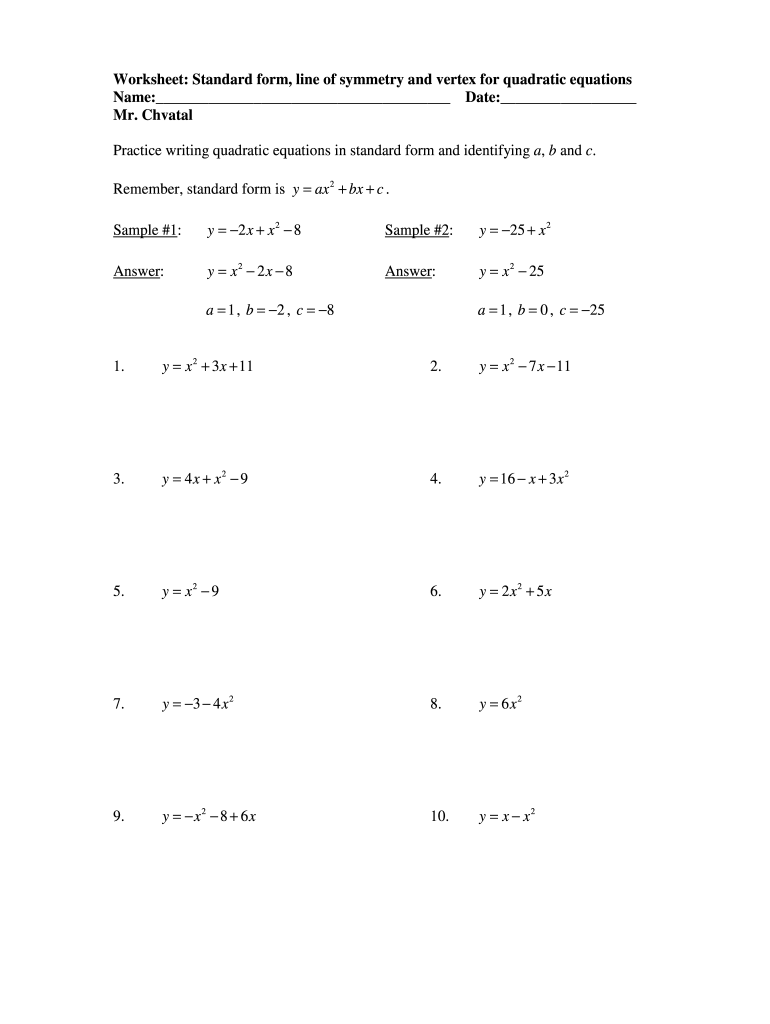
When working with quadratic equations, utilizing worksheets dedicated to the conversion between these forms, such as a "converting quadratic equations worksheet standard to vertex," allows for structured practice and reinforces understanding.
Step-by-Step Process for Conversion
Converting a quadratic equation from standard form to vertex form involves several clear steps:
-
Identify Coefficients: Start with the given quadratic equation ( ax^2 + bx + c ).
- Example: For ( 2x^2 + 8x + 5 ), identify ( a = 2 ), ( b = 8 ), and ( c = 5 ).
-
Factor Out the Leading Coefficient: If ( a ) is not equal to one, factor it out from the terms involving ( x ).
- Example: Factor ( 2 ) out of ( 2x^2 + 8x ) to get ( 2(x^2 + 4x) + 5 ).
-
Complete the Square: Add and subtract ( (b/2)^2 ) inside the parentheses to form a perfect square trinomial.
- Example: For ( x^2 + 4x ), take half of ( 4 ) (which is ( 2 )), square it (getting ( 4 )), then modify the equation: ( 2(x^2 + 4x + 4 - 4) + 5 ).
-
Rewrite as Vertex Form: The expression inside the parentheses can now be factored as ( (x + 2)^2 ).
- Final Conversion: Rewrite the equation as ( 2((x + 2)^2 - 4) + 5 = 2(x + 2)^2 - 8 + 5).
- Hence, ( 2(x + 2)^2 - 3 ) becomes the vertex form.
-
Identify Vertex: The vertex of the parabola can be obtained from ( (h, k) ) in ( a(x-h)^2 + k ).
- Vertex: For our example, the vertex is ( (-2, -3) ).
Common Errors and Misunderstandings
While converting quadratic equations, learners may encounter common pitfalls:
- Forgetting to factor out the leading coefficient before completing the square often leads to incorrect vertex forms.
- Miscalculating ( (b/2)^2 ) can result in errors in determining the vertex coordinates.
- Failing to properly rewrite the equation in vertex form can lead to confusion when analyzing the parabola's features.
Practical Exercises and Applications
Worksheets dedicated to converting quadratic equations often include:
- Sample Problems: Exercises in which students convert equations from standard to vertex form and vice versa.
- Graphical Representation: Practice in sketching the graphs of the equations after conversion to visualize their characteristics.
- Real-World Applications: Scenarios where students apply their understanding of quadratic equations to solve practical problems, enhancing contextual understanding.
By consistently practicing these conversion skills using targeted worksheets, students solidify their understanding of quadratic equations and improve their mathematical proficiency.