




01. Edit your railway concession form for cancer patients pdf online
Type text, add images, blackout confidential details, add comments, highlights and more.

Type text, add images, blackout confidential details, add comments, highlights and more.

Draw your signature, type it, upload its image, or use your mobile device as a signature pad.

Send railway concession form for cancer patients via email, link, or fax. You can also download it, export it or print it out.
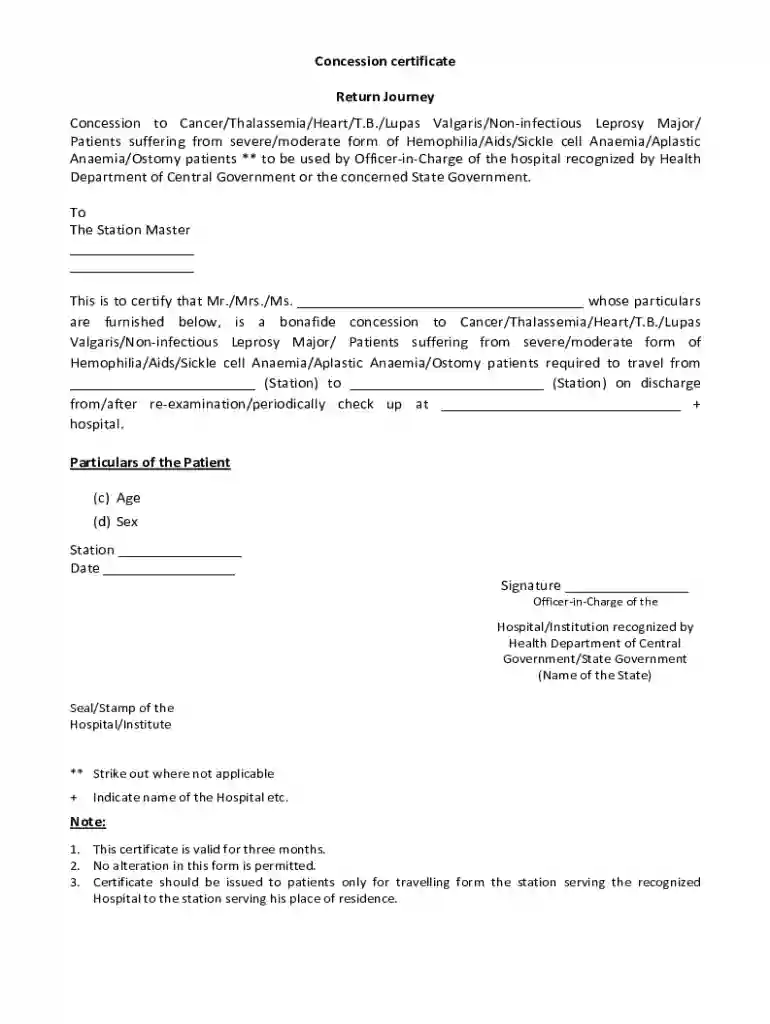
The railway concession form for cancer patients is an essential document designed to provide financial relief for patients traveling for medical treatments. It allows eligible individuals to access discounted railway fares in India, specifically aimed at easing the financial burden associated with transportation for those undergoing cancer treatment. This form is often referred to as the IRCTC cancer patient concession form, and it includes several critical components necessary for securing the concession.
To qualify for the railway concession, certain criteria must be met:
Medical Condition: The form is specifically for patients with substantial medical conditions, most notably cancer. This includes those undergoing treatment referred by certified medical professionals.
Certification Requirement: A concession certificate must be issued by an officer-in-charge from a recognized hospital. This certificate is needed to verify the patient's medical condition and the necessity of travel for treatment.
Validity Period: The certificate issued for cancer patients is typically valid for one year, allowing multiple travels for ongoing treatment.


When filling out the railway concession form for cancer patients, the following documents are required:
Medical Certificate: A duly signed declaration from the doctor, including details of the diagnosis and the necessary treatment.
Identification Proof: Valid government-issued ID to verify the patient’s identity.
Travel Details: Information about the intended journey, including dates, routes, and the purpose of travel.
Photographs: Recent passport-sized photographs may be required for further verification.
Additional Documentation: Any other documents as specified by the railway authorities that may assist in the approval of the concession.
Filling out the railway concession form involves a systematic approach:
Obtain the Form: The railway concession form for cancer patients can be downloaded in PDF format from the IRCTC website or other government resources.
Fill in Personal Details: Enter necessary personal information, including the patient's name, age, and contact information.
Include Medical Information: Input details from the medical certificate, including the hospital's name, the treating physician, and the patient's condition.
Specify Travel Information: Include details about the journey, such as travel dates, train preferences, and any additional travel companions, if applicable.
Submit the Form: Once the form is completed and signed, it should be submitted to the relevant railway authority or the ticket counter designated for concession applications. Be sure to keep copies of all submitted documents.
The processing of the railway concession form for cancer patients can take time, and users should be aware of the following:
Time Frame: Generally, the processing may take a few days to a couple of weeks, depending on the railway zone and workload.
Approval Notification: Upon approval or rejection, the patient will be notified either electronically or through mail.
Other considerations regarding the railway concession form for cancer patients include:
Renewal: If a patient requires ongoing travel, a renewal of the concession certificate may be necessary upon expiry.
Form Variants: Different railway zones might have variations of the concession form; however, the fundamental requirements remain consistent across regions.
Travel with Companions: The concession typically extends to one companion who is accompanying the patient for medical assistance.
Legal Compliance: It is essential to ensure all submitted information is accurate to avoid complications or potential legal issues regarding misuse of the concession.
Example 1: A cancer patient needing chemotherapy treatment might apply for the concession form to travel from their home to the treatment center. With the concession, they can significantly reduce travel costs over the year.
Example 2: A patient undergoing radiation therapy travels regularly for sessions, and thus, applies for the railway concession to ease the burden of frequent travel.
This comprehensive understanding of the railway concession form for cancer patients helps illuminate its significance, simplifies the application process, and emphasizes the importance of proper documentation, ensuring that eligible patients can successfully access the necessary support for their travel needs.
We've got more versions of the railway concession form for cancer patients pdf form. Select the right railway concession form for cancer patients pdf version from the list and start editing it straight away!
| Versions | Form popularity | Fillable & printable |
|---|---|---|
| 2014 | 4 Satisfied (42 Votes) |
At DocHub, your data security is our priority. We follow HIPAA, SOC2, GDPR, and other standards, so you can work on your documents with confidence.
by L Devaraj 2026 This study aims to assess travel time, associated costs, challenges and factors influencing healthcare facility choices among persons with
Mar 28, 2016 They have been written in the intervals of research work and teaching, to a large extent in railway trains. Many scientific workers believe thatRead more


