Breast Cancer Questionnaire - bdbsb-blifemarkbbcomb 2026

Get Form
bdbsb Preview on Page 1

Here's how it works

01. Edit your bdbsb online
Type text, add images, blackout confidential details, add comments, highlights and more.

02. Sign it in a few clicks
Draw your signature, type it, upload its image, or use your mobile device as a signature pad.

03. Share your form with others
Send breast cancer questionnaire via email, link, or fax. You can also download it, export it or print it out.

How to use or fill out Breast Cancer Questionnaire - bdbsb-blifemarkbbcomb with DocHub

Form edit decoration
9.5
Ease of Setup
DocHub User Ratings on G2
9.0
Ease of Use
DocHub User Ratings on G2
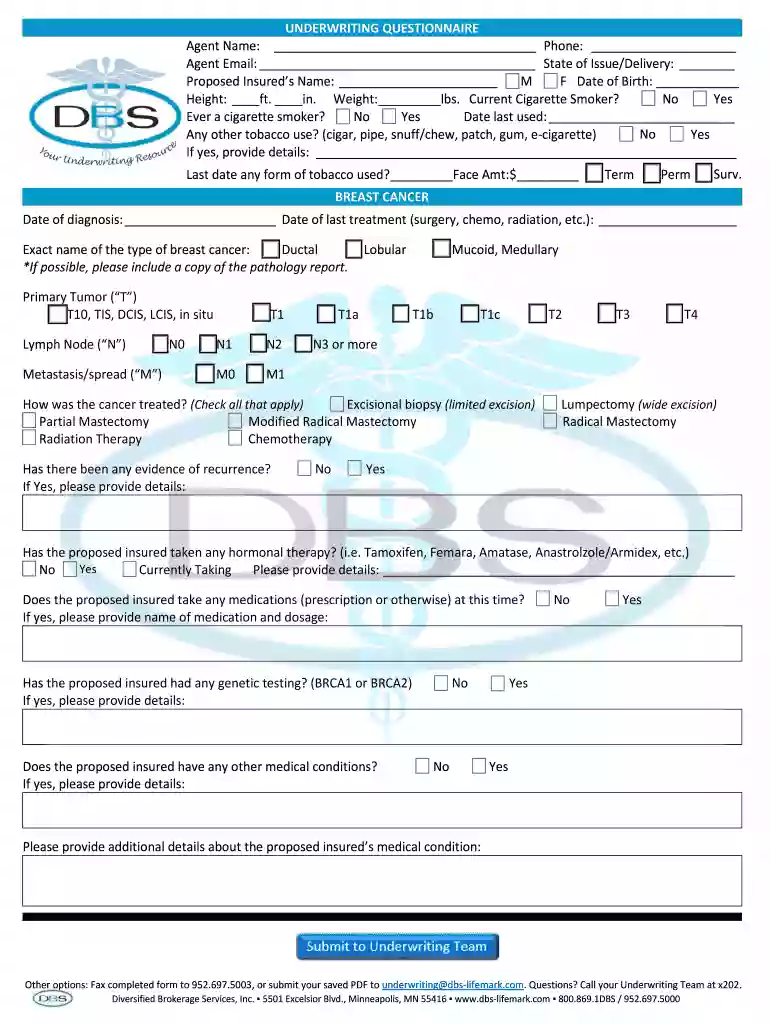
  1. Click ‘Get Form’ to open the Breast Cancer Questionnaire in our editor.
  2. Begin by entering the agent's name, phone number, and email at the top of the form. This information is crucial for communication.
  3. Fill in the proposed insured’s details, including their name, gender, date of birth, height, weight, and smoking history. Be thorough to ensure accurate assessment.
  4. In the Breast Cancer section, provide the date of diagnosis and last treatment. Specify the type of breast cancer and include any relevant pathology reports if available.
  5. Indicate how the cancer was treated by checking all applicable options. If there has been evidence of recurrence, provide detailed information.
  6. Complete any additional medical history questions regarding hormonal therapy, medications, genetic testing, and other medical conditions as necessary.
  7. Once completed, save your document and submit it via fax or email as instructed at the bottom of the form.

Empower yourself with our platform to complete your Breast Cancer Questionnaire easily and for free!

See more Breast Cancer Questionnaire - bdbsb-blifemarkbbcomb versions

We've got more versions of the Breast Cancer Questionnaire - bdbsb-blifemarkbbcomb form. Select the right Breast Cancer Questionnaire - bdbsb-blifemarkbbcomb version from the list and start editing it straight away!
Versions Form popularity Fillable & printable
2015 4 Satisfied (51 Votes)
be ready to get more

Complete this form in 5 minutes or less

Get form

Got questions?

We have answers to the most popular questions from our customers. If you can't find an answer to your question, please contact us.
Contact us
If you have a 20% lifetime risk (or higher) of developing cancer, youre considered high risk.
This is a scoring system that has been used for over a decade to calculate a persons risk of developing cancer. It gives two separate risks one for the risk of developing cancer over the next 10 years, and the risk over lifetime (until age 80).
When she didnt, they quickly went through the public, online Tyrer-Cuzick risk assessment test. A result over 20 percent is considered high risk. Munns score was 37.3 percent. Tumors were detected in both of her , confirmed via biopsies as stage 1 invasive cancer.
The Cancer Risk Assessment Tool (BCRAT), also known as The Gail Model, allows health professionals to estimate a womans risk of developing invasive cancer over the next five years and up to age 90 (lifetime risk).
BCSBQ has 12 items on womens attitudes towards general health assessment, their knowledge, attitudes, and perceptions regarding BC, and their screening practice in the area of mammography. BCSBQ items are scored using a Likert-type scale from 1 (Completely agree) to 5 (Completely disagree).

Security and compliance

At DocHub, your data security is our priority. We follow HIPAA, SOC2, GDPR, and other standards, so you can work on your documents with confidence.

Learn more
ccpa2
pci-dss
gdpr-compliance
hipaa
soc-compliance
be ready to get more

Complete this form in 5 minutes or less

Get form