01. Edit your material safety data sheet sample online
Type text, add images, blackout confidential details, add comments, highlights and more.
02. Sign it in a few clicks
Draw your signature, type it, upload its image, or use your mobile device as a signature pad.
03. Share your form with others
Send safety data sheet image via email, link, or fax. You can also download it, export it or print it out.
How to use or fill out Material Safety Data Sheet - Monopol Colors with our platform
Ease of Setup
DocHub User Ratings on G2
Ease of Use
DocHub User Ratings on G2
Click ‘Get Form’ to open the Material Safety Data Sheet - Monopol Colors in the editor.
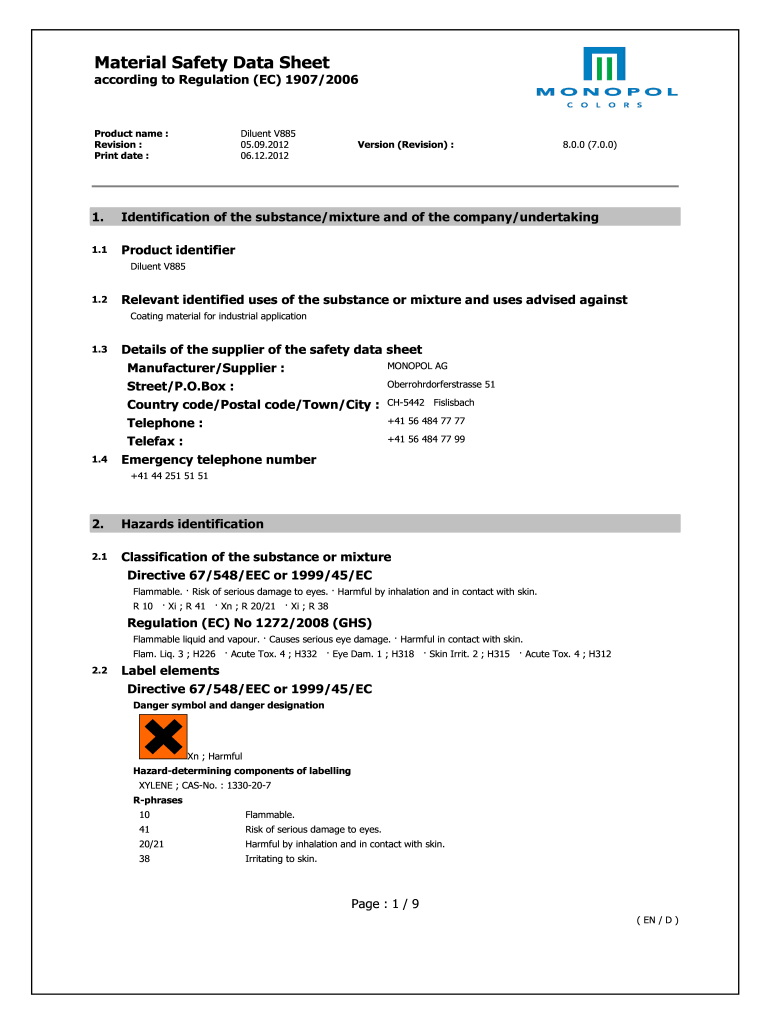
Begin by filling out the 'Identification' section. Enter the product name, Diluent V885, and ensure you include relevant details about the supplier, including their address and contact information.
Proceed to the 'Hazards Identification' section. Carefully review and input any necessary hazard classifications and precautionary statements as outlined in the document.
In the 'Composition/Information on Ingredients' section, list all hazardous components along with their respective concentrations and classifications.
Complete the 'First Aid Measures' section by detailing appropriate responses for inhalation, skin contact, eye contact, and ingestion based on provided guidelines.
Review all sections for accuracy before saving your completed form. Utilize our platform's features to easily share or print your finalized document.
Start using our platform today for free to streamline your document editing process!
Fill out Material Safety Data Sheet - Monopol Colors online It's free
See more Material Safety Data Sheet - Monopol Colors versions
We've got more versions of the Material Safety Data Sheet - Monopol Colors form. Select the right Material Safety Data Sheet - Monopol Colors version from the list and start editing it straight away!
As such, you will need an SDS for any chemical in the workplace which is defined as a hazardous chemical in accordance with the definition in section 5 of the Regulations.
What are the OSHA color codes?
DANGER - Red, or predominantly red, with lettering or symbols in a contrasting color. CAUTION - Yellow, or predominantly yellow, with lettering or symbols in a contrasting color. WARNING - Orange, or predominantly orange, with lettering or symbols in a contrasting color.
What section on a safety data sheet would you find the color and physical properties?
Section 9: Physical and Chemical Properties. This section identifies physical and chemical properties associated with the substance or mixture. The minimum required information consists of: Appearance (physical state, color, etc.)
What is the color code for chemical storage?
Many suppliers use a color coding system for chemical storage classification. All of the companies use the color red for flammability, blue for health, and yellow for reactivity as taken from the National Fire Protection Association (NFPA) color code system. Most chemical suppliers use white for contact hazard.
What is the color code for hazardous materials?
General Specific Information ElementLiquids 9(a) appearance, such as physical state and colour Applicable 9(b) odour Applicable 9(c) odour threshold Applicable 9(d) pH Applicable15 more rows
Related Searches
Material safety data sheet monopol colors pdfMaterial safety data sheet monopol colors 2022
Security and compliance
At DocHub, your data security is our priority. We follow HIPAA, SOC2, GDPR, and other standards, so you can work on your documents with confidence.
Safety Data Sheet Binder Features Bright yellow/red color scheme makes identifying the SDS binder easy.
What is the color code of MSDS file?
MSDS or chemical catalog. 9. Every container shall have a storage color (see Chemical Storage by Hazard Class below). Many container labels will have diamond or a box that is divided into color coded sections: Health (blue), Flammability (Red), Reactivity (Yellow) and Other or Corrosive (white).
Related links
The Era blue book : a universal price list and directory of
For decolorizing and purifying fine chemicals, organic acids, wines, sugar solutions, mo- lasses, ete. More efficient and cheaper than purified Bone Black orRead more
Cookie consent notice
This site uses cookies to enhance site navigation and personalize your experience.
By using this site you agree to our use of cookies as described in our Privacy Notice.
You can modify your selections by visiting our Cookie and Advertising Notice.