Posture assessment pdf 2026

Get Form
posture assessment form pdf Preview on Page 1

Here's how it works

01. Edit your posture assessment form pdf online
Type text, add images, blackout confidential details, add comments, highlights and more.

02. Sign it in a few clicks
Draw your signature, type it, upload its image, or use your mobile device as a signature pad.

03. Share your form with others
Send posture assessment pdf via email, link, or fax. You can also download it, export it or print it out.

Understanding Posture Assessment PDF

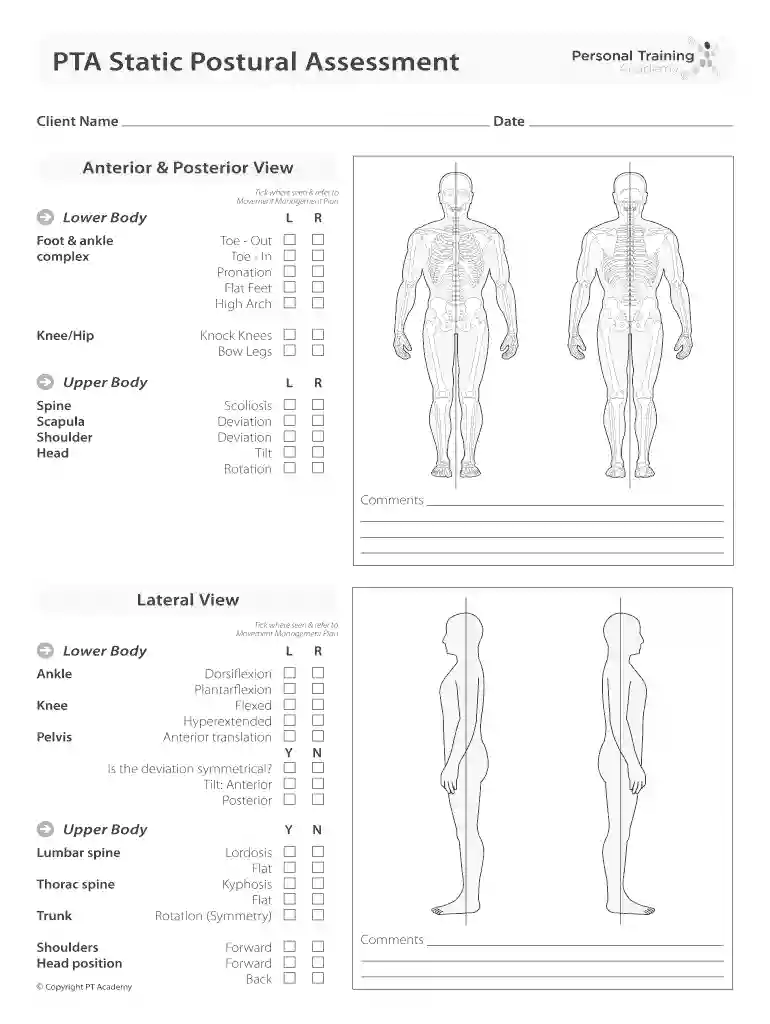
A posture assessment PDF serves as a vital tool for analyzing and evaluating an individual's posture. This document typically includes various methodologies for assessing static and dynamic postural alignment, focusing on both lower and upper body postures.

Purpose of a Posture Assessment

The primary aim of a postural assessment is to identify any deviations or imbalances in an individual's posture that may lead to discomfort or functional limitations. A thorough evaluation can help in recommending a tailored movement management plan to address these issues, promoting overall well-being.

  • Identification of Imbalances: Early detection of postural discrepancies can prevent further complications.
  • Functional Analysis: It assesses how alterations in posture affect movement during daily activities.
  • Tailored Recommendations: Generated insights can lead to personalized exercise programs and interventions.

Structure of a Posture Assessment PDF

A standard posture assessment PDF usually comprises several key components. These may include:

  • Visual Inspection Protocols: Guidelines for observing postural alignment from various angles, including anterior, posterior, and lateral views.
  • Specific Body Part Assessments: Detailed instructions for evaluating distinct regions of the body, such as:
    • Foot and ankle
    • Knee and hip
    • Spine and shoulders
  • Postural Analysis Grid Chart: A visual tool aiding in the documentation and comparison of findings.

Applications in Physical Therapy

In a physical therapy context, using a posture assessment form PDF can greatly enhance therapeutic outcomes. Practitioners utilize these assessments to:

  • Track Progress: Regular assessments provide a comprehensive way to monitor improvements or setbacks in posture over time.
  • Guide Treatment Plans: Clinical decisions can be informed by clear data derived from systematic assessments.
  • Educate Patients: Clients can better understand their bodies through informed discussions about their postural patterns.

Common Features of a Posture Assessment Form

A well-designed form typically includes:

  • Fillable Fields: Interactive elements that allow practitioners to input patient data efficiently.
  • Required Sections: Ensuring vital information is captured, such as patient history and specific complaints.
  • User-Friendly Layout: The design should facilitate easy navigation and comprehension for both the practitioner and the client.

Legal and Ethical Considerations

When conducting posture assessments, it is crucial for practitioners to adhere to relevant legal and ethical guidelines. This involves:

  • Confidentiality: Safeguarding client information is paramount under healthcare regulations.
  • Informed Consent: Clients should be made aware of the assessment's purpose and any potential risks involved.
  • Professional Standards: Practitioners should use the assessment tools as intended, ensuring accurate and unbiased evaluations.

Examples of Posture Assessment Scenarios

Real-world examples help illustrate practical applications:

  • Athletic Assessments: Coaches may utilize a posture assessment PDF to evaluate athletes' postures to prevent injuries.
  • Workplace Ergonomics: HR professionals implement assessments to promote employee wellness in office settings.
  • Rehabilitation Programs: Rehabilitation specialists frequently rely on detailed posture assessments to refine recovery strategies for their patients.

Recommendations for Practitioners

To maximize the effectiveness of posture assessments, practitioners should consider:

  • Regular Updates: Stay current with the latest research and techniques in posture analysis.
  • Customized Training: Tailor assessments to meet the specific needs of various populations, including children, seniors, or athletes.
  • Integration with Technology: Explore software solutions that can enhance the functionality and ease of obtaining posture assessment PDFs.

Utilizing a posture assessment PDF can be transformative for both practitioners and clients. Through structured analysis and documentation, it fosters a deeper understanding of individual posture-related challenges, leading to enhanced health outcomes and informed interventions.

be ready to get more

Complete this form in 5 minutes or less

Get form

Got questions?

We have answers to the most popular questions from our customers. If you can't find an answer to your question, please contact us.
Contact us
Posture Checklist Set the arch of the foot so your weight is evenly distributed. Align the second and third toe with the knees. Hips should be neutral with your rib cage tucked down. Natural spine avoid hunching, extension and reaching. The shoulders should be drawn down and back. Center your head on the shoulders.
A security posture assessment builds a baseline view of your organisations security capabilities end-to-end. The ultimate aim of such an assessment is to build maturity in the organisations cyber resilience strategy to minimise the risk of cyber-attacks and data breaches.
Postural control can be quantitatively considered by measuring the movement of the centre of mass (COM), the centre of foot pressure (COP), and body segments but also by measuring electromyographic activities and evaluations of the contribution of different sensory information.
Good posture feels effortless, which is why traditional good posture suggestions like throwing your shoulders back and sticking out your chest may feel uncomfortable too. Instead, listen to your body. Make minor adjustments while standing and sitting.
0:44 2:01 And your head to touch the wall. Without having to look up or down to get your head against the wallMoreAnd your head to touch the wall. Without having to look up or down to get your head against the wall. Another good way is if youre lying on your back. Without a pillow on a flat surface.

Security and compliance

At DocHub, your data security is our priority. We follow HIPAA, SOC2, GDPR, and other standards, so you can work on your documents with confidence.
Learn more