






Definition & Meaning
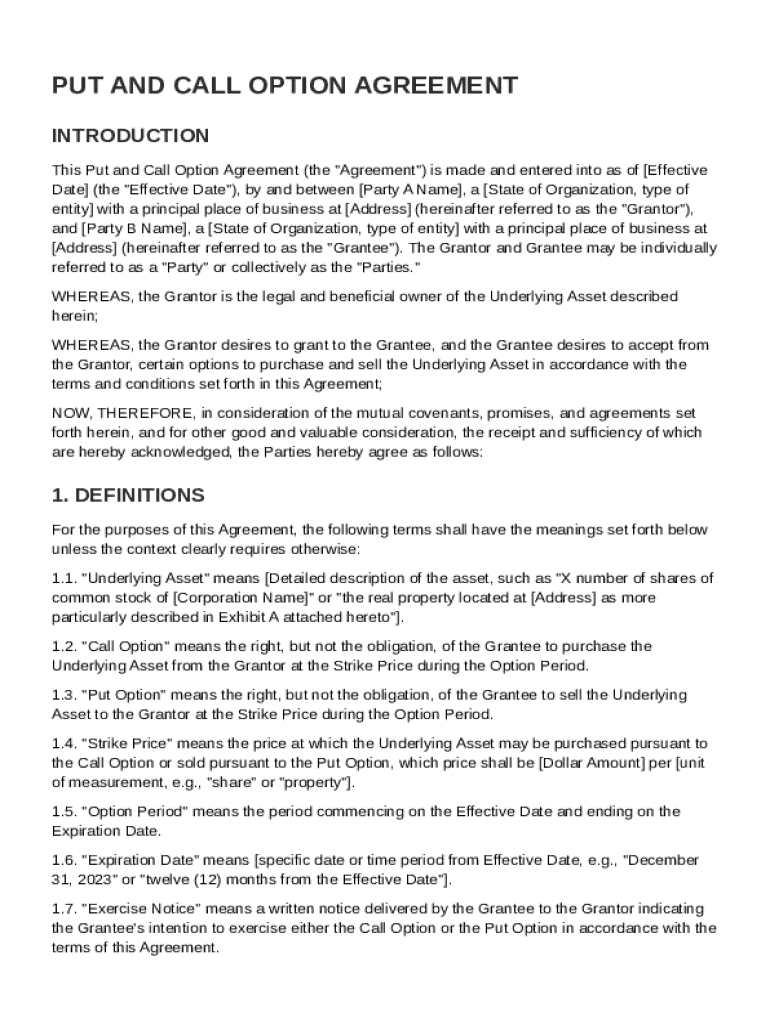
The Put and Call Option Agreement Template refers to a legal document that defines the terms under which one party, known as the Grantor, grants another party, referred to as the Grantee, options to either purchase (Call Option) or sell (Put Option) a specified underlying asset. This transaction must occur within a predetermined option period and at a set strike price. The agreement outlines essential components including definitions, execution terms, payment conditions, representations, warranties, indemnification clauses, termination conditions, governing law, and dispute resolution mechanisms. It provides a comprehensive framework to facilitate and secure the transaction.
Key Elements of the Put and Call Option Agreement Template
Underlying Asset
The agreement clearly identifies the underlying asset, which can include real estate, stocks, or any other property. Understanding the nature, value, and conditions associated with this asset is critical for both parties. This section details attributes such as asset description, condition requirements, and ownership verification.
Strike Price and Option Period
The strike price is the price at which the Grantee can execute the option. This section discusses how the strike price is determined and stipulates the exact duration, known as the option period, during which the agreement remains valid. Factors affecting these terms may include market conditions and appraisal values.
Payment Conditions
Payment conditions specify how and when financial transactions should occur. This section might include payment deadlines, acceptable forms of payment, and potential penalties for late payment. Detailed explanations clarify each party's financial obligations under the agreement.
Important Terms Related to Put and Call Option Agreement Template
Grantor and Grantee Definitions
In the context of this template, the Grantor is the party that provides the option, while the Grantee is the party that receives the option. Recognizing their roles helps both parties understand their rights and duties, contributing to smoother negotiations and compliance.
Exercising the Options
The process by which the Grantee must notify the Grantor when exercising the call or put option is detailed in this section. Clear procedures ensure that both parties have a shared understanding of how and when the options may be activated or declined.
Steps to Complete the Put and Call Option Agreement Template
-
Gather Necessary Information
- Collect all relevant details about the underlying asset, including valuations, legal descriptions, and ownership documents.
-
Define the Terms
- Set the strike price, the option period, and conditions for payment through negotiations between parties.
-
Draft the Agreement
- Fill in the template with the agreed-upon terms, ensuring every component aligns with the legal requirements and parties' expectations.
-
Review and Revise
- Both parties, often in consultation with legal counsel, should carefully review the document for accuracy, completeness, and legal compliance.
-
Finalize and Execute
- Once satisfied, both parties sign the agreement, making it legally binding and enforceable.
Legal Use of the Put and Call Option Agreement Template
The template serves as an enforceable document within U.S. jurisdiction, valid under federal law and any applicable state laws. This section discusses how various legal requirements, such as disclosures and regulatory compliance, affect the enforcement and execution of the agreement. It highlights why legal advice is often necessary to ensure the document aligns with current laws.
Examples of Using the Put and Call Option Agreement Template
Real-world scenarios illustrate how this template applies in different contexts:
-
Real Estate Transactions: A buyer leverages a call option to secure a future purchase of real estate at today’s rates, while the seller retains security through payment conditions.
-
Corporate Stock Agreements: Corporations use put options to allow shareholders to sell their stock back to the company under predetermined conditions, facilitating corporate buybacks or managing ownership stakes.
Who Typically Uses the Put and Call Option Agreement Template


Businesses and Corporations
Enterprises involved in acquisitions, mergers, or property deals frequently utilize these agreements to secure financial interests while managing risk.
Individual Investors
Investors use these agreements to lock in purchase or sale prices in volatile markets, protecting investments and planning strategically for future financial scenarios.
State-Specific Rules for the Put and Call Option Agreement Template
Each U.S. state may have unique rules and regulations that can affect the structure and application of the agreement. This section covers common variations, such as required disclosures or specific language that must be included to comply with local laws. Consult legal professionals familiar with jurisdiction-specific rules to ensure compliance.
Digital vs. Paper Version
The choice between a digital and paper version of the template can impact usability and legality. This section outlines:
-
Digital Version Advantages:
- Ease of editing and signing using platforms like DocHub.
- Enhanced storage and sharing options.
-
Paper Version Considerations:
- Traditional validity for in-person transactions.
- Preference in jurisdictions with stringent electronic signature laws.
Software Compatibility
The template is compatible with various software platforms, including TurboTax and QuickBooks, for those integrating financial documentation into larger workflows. This compatibility supports efficient document management, ensuring that all parties access and process the agreements consistently.
Each section of this response aims to provide the reader with a comprehensive and in-depth understanding of each aspect related to the Put and Call Option Agreement Template, offering practical insights and legal considerations tailored to U.S. contexts.