
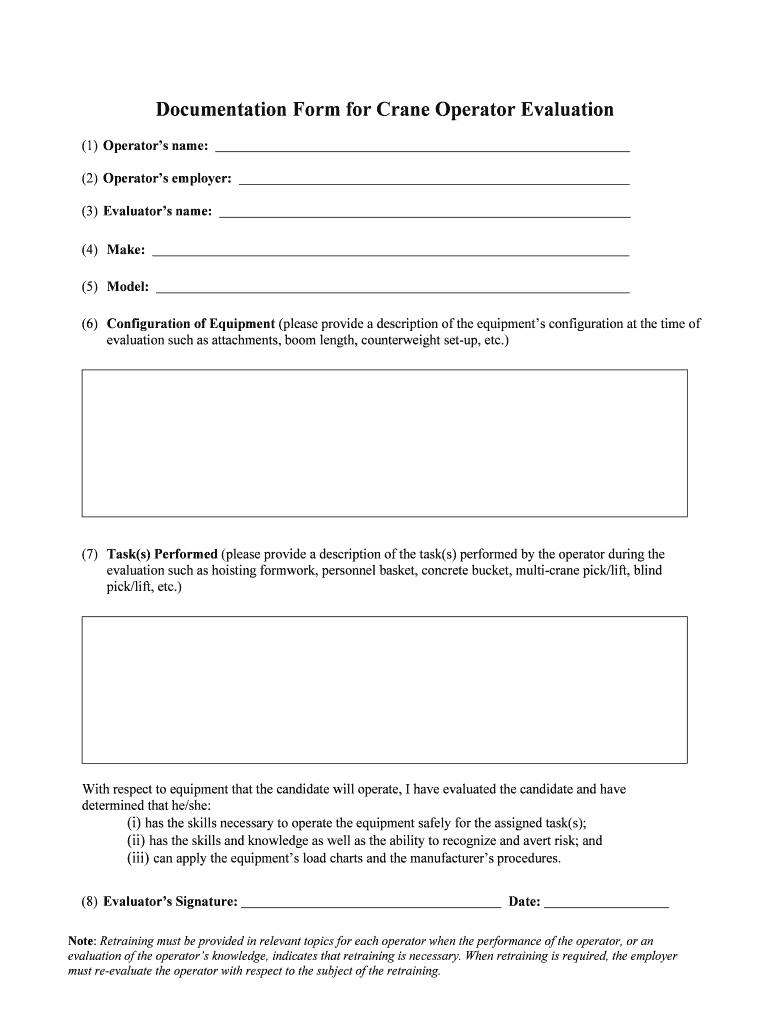







Definition & Purpose of the Crane Operator Evaluation Form
The Crane Operator Evaluation Form is a critical document used to assess the skills and competencies of crane operators. It combines various evaluative criteria into a comprehensive format, focusing on both practical abilities and safety knowledge. This form helps ensure that operators possess the necessary skills to handle crane operations efficiently and safely. The evaluation includes aspects such as equipment control, load management, and adherence to safety protocols. By utilizing this form, employers can confirm that operators are qualified to meet industry and occupational safety standards, minimizing the risk of accidents and ensuring compliance with regulations.
Importance of Accurate Evaluation
- Ensures that all crane operators have undergone a thorough assessment.
- Helps identify training needs and areas for improvement.
- Supports compliance with Occupational Safety and Health Administration (OSHA) regulations.
- Provides employers with documented proof of operator competence.
Steps to Complete the Crane Operator Evaluation Form
Filling out the Crane Operator Evaluation Form involves several straightforward steps. Here is a guide to understanding and completing this essential document.
- Collect Required Information: Ensure you have the operator's details, equipment specifics, and evaluator's credentials ready.
- Record Operator Details: Fill in the operator’s name, employer details, and contact information.
- Equipment Specifications: Enter make, model, and any specific configuration details of the crane being evaluated.
- Evaluator Information: Provide the evaluator’s name, position, and qualifications.
- Operational Assessment: Document the operator’s performance in different crane functions e.g., hoisting, swinging, traveling.
- Safety Checklist: Verify compliance with safety protocols and record observations.
- Finalize the Evaluation: Conclude with the evaluator’s remarks, recommendations, and signature.
Ensuring a Comprehensive Assessment
- Use clear and detailed descriptions for all performance metrics.
- Be consistent and objective in evaluation criteria.
- Include anecdotal evidence or scenarios observed during the assessment.
Key Elements of the Crane Operator Evaluation Form
The form is structured to cover several key elements crucial for a comprehensive operator assessment. Each section plays a significant role in evaluating the operator's capability and ensuring the safe operation of cranes.
Core Components of the Form
- Operator Information: Includes basic personal and professional details.
- Equipment Details: Specifics about the crane used during the evaluation.
- Performance Metrics: Evaluation of operational control and task execution.
- Safety Protocols: Assessment of adherence to safety measures and emergency procedures.
- Evaluator Comments: Provides space for detailed feedback and suggestions for improvement.
Additional Elements
- Checklist for Regulations: Ensures compliance with federal and state regulations.
- Training Recommendations: Suggestions for further development and training.
Who Typically Uses the Crane Operator Evaluation Form
Several stakeholders within an organization or industry rely on the Crane Operator Evaluation Form to maintain standards and ensure safety.


Primary Users
- Safety Officers: Use the form to maintain compliance with occupational safety standards.
- HR Departments: Utilize the evaluations for personnel records and training programs.
- Training Instructors: Reference the form to build targeted training sessions for operators.
Secondary Users
- Regulatory Bodies: May review evaluation forms during safety audits.
- Production Managers: Assess operator efficiency and skill levels to optimize workflow.
Legal Use of the Crane Operator Evaluation Form
The Crane Operator Evaluation Form is a legally significant document that directly impacts compliance with industry regulations.
Compliance and Regulations
- OSHA Standards: Ensures operators fulfill criteria outlined by OSHA, particularly in the construction and industrial sectors.
- Documentation for Audits: Acts as evidence of compliance during state and federal audits.
- Liability Issues: Provides legal protection by evidencing formal evaluation processes and adherence to safety protocols.
Legal Framework
- The form should be retained according to employer documents policy, typically ranging from 3 to 7 years.
- Non-compliance with the proper use of this form can lead to penalties and increased liability risks.
How to Use the Crane Operator Evaluation Form Effectively
For the form to be a useful tool in ensuring safety and competence, it must be used correctly and strategically within an organization.
Best Practices
- Consistent Application: Conduct evaluations regularly and consistently across all operators.
- Comprehensive Feedback: Provide detailed feedback to operators to promote improvement.
- Collaborative Reviews: Involve operators in review discussions to foster understanding and engagement.
Practical Applications
- Implement the form as part of a broader safety and skills certification program.
- Utilize evaluations to influence the design and implementation of continuous improvement initiatives.
Examples of Using the Crane Operator Evaluation Form
Analyzing practical scenarios where the evaluation form has been used can illustrate its real-world value.
Real-World Examples
- Construction Sites: Used to assess operator readiness before starting a new project.
- Industrial Plants: Serve as part of the annual review process for operator certification.
- Training Simulations: Utilized as a benchmark tool during training programs to measure progress and identify additional training needs.
Case Study
In an industrial plant setting, a crane operator was evaluated using the form and identified training gaps in load balancing. The evaluation led to targeted training, resulting in improved performance and a significant reduction in load mishandling incidents.
Digital vs. Paper Version of the Crane Operator Evaluation Form
Evaluators have the option to choose between digital and paper forms, each having its pros and cons.
Digital Form Advantages
- Ease of Access: Forms can be completed using mobile devices on-site, increasing efficiency.
- Automatic Archiving: Digital entries are quickly archived, reducing paper waste and manual recording errors.
- Enhanced Collaboration: Allows multiple evaluators to provide input and comments in real-time.
Paper Form Benefits
- Familiarity: Some evaluators and sites prefer the tangibility and simplicity of paper forms.
- No Dependence on Technology: Paper forms can be filled out without electronic devices, which is essential in remote areas.
Choosing the Right Format
- Consider the site's technological capabilities and the evaluators' preferences.
- Balance the need for electronic records with the practicality of existing workflows.




