






Definition and Meaning of the National Registry EMT Exam Authorization
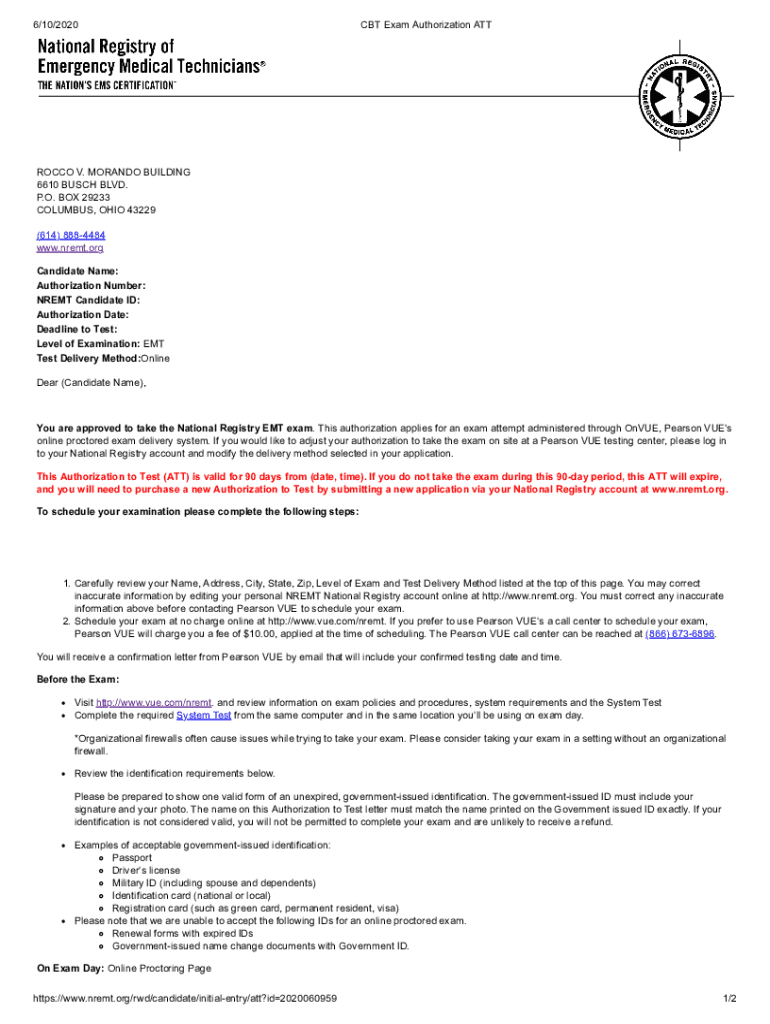
The National Registry EMT Exam Authorization is an essential credential for candidates aspiring to become Emergency Medical Technicians (EMTs) in the United States. This form serves as official permission for candidates to schedule and take the EMT certification exams administered by the National Registry of Emergency Medical Technicians (NREMT). It signifies that applicants have fulfilled the prerequisites to sit for the exam, thus progressing towards achieving recognized EMT certification.
Importance of EMT Certification
- Professional Recognition: The certification affirms that candidates meet national standards for EMTs, enhancing their professional credibility.
- Career Opportunities: Certified EMTs have broader employment opportunities in the field of emergency medical services.
- Legal Compliance: Certification ensures compliance with state and national laws governing the practice of emergency medical services.
How to Use the National Registry EMT Exam Authorization
To maximize the utility of the Exam Authorization, candidates must be adept at navigating the NREMT's procedures. Here is a step-by-step guide on utilizing the authorization effectively:
- Verification of Eligibility: Before scheduling the exam, confirm that all prerequisite courses and state requirements have been met.
- Scheduling the Exam: Use the authorization to access the NREMT's online portal and select an available test date and location.
- Exam Preparation: Utilize study materials and practice exams provided by the NREMT or other reputable sources.
- Day of the Exam: Present the Exam Authorization along with a valid ID at the testing center.
Practical Tips
- Track Deadlines: Ensure you are aware of scheduling deadlines to avoid forfeiting your exam authorization.
- State-Specific Requirements: Check for any additional state-specific requirements related to testing locations or procedures.
How to Obtain the National Registry EMT Exam Authorization
The process of obtaining the Exam Authorization is straightforward but requires careful attention to detail.
- Completion of Training Programs: Ensure successful completion of an NREMT-approved EMT training course.
- Application Submission: Fill out the online NREMT application form, providing all necessary personal and educational details.
- State Approval: Obtain state approval from the relevant EMS agency, affirming the eligibility to test.
- Payment of Fees: Pay the required examination fees to receive the authorization.
Documentation Requirements
- Proof of Training: Provide certificates of completion from recognized training programs.
- Identification Verification: Submit a valid government-issued ID.
Steps to Complete the National Registry EMT Exam Authorization
Completing the necessary preparations involves several crucial steps:
- Create an Account: Register on the NREMT website for an account to access the necessary forms and information.
- Submit Required Information: Provide detailed personal, educational, and professional information.
- Review and Confirm Application: Double-check all submitted information for accuracy before final submission.
- Await Authorization: Once the application is approved, the Exam Authorization will be issued.
Common Mistakes to Avoid
- Incomplete Applications: Missing information can delay the approval of the Exam Authorization.
- Incorrect Contact Details: Ensure all contact details are current to receive updates and authorization promptly.
Key Elements of the National Registry EMT Exam Authorization
Understanding the integral parts of the Exam Authorization facilitates a smoother examination process:
- Candidate Information: Includes name, contact details, and any relevant candidate identification numbers.
- Authorization Number: A unique number assigned to each candidate for reference.
- State Approval: Confirmation from the state EMS office that the candidate is eligible to test.
Examples of Usage
- Candidate Updates: Authorization may allow candidates to receive important updates regarding test procedures or rescheduling.
- Verification at Test Centers: Must be presented at the testing location as proof of eligibility to sit for the exam.
Who Typically Uses the National Registry EMT Exam Authorization
The Exam Authorization is primarily intended for candidates pursuing a career in emergency medical services as EMTs. It is utilized by:
- EMT Trainees: Individuals who have completed the necessary training and are ready to sit for the examination.
- EMS Instructors: Professionals who guide trainees in how to properly secure and utilize the Exam Authorization.


Demographic Factors
- Age Range: Typically used by individuals aged 18 and above, adhering to minimum age requirements for certification.
- Educational Background: Candidates often have backgrounds in healthcare or related fields.
Legal Use of the National Registry EMT Exam Authorization
The legal implications of using the Exam Authorization underscore its critical role in the EMT certification process.
- Compliance with ESIGN Act: Ensures that all electronic documents related to the authentication process are legally binding.
- Data Protection: Adheres to privacy standards to protect candidate information.
Consequences of Misuse
- Revocation of Authorization: Improper use or sharing of authorization details may lead to revocation of exam privileges.
- Legal Penalties: Misrepresentation or fraud during the application process can result in serious legal consequences.
State-Specific Rules for the National Registry EMT Exam Authorization
Regulations may vary across states, impacting how the Exam Authorization is used and validated:
- Testing Locations: States may designate specific testing centers for candidates within their jurisdiction.
- Additional Requirements: Some states might impose further educational or testing prerequisites to complement the NREMT standards.
Participating States
- California: Requires additional state certification processes post-exam.
- New York: Offers a combined state and national certification process for EMTs.
Understanding these variations helps ensure compliance and successful completion of the EMT certification process.