







Definition and Meaning
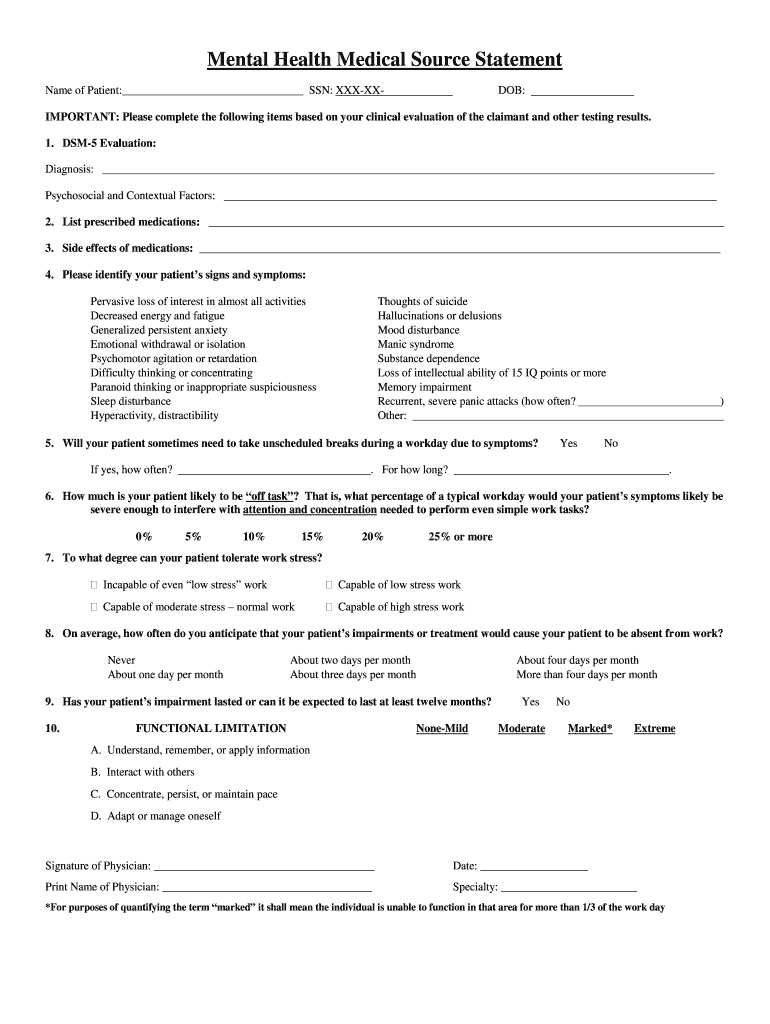
The Mental Health Medical Source Statement is a crucial document used by healthcare professionals to evaluate a patient's mental health status comprehensively. It serves as a formal assessment tool to document various aspects of a patient's mental health condition. This statement typically includes diagnosis, prescribed medications, symptoms, and any functional limitations that may affect the patient's daily activities or work capacity. It is an essential resource for conveying the patient's mental health condition in a structured format, frequently utilized in legal, occupational, and health care settings.
Key Components
The Mental Health Medical Source Statement contains several key sections that offer a full spectrum of information regarding a patient's mental health:
- DSM-5 Evaluation: This section elaborates on the patient's mental health diagnosis according to the criteria set by the Diagnostic and Statistical Manual of Mental Disorders, Fifth Edition (DSM-5).
- Medication Side Effects: Detailed information on any side effects the patient might be experiencing due to prescribed medications.
- Signs and Symptoms: A thorough list of observable mental health symptoms and problems impacting the patient.
- Work-Related Impairments: Documentation of any impairments affecting the patient's ability to work or perform job-related tasks.
- Expected Duration: This indicates how long the patient's condition is expected to last and whether it is chronic or temporary.
How to Use the Mental Health Medical Source Statement
Utilizing the Mental Health Medical Source Statement effectively requires understanding each section of the form and adhering to the intended purpose of the document. Medical practitioners, particularly psychiatrists and psychologists, fill out this form during patient evaluation sessions.
Steps for Use
- Assessment Meeting: Conduct a comprehensive assessment session with the patient to gather sufficient information.
- Complete Each Section: Methodically complete each part of the form, ensuring accuracy. Use specific criteria from the DSM-5 for the diagnosis section.
- Discuss with the Patient: Review the information with the patient to ensure transparency and accuracy.
- Verification and Signature: The practitioner must sign the form, affirming that all provided information is correct and complete.
How to Obtain the Mental Health Medical Source Statement
Obtaining the Mental Health Medical Source Statement is generally straightforward but requires certain steps, primarily from the medical professional responsible for its completion.
Where to Get the Form
- Healthcare Facility: Patients and practitioners can obtain this form from clinics, hospitals, or directly from mental health professionals.
- Online Resources: Some medical facilities provide downloadable versions of this document on their websites for ease of access.
Steps to Complete the Mental Health Medical Source Statement
Filling out the Mental Health Medical Source Statement demands attention to detail and an understanding of each section. Below are the summarized steps to complete it effectively:
- Conduct Evaluations: Carry out the necessary mental health evaluations in a clinical setting.
- Diagnosis: Use the DSM-5 to provide an accurate diagnosis of the patient's mental health condition.
- Medication Details: List any prescribed medications including observed side effects.
- Document Symptoms and Limitations: Clearly note the symptoms, their severity, and any functional limitations faced by the patient.
- Estimate Duration: Determine and record the expected duration or prognosis of the condition.
- Signature and Verification: The healthcare provider must sign the form to validate the contained information.
Why You Need the Mental Health Medical Source Statement
There are multiple reasons patients, legal professionals, and healthcare providers may require a Mental Health Medical Source Statement:
- Disability Claims: Frequently used in disability determination processes for federal and state programs.
- Employment Accommodations: Helps inform employers about the necessary accommodations for employees with mental health conditions.
- Legal Proceedings: Often required in court cases to establish mental health conditions as part of legal defenses or claims.
Who Typically Uses the Mental Health Medical Source Statement
Several groups find this document vital within various contexts:
- Healthcare Providers: Psychiatrists and psychologists primarily use this form to assess and communicate patient mental health conditions.
- Legal Professionals: Lawyers may use the statement when handling cases that involve mental health considerations.
- Insurance and Disability Assessors: This form is essential in processing claims related to mental health disabilities.


Important Terms Related to the Mental Health Medical Source Statement
Understanding key terms associated with this form is vital for accurate interpretation and application:
- DSM-5: The standard classification of mental disorders used by mental health professionals.
- Functional Limitations: Restrictions that impact a person's abilities to perform daily tasks or work functions.
- Work-Related Impairments: Specific constraints affecting a person's capacity to effectively perform their job.
- Legally Binding: Any statement or information that holds legal accountability if used in judicial or administrative processes.
Legal Use of the Mental Health Medical Source Statement
This form is often used in legal proceedings and must be handled with care to ensure proper legal compliance:
- Court Fees and Evaluations: The statement can serve as evidence in court, particularly in cases involving mental competency or capacity.
- Insurance Claims: It substantiates mental health claims with insurers for coverage or compensation.
Understanding the extensive use and necessity of the Mental Health Medical Source Statement equips stakeholders with the ability to utilize it effectively.




