



01. Edit your form online
Type text, add images, blackout confidential details, add comments, highlights and more.

Type text, add images, blackout confidential details, add comments, highlights and more.

Draw your signature, type it, upload its image, or use your mobile device as a signature pad.

Send it via email, link, or fax. You can also download it, export it or print it out.
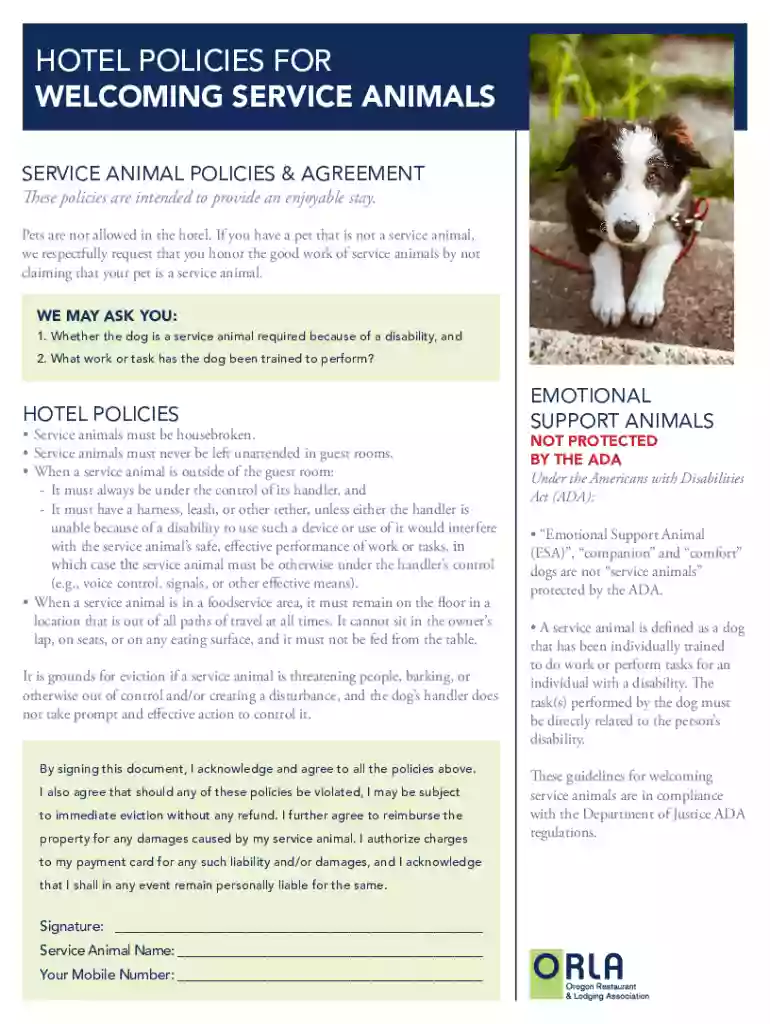
Service dogs play a crucial role in assisting individuals with disabilities, and their presence in hotels is governed by specific rules. These rules are centered around ensuring accessibility and maintaining a safe, welcoming environment for all guests. Only trained service dogs are permitted in hotels, while emotional support animals do not receive the same protections under the Americans with Disabilities Act (ADA). Hotel guests must adhere to these rules, which include controlling the service dog's behavior at all times.
When planning a stay at a hotel with a service dog, understanding and following the service dog rules is essential. These rules ensure the safety and comfort of both the service dog and other guests. Typically, travelers should inform the hotel in advance about the service dog to avoid misunderstandings upon arrival. While hotels cannot charge additional fees for service dogs, guests must ensure their service dog is well-behaved and under control at all times to prevent any disturbances.
The rules surrounding service dogs in hotels are essential to ensure that individuals with disabilities can access accommodations without facing discrimination. By establishing clear guidelines, hotels can provide an inclusive and supportive environment for all guests. These rules also protect the integrity of service animals, ensuring that they are legitimately trained to perform tasks that assist their owners.
The primary components of the service dog rules in hotels include the recognition of service dogs as working animals, not pets. This distinction is crucial, as service dogs perform specific tasks to assist individuals with disabilities. Hotels are prohibited from charging extra fees for service dogs but may have policies related to the dog's behavior and control. If a service dog disrupts or poses a threat, the hotel has the right to take appropriate action.
Understanding the legal backdrop of service dog rules helps hotel staff and guests align their actions with federal and state laws. The ADA provides comprehensive guidelines on what qualifies a service dog and outlines the rights of individuals using service dogs. Non-compliance with these rules can lead to legal repercussions for establishments.
Practical scenarios offer insight into how service dog rules are applied in real-life situations. For example, a guest with a visual impairment may rely on their guide dog for navigation within the hotel premises. Understanding these situations helps hotel staff provide necessary accommodations while ensuring that other guests are not inconvenienced.
While the ADA sets a baseline for service dog regulations, some states may have additional laws that further define or regulate the presence of service dogs in hotels. It's important for both guests and hotel staff to be aware of any state-specific rules that may affect service dog accommodations.
Understanding key terminology is crucial for comprehending service dog rules fully. Terms such as "service animal," "emotional support animal," and "task" have specific meanings under the ADA. Clarifying these terms can help differentiate between animals that qualify under the law and those that do not.
Guests staying in hotels with service dogs have certain responsibilities. These include ensuring that their service dog does not pose a threat, cleaning up after their dog, and being prepared to answer permissible inquiries about their service dog's role. Meeting these obligations helps create a harmonious environment for all guests.
Understanding these aspects of service dog rules for staying in hotels equips both guests and staff with the knowledge needed to ensure compliance and foster an inclusive environment.
At DocHub, your data security is our priority. We follow HIPAA, SOC2, GDPR, and other standards, so you can work on your documents with confidence.



Jul 20, 2015 A guest with a disability who uses a service animal must be provided the same opportunity to reserve any available room at the hotel as other
This 30-day fatality counting rule is suitable for most applications, but other fatality counting rules are sometimes needed to meet specialized requirements.


