






Definition & Meaning
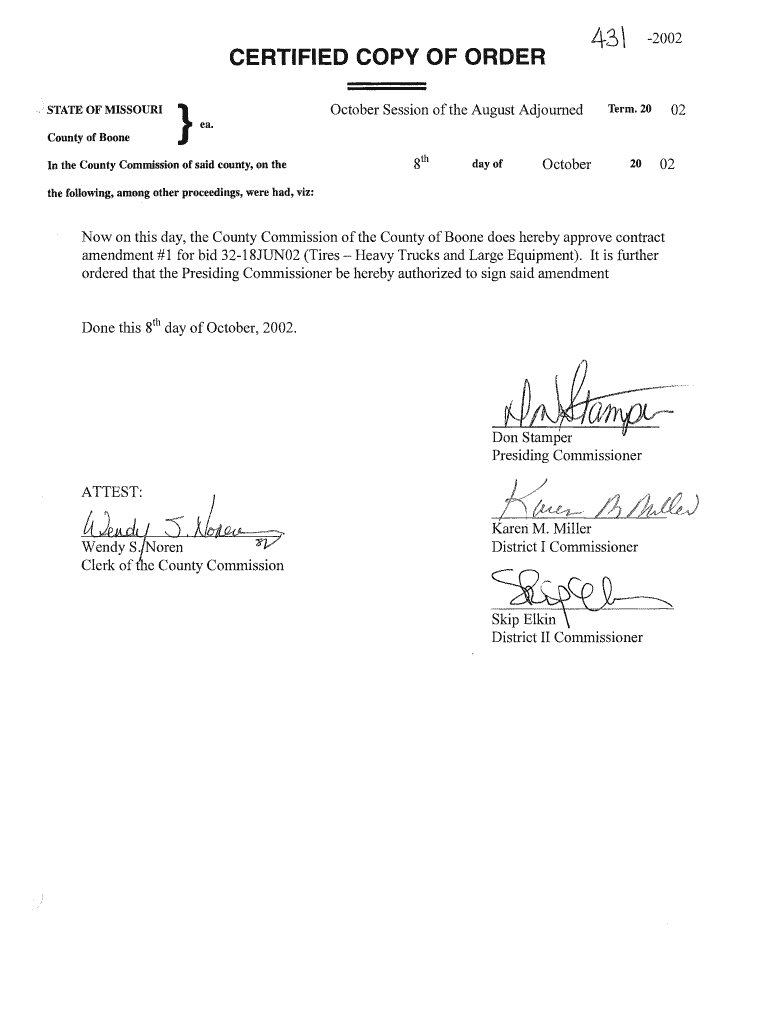
A "Certified Copy of Order" refers to an official replication of a court's ruling or directive, verified as accurate and legitimate by a court clerk or an authorized official. This document serves as legal evidence of the order's existence and contents, ensuring that parties involved have reliable documentation for legal or administrative purposes. Certified copies are crucial in maintaining the integrity and authority of court orders, which might be critical in situations like modifying custody arrangements or enforcing judgements.
Practical Use Cases
- Legal Proceedings: A certified copy is often needed when the parties involved in a legal dispute require substantiated proof of a court's decision.
- Property Matters: For instances like divorce settlements, where property division is involved, a certified copy can serve as proof of court-approved arrangements.
- Financial Transactions: Certified copies may be necessary for banks or financial institutions to confirm a court order when granting loans or altering account access as per legal directives.
How to Use the CERTIFIED COPY OF ORDER
To effectively employ a certified copy of order, individuals need to understand its purpose within various legal and administrative contexts. Using this document properly can prevent legal complications and ensure compliance with requisite processes.
Steps to Utilize
- Verify Accuracy: Ensure the copy includes all expected details such as signatures and seals to confirm authenticity.
- Present as Evidence: In court or other legal proceedings, use the certified copy to substantiate claims or actions while maintaining compliance with legal standards.
- Support Formal Requests: Provide the document when filling applications or requests where proof of a court's decision is a requirement.
How to Obtain the CERTIFIED COPY OF ORDER
Acquiring a certified copy involves a structured process where court-goers can apply either in person or via mail, depending on statutory preferences of the jurisdiction.
Steps to Obtain
- Identify the Correct Court: Start by determining which court issued the original order.
- Submit Application: Either visit the court's clerk office or use their online portal to apply for a certified copy.
- Pay Applicable Fees: A fee may be required, with costs varying by location and number of pages requested.
- Provide Identification: Valid identification most times is necessary to process the request efficiently.
- Receive Document: Once processed, the certified copy will be provided for personal collection or mailed as designated during application.
Key Elements of the CERTIFIED COPY OF ORDER
A certified copy features several elements that authenticate its legitimacy and ensure clarity for all parties reviewing the document.
Important Components
- Court Seal: The issuing court's seal must be visible to validate the document's authenticity.
- Clerk’s Signature: Includes the signature of the court clerk or an authorized official.
- Case Details: Document must contain specific case numbers, party names, and relevant details as identified by the source court order.
- Date of Issuance: Clearly stated to reflect the document's validity and applicability from the issuance date.
Why Should You Obtain a CERTIFIED COPY OF ORDER
The necessity for possessing a certified copy often arises from regulatory, personal, and financial scenarios where legal documentation must corroborate a statement or action.
Benefits
- Legal Assurance: Provides indisputable evidence of a court's decision.
- Administrative Compliance: Ensures compliance with legal standards requiring documented proof for administrative processes.
- Personal Security: Grants peace of mind knowing one holds court-verified documentation if disputes arise.
Legal Use of the CERTIFIED COPY OF ORDER
In legal circles, certified copies are critical due to their authoritativeness and ability to prevent issues related to order misinterpretation or refusal of recognition.
Common Legal Scenarios
- Judicial Appeals: Needed for appeals to substantiate original rulings.
- Dispute Resolution: Utilized to resolve disputes when there are contentions about order terms.
- Enforcement Actions: Enabling law enforcement task execution by confirming legal directives.
Examples of Using the CERTIFIED COPY OF ORDER
Numerous scenarios exist where a certified copy holds substantial value for both individuals and businesses in demonstrating compliance with a court order.
Real-life Instances
- Family Law: Courts often require certified copies for agreements related to child custody or support.
- Estate Settlements: Executors need certified copies to manage contentious estate divisions legally.
- Business Compliance: Companies utilize certified copies to comply with legal mandates affecting business transactions and partnerships.
Form Submission Methods (Online / Mail / In-Person)
The process for submitting a request for a certified copy is flexible, allowing for online, mail, and in-person methods, each providing its unique efficiencies.
Online Submissions
- Convenience: Facilitates application submissions from home, streamlining the request process.
- Status Tracking: Allows for real-time status updates on application progress.
Mail Requests
- Written Records: Maintains a tangible paper trail, advantageous for audits or verifications.
- Broad Access: Ensures availability for individuals without easy internet access.
In-Person Visits
- Direct Interaction: Permits immediate resolution of queries or issues with court officials.
- Immediate Receipt: Potentially faster access to the document for urgent needs.