



01. Edit your form online
Type text, add images, blackout confidential details, add comments, highlights and more.

Type text, add images, blackout confidential details, add comments, highlights and more.

Draw your signature, type it, upload its image, or use your mobile device as a signature pad.

Send it via email, link, or fax. You can also download it, export it or print it out.
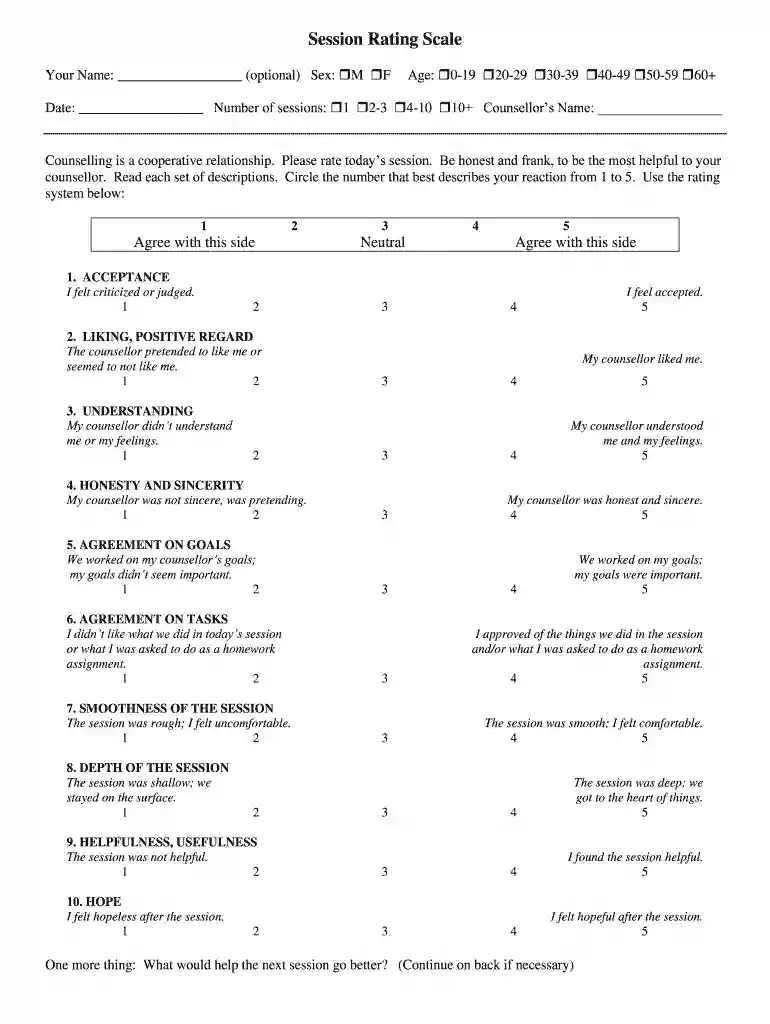
The Session Rating Scale Manual - Dr. Lynn Johnson is a structured form used by clients to provide feedback on their counseling sessions. It features a set of statements related to key aspects such as acceptance, understanding, honesty, goal alignment, session fluidity, and hopefulness. Typically evaluated on a scale from one to five, the feedback collected helps in assessing the efficacy of sessions and in tailoring future counseling to better meet the needs of clients. This document serves as a tool for enhancing communication between the client and their counselor.
Using the Session Rating Scale Manual involves following specific steps to ensure accurate and meaningful feedback. Clients are asked to consider different aspects of their session, such as their sense of being understood and the helpfulness of the session. They then provide ratings that reflect their experiences. Counselors use this feedback to adjust their approach, address any issues, and optimize the effectiveness of future sessions. This scale is an important part of maintaining an informed and responsive counseling process.
To obtain the Session Rating Scale Manual - Dr. Lynn Johnson, individuals often need to access it through specific channels. Typically, it's provided by the counseling service, either in print or digital format. It can also be accessed through professional counseling organizations who incorporate this tool into their standard practices. If it is not readily available, you may contact your counselor or counseling agency for a copy.
The effectiveness of this manual lies in its structured elements, each designed to elicit critical feedback:
The primary users of The Session Rating Scale Manual are counseling professionals and their clients. This tool is widely utilized in therapeutic settings to enhance communication and improve the quality of counseling services. Counselors use the feedback to refine their techniques, while clients benefit from more tailored and effective counseling experiences. The scale is versatile and suitable across different counseling settings, including individual therapy, family counseling, and group sessions.

While the manual is not a legal document, its use in counseling must adhere to applicable laws regarding privacy and data protection, particularly those concerning client confidentiality and data handling under regulations such as HIPAA. Counselors must ensure that all feedback is collected and stored in compliance with these legal standards, protecting the client’s sensitive information while using the feedback to improve service delivery.
The Session Rating Scale Manual can be utilized in both digital and paper formats. The choice between digital and paper often depends on the preference of the counselor and the infrastructure of the counseling service. Digital versions offer easy distribution and collection, and often integrate directly into client management software, allowing quick analysis and feedback loops. Paper versions remain popular for their simplicity and ease of use during in-person sessions.
Consider a scenario where a counselor has engaged with a new client. After a few sessions, the counselor administers the Session Rating Scale Manual. The client rates their sessions, highlighting a high understanding but a lower goal agreement. Based on this feedback, the counselor works with the client to revisit and clarify treatment goals. In another case study, a counselor uses the manual after each session to understand ongoing client satisfaction, leading to continuous improvement of counseling techniques and strategies.
At DocHub, your data security is our priority. We follow HIPAA, SOC2, GDPR, and other standards, so you can work on your documents with confidence.
May 17, 2017 I am here to discuss the FDA Safety Communication and CDCs Health Alert regarding blood testing, issued earlier today. Im joined by Dr. Jeff
by TL Fresquez 2017 The Session. Rating Scale Version 3.0 (SRS V.3) was developed by Lynn D. Johnson, Scott D. Miller and. Barry L. Duncan in 2000 as an ultra-brief alliance


