







Definition & Meaning
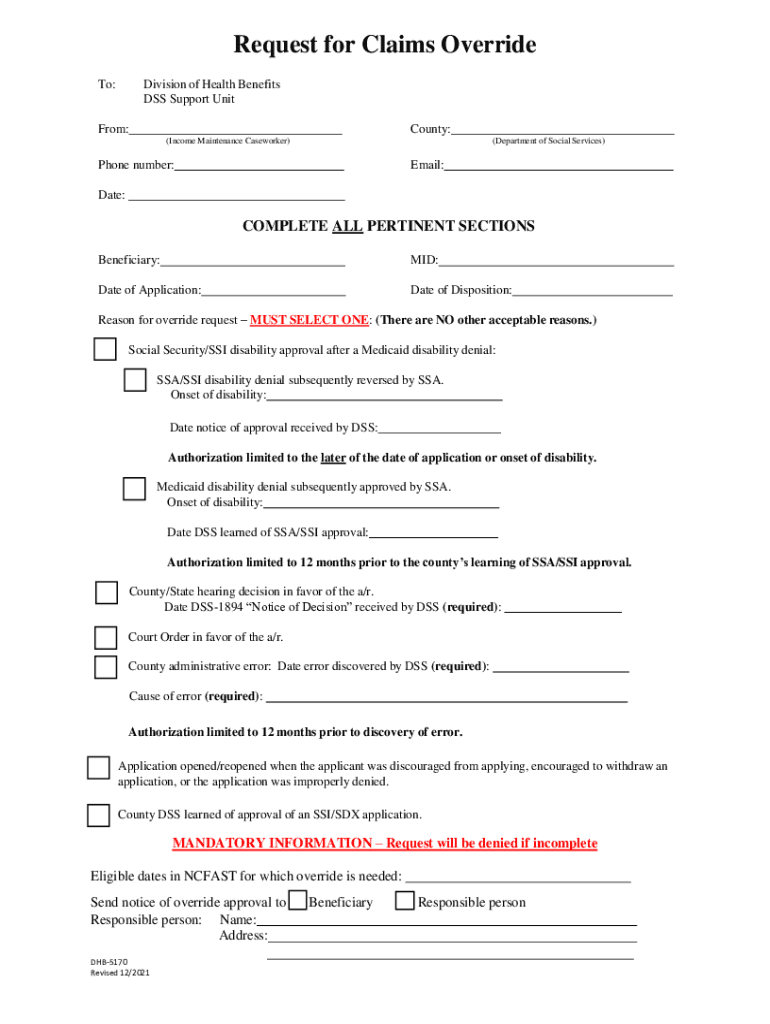
A "Request for Claims Override" is a formal document submitted to the Division of Health Benefits by an Income Maintenance Caseworker from the Department of Social Services. This form is used to request changes or exceptions to standard claims processing procedures due to specific circumstances. These circumstances can include Social Security disability approvals, county administrative errors, or other acceptable reasons. The document is essential for addressing unique situations that standard processes cannot accommodate, ensuring that claims are handled fairly and accurately.
- Purpose: To provide a mechanism for adapting claims processing to account for exceptional situations.
- Common Reasons: Includes approval of Social Security disability, administrative errors, or other predefined criteria.
- Key Participants: Typically involves Income Maintenance Caseworkers, health benefit administrators, and impacted individuals.
How to Use the Request for Claims Override
Understanding how to use this form effectively is crucial for ensuring accurate processing and resolution of claims.
-
Identify the Need: Determine if an override is necessary by assessing whether standard claims processes do not apply due to unique or extraordinary circumstances.
-
Gather Information: Accumulate all relevant documents and information related to the reason for the override request, such as Social Security disability determinations or error documentation.
-
Complete the Form: Fill out the form with mandatory fields, providing detailed information about the claim and the reasons for the requested override.
-
Review and Submit: Double-check the form for accuracy and completeness before submission to avoid delays.
-
Follow Up: Once submitted, track the request to ensure timely review and action by the relevant authorities.
- Signatures Required: Ensure all necessary parties have signed the document.
- Approval Process: Understand the criteria used by approving authorities to make informed decisions about the request.
How to Obtain the Request for Claims Override
Acquiring the Request for Claims Override involves specific steps to ensure the appropriate form is used for the intended purpose.
- Department of Social Services: Contact the local Department of Social Services for guidance on obtaining the form.
- Online Resources: Check if the form is available for download from official government or department websites.
- Direct Assistance: Request assistance from a caseworker if there is difficulty accessing the form independently.
Steps to Complete the Request for Claims Override
Completing the Request for Claims Override involves meticulous attention to detail to ensure all information is accurately and thoroughly represented.
- Access the Form: Obtain a copy of the form through the appropriate channels.
- Mandatory Information: Fill out all required sections, which typically include claimant details, the specific override reason, and supporting evidence.
- Attach Documents: Include necessary documentation that supports the request, such as proof of Social Security approval or records of administrative errors.
- Review for Completeness: Ensure no required fields are left blank and that all entered information is correct.
- Submit for Approval: Provide the completed form to the appropriate division or individual as directed.
- Signatures: Obtain necessary signatures from relevant parties.
- Double-Check Documentation: Confirm that all required supporting documents are attached.
Why Should You Request a Claims Override
Requesting a Claims Override is often necessary when standard procedures inadequately address specific situations, potentially impacting benefits eligibility or processing.
- Ensure Fair Processing: Overrides can correct or adapt processes that may otherwise result in unfair or incorrect claims handling.
- Address Errors: Provides a corrective mechanism for resolving errors, such as administrative mistakes or incorrect data handling.
- Secure Benefits: Ensures that individuals receive the correct benefits or approvals to which they are entitled under exceptional circumstances.
Who Typically Uses the Request for Claims Override
The primary users of the Request for Claims Override form are individuals and professionals involved in claims processing within the health benefits domain.
- Income Maintenance Caseworkers: Responsible for submitting requests on behalf of claimants when needed.
- Social Services Departments: Handle and process forms to ensure claims are accurately adjusted for extraordinary circumstances.
- Claimants: May initiate a request in collaboration with caseworkers to address personal claims issues.

Important Terms Related to Request for Claims Override
Understanding key terms associated with the Request for Claims Override can facilitate its use and comprehension.
- Override: An exception to standard procedure due to qualifying conditions.
- Claimant: The individual whose claim is under consideration for an override.
- Administrative Error: Mistakes made during the processing or handling of claims that may justify an override request.
Key Elements of the Request for Claims Override
The Request for Claims Override comprises several critical components that must be completed accurately.
- Claim Information: Details about the original claim, including dates, amounts, and relevant identifiers.
- Reason for Override: A clear, documented reason for requesting the override, supported by evidence.
- Supporting Documentation: Attachments that substantiate the claim for an override, such as letters, official notices, or prior approvals.
State-Specific Rules for the Request for Claims Override
Different states may have varying requirements and processes for dealing with claims overrides, making it essential to understand and comply with local regulations.
- Local Guidelines: Check state-specific rules that may affect eligibility or the submission process for claims overrides.
- Adaptations: Be aware of any adaptations necessary for complying with local claims handling laws and policies.
Understanding and utilizing the Request for Claims Override correctly can significantly impact the handling and outcome of claims under special circumstances, ensuring benefits are administered fairly and accurately.




