




01. Edit your form online
Type text, add images, blackout confidential details, add comments, highlights and more.

Type text, add images, blackout confidential details, add comments, highlights and more.

Draw your signature, type it, upload its image, or use your mobile device as a signature pad.

Send it via email, link, or fax. You can also download it, export it or print it out.
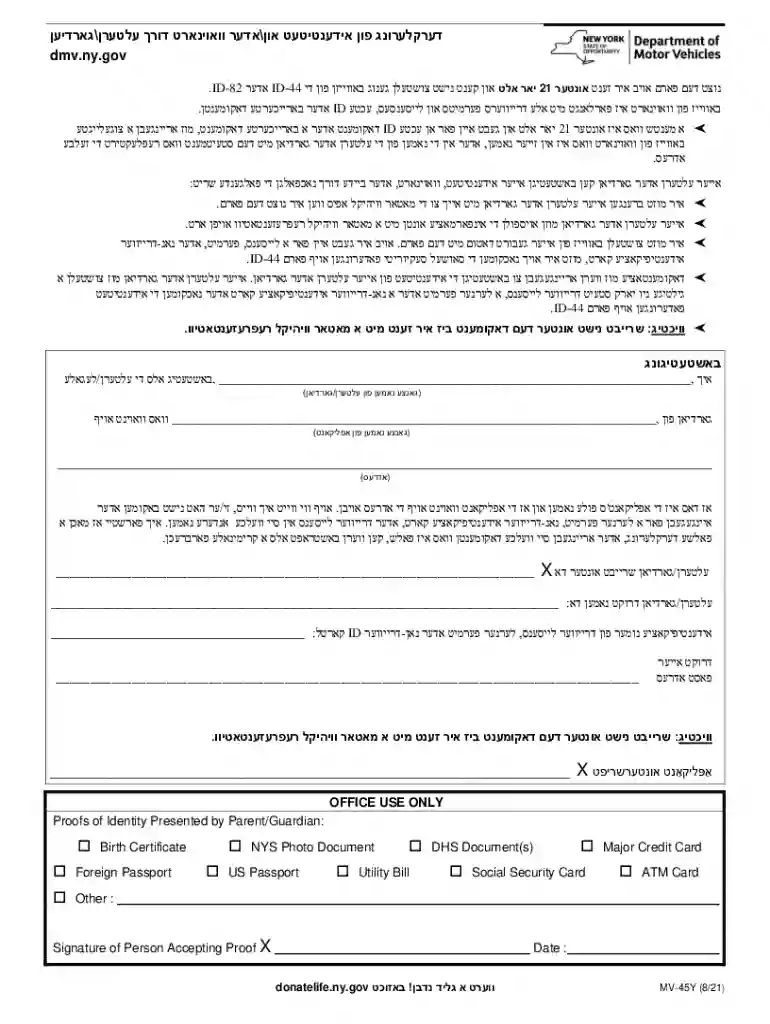
Proofs of identity refer to the documents required by the New York Department of Motor Vehicles (DMV) to verify an individual's identity, age, and residency. These documents are crucial for various DMV transactions, including applying for or renewing a driver's license, learner's permit, or state identification card. In the context of New York, these proofs must comply with both state-specific requirements and federal regulations, particularly for REAL ID compliance. Understanding what constitutes valid proofs of identity in New York is essential for a smooth and successful DMV application process.
To utilize the proofs of identity effectively, applicants must present original or certified copies of documents that validate their identity. When visiting a DMV office, individuals should ensure they carry the appropriate documents that meet the required point system used by the New York DMV. Common documents include a valid passport, birth certificate, and Social Security card. Each document is assigned a specific point value, and applicants must accumulate a certain number to verify their identity. It is vital to review the list of acceptable documents and their corresponding point values before visiting a DMV office to avoid delays or rejections.
The New York DMV requires applicants to provide a combination of documents to prove their identity and residency. These typically include:
It is important to ensure each document is current and matches the individual's current legal name.
New York State has specific rules for what constitutes acceptable proof of identity and residency. For instance, high school students might use a high school diploma or transcript as part of their documentation. The state also offers specific guidelines for individuals under 21, who can verify residency through a parent or guardian's documentation. Understanding these nuances can prevent unnecessary frustrations during the DMV application process.
The documents provided as proofs of identity for the New York DMV are legally binding for all DMV transactions. They serve as the foundation for issuing identification documents that comply with state and federal regulations. These IDs can be used for voting, travel (in the case of REAL ID-compliant licenses), and other legal verifications requiring government-issued identification. Ensuring the authenticity and accuracy of these documents is crucial for maintaining their legal integrity.
Proofs of identity are typically used by individuals who are:
Failure to provide adequate proofs of identity can result in the denial of DMV services. Attempting to use fraudulent documents is a serious offense and can lead to legal repercussions, including fines and potential criminal charges. It is critical to adhere to DMV guidelines to avoid such penalties.
At DocHub, your data security is our priority. We follow HIPAA, SOC2, GDPR, and other standards, so you can work on your documents with confidence.



by USMPID Card Cited by 4 The documents you submit to prove your name must have a total point value of 6 points. A New York State photo driver license, learner permit, or non-driver ID
You can apply for a non-driver photo ID card ; Apply for a Learners Permit. Take a written test about the rules of the road, NYS Drivers Manual ; If you are not
May 23, 2025 Requires proof of surgery to change sex designation. New York, X available on birth certificates since 2019. Allows people to change sex


