




01. Edit your form online
Type text, add images, blackout confidential details, add comments, highlights and more.

Type text, add images, blackout confidential details, add comments, highlights and more.

Draw your signature, type it, upload its image, or use your mobile device as a signature pad.

Send it via email, link, or fax. You can also download it, export it or print it out.
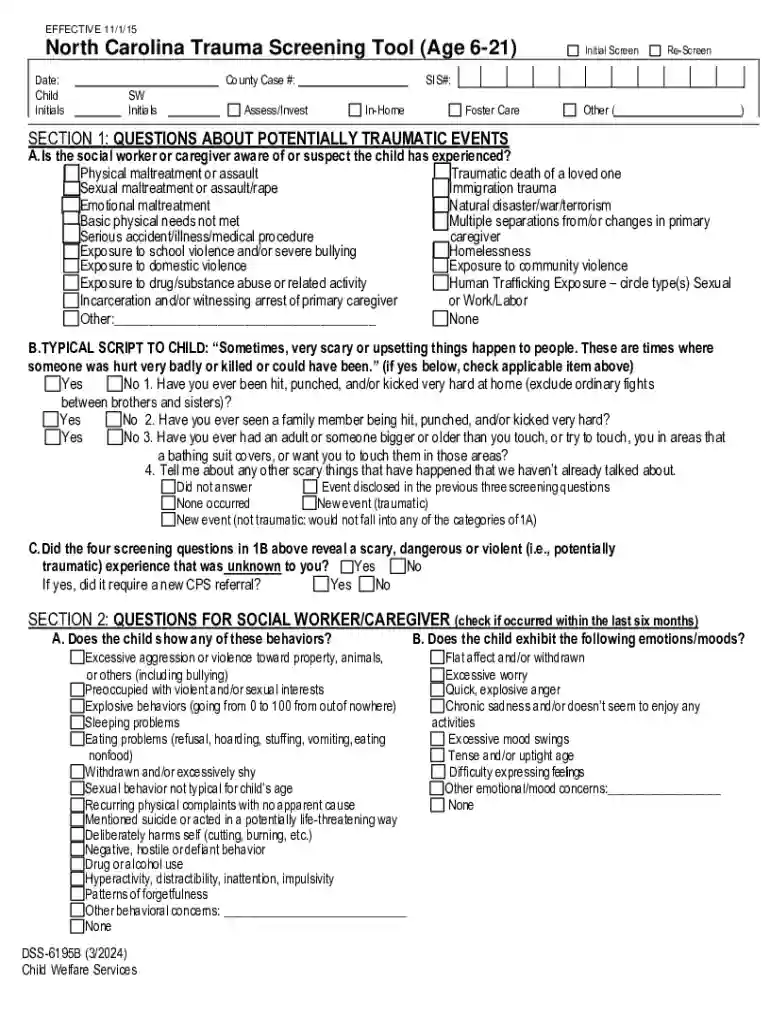
The North Carolina Trauma Screening Tool, designed for children aged six to 21, is an important resource to help identify exposure to trauma and assess related symptoms. Its primary aim is to evaluate potentially traumatic events that children may have experienced. This assessment focuses on the children's emotional and behavioral responses, helping social workers, caregivers, and mental health professionals determine if further trauma-informed mental health assessments are needed. This tool is a structured approach that enables early identification of trauma-related issues, ensuring that affected children receive appropriate support and interventions to improve their mental health outcomes.
Understanding the significance of the North Carolina Trauma Screening Tool is fundamental for professionals working with children. The tool is vital because it helps to:
Consider a scenario where a social worker uses the tool in a school setting. They can identify students who may not show blatant signs of distress but who have underlying trauma that affects their performance and behavior. By using the tool, these students can receive the support they need to succeed academically and socially.
Completing the North Carolina Trauma Screening Tool involves several steps that ensure a comprehensive assessment:
A social worker administering the tool may notice that a child's responses indicate significant stress related to a recent parental separation. Acting on this finding, the social worker could refer the child to a counselor specializing in family dynamics and trauma.
The North Carolina Trauma Screening Tool comprises several crucial elements designed to capture comprehensive data:
This tool is predominantly used by professionals involved in the welfare and mental health of children:


In a school setting, counselors may use the tool as part of routine health assessments to ensure no child at risk goes unnoticed. In healthcare, pediatricians might use it to corroborate findings during routine well-child visits where behavioral concerns arise.
The use of the North Carolina Trauma Screening Tool must adhere to particular legal and ethical guidelines to ensure children's rights and privacy are protected:
Ethical practice mandates that professionals use the tool devoid of bias, ensuring that personal beliefs or prejudices do not influence the assessment outcomes. Additionally, professionals should engage in continuous learning about trauma and its presentation in various populations to improve the quality of care delivered.
Professionals seeking to utilize the North Carolina Trauma Screening Tool can access it through various reputable sources:
When accessing the tool, ensure to verify its authenticity and make sure it aligns with the legal requirements for your jurisdiction. Consider attending workshops to become proficient in its application and interpretation to provide the most accurate and beneficial support to the children assessed.
At DocHub, your data security is our priority. We follow HIPAA, SOC2, GDPR, and other standards, so you can work on your documents with confidence.



Feb 12, 2016 Several programs used the Food Sovereignty Assessment Tool developed by the First Nations Development Institute (70). Community-driven
Project Broadcast Trauma Screening Tool (Under Age 6) Initial Screen Re-Screen To non NC-CTP rostered clinician for trauma-informed mental health assessment.
The tool screens for trauma exposure (Section 1) and symptoms (Section 2). If both sections have items checked, a child should be referred for a trauma-


