
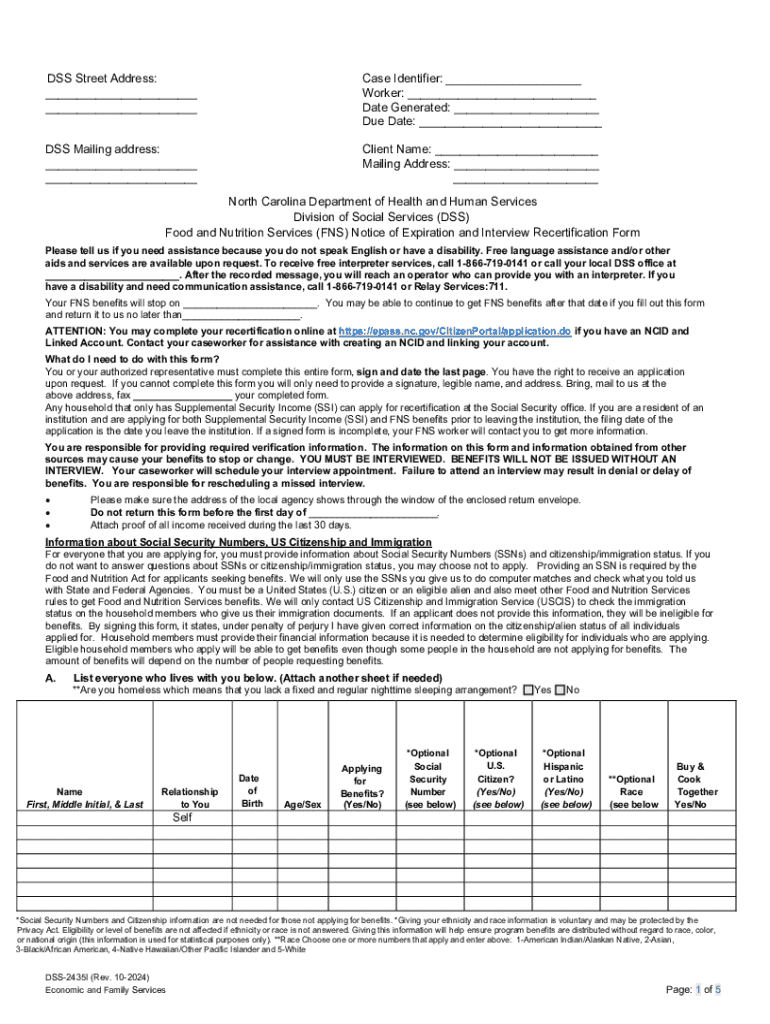







Definition and Purpose of DSS Contact InformationNCDHHS
The DSS Contact InformationNCDHHS form is a vital document utilized by the North Carolina Department of Health and Human Services. It serves as a centralized resource for individuals and families seeking assistance or information regarding services provided by the Department of Social Services (DSS). This form is essential for understanding the various social service programs available and for facilitating direct communication with relevant departments.
Common Use Cases
The DSS Contact InformationNCDHHS form is used by individuals who need to contact their local DSS office for several reasons:
- Inquiry about eligibility and application status for social service programs.
- Reporting changes in household circumstances or income.
- Requesting assistance with documentation or appointment scheduling.
- Accessing emergency services like food or housing support.
Key Benefits
- Streamlined Communication: Provides clear contact details to help residents efficiently reach the appropriate DSS office.
- Comprehensive Information: Offers a wide range of department contacts, ensuring that inquiries are directed to specialized service areas for quicker responses.
How to Use the DSS Contact InformationNCDHHS
Using the DSS Contact InformationNCDHHS form is straightforward. The primary function is to assist users in identifying and reaching out to the correct office based on their specific needs.
-
Identify Your Requirement: Determine the type of assistance or information you require—for example, food assistance, Medicaid, or child protective services.
-
Locate Appropriate Section: Use the form to find relevant contact details. It is usually organized by service type, ensuring direct access to the needed department.
-
Prepare Contact Information: Note down addresses, phone numbers, or email contacts provided for easy reference when initiating contact.
Accessibility Features
- Multilingual Options: In most cases, the form includes information in multiple languages to cater to non-English speakers.
- Alternate Contact Methods: Includes phone, email, and physical address options to accommodate different preferences and abilities.
Steps to Complete the DSS Contact InformationNCDHHS
Completing any required information on the DSS Contact InformationNCDHHS involves ensuring that the form is entirely filled to aid the Department in processing inquiries effectively.
-
Personal Details: Ensure that your personal information is entered accurately if requested, such as name, address, and contact info.
-
Service Type Identification: Clearly identify your need and find the correct section on the form. This ensures that your inquiry or application is directed efficiently.
-
Additional Information: Provide supporting details—a brief explanation of your needs can help DSS prioritize and expedite assistance.
Who Typically Uses the DSS Contact InformationNCDHHS
The form is primarily targeted towards residents of North Carolina who need to understand or access the services provided by the DSS. This includes but is not limited to:
- Families applying for child care assistance or educational support.
- Individuals seeking healthcare through programs like Medicaid.
- Seniors and disabled persons looking for specialized care or resources.


Outreach Groups
- Community Organizations: Often use the form to support residents in accessing public welfare services.
- Healthcare Providers: Facilitate client referrals to appropriate DSS services.
Legal Use and Compliance of the DSS Contact InformationNCDHHS
Using the DSS Contact InformationNCDHHS must comply with privacy and confidentiality laws. Users should be aware of:
- Data Privacy: Personal information should be handled according to state regulations regarding data protection.
- Consent Requirements: Ensure informed consent when providing or sharing personal details.
Important Considerations
- Compliance with federal and state regulations, such as the Health Insurance Portability and Accountability Act (HIPAA), when accessing or sharing health-related information.
- Understand that improper use of contact information for non-intended purposes can result in penalties.
Important Terms Relating to DSS Contact InformationNCDHHS
Understanding key terminology used in the form can aid in its effective use:
- Eligibility: Defines who qualifies for certain services based on criteria such as income or family size.
- Verification: Involves documentation required to prove identity or circumstance changes for benefit adjustments.
Examples of Key Terms in Context
- Caseworker: A professional assigned to help clients navigate services, whose contact information might be provided on the form for specific programs.
- Benefit Renewal: A process that might necessitate contacting DSS for ongoing support confirmation.
Examples of Using the DSS Contact InformationNCDHHS
The form provides practical examples of how to engage with DSS units effectively:
-
Renewing Benefits: Katie needs to renew her Food and Nutrition Services benefits. She uses the form to contact her local DSS office to schedule an interview and verify required documents.
-
Emergency Assistance: A family displaced by a natural disaster uses the form to find emergency housing resources, directly connecting with the appropriate DSS department.
Real-World Scenario
- Healthcare Access: Mark, a recent transplant to North Carolina, finds the contact for local Medicaid assistance using the form, facilitating the transition of his healthcare benefits.
Form Submission Methods for DSS Contact InformationNCDHHS
While this document primarily serves contact purposes rather than direct submissions, related communications can often be conducted online, by mail, or in person. Understanding these methods enhances accessibility:
- Online: Many queries can be initiated via state-operated platforms or emails listed on the form.
- Mail: Some interactions may require documentation submission via traditional mail.
- In-Person Visits: Certain services or complex queries might necessitate face-to-face interaction for resolution.
Accessibility Considerations
- Ensuring flexible submission approaches supports various user needs, such as those without internet access who may prefer mail or in-person visits.
Required Documentation when Using DSS Contact InformationNCDHHS
While the form itself does not require submission, contacting DSS for services often necessitates documentation:
- Identity Verification: Government-issued ID or birth certificate copies.
- Proof of Residence: Utility bills or lease agreements to confirm address.
- Income Statements: Recent pay stubs or tax returns for financial assistance applications.
Contextual Use
- Use required documentation to prepare for meetings or calls effectively, enabling smoother processing of benefits or information requests.
Selecting and elaborating on these topics ensures comprehensive coverage relevant to DSS Contact InformationNCDHHS, providing a detailed, insightful guide for users navigating this essential resource.




