



01. Edit your form online
Type text, add images, blackout confidential details, add comments, highlights and more.

Type text, add images, blackout confidential details, add comments, highlights and more.

Draw your signature, type it, upload its image, or use your mobile device as a signature pad.

Send it via email, link, or fax. You can also download it, export it or print it out.
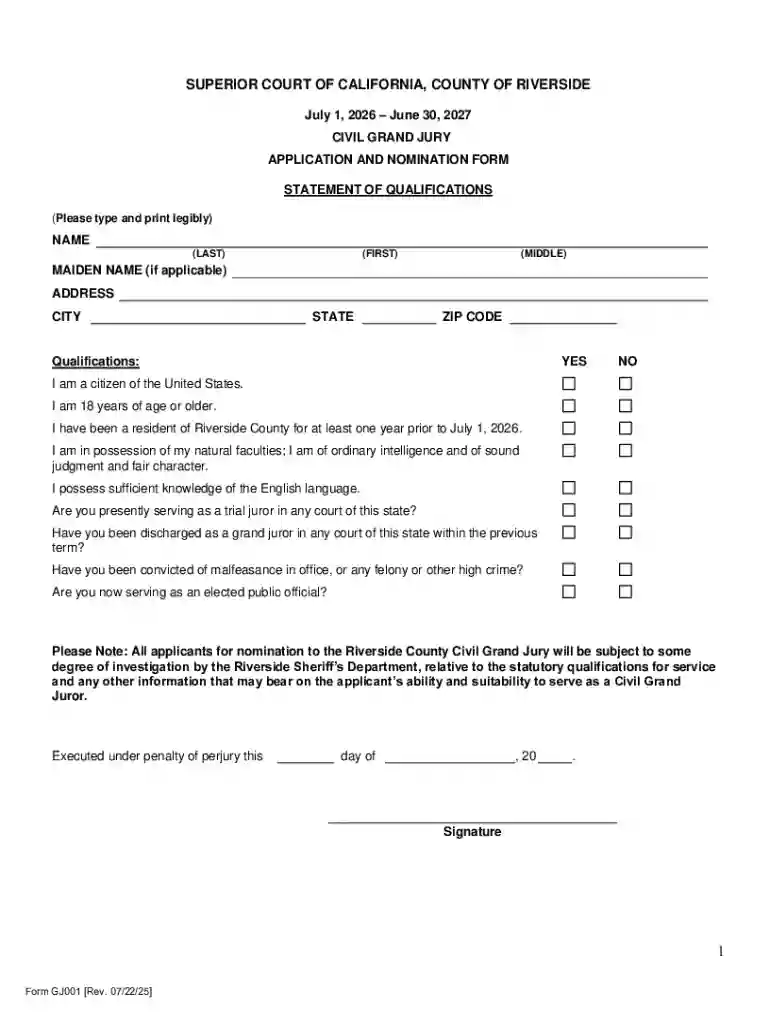
The Civil Grand Jury Application and Nomination Form is an essential document for individuals seeking to participate as jurors in the civil grand jury system. This form serves as the gateway for potential jurors to express their interest in serving on a panel that investigates governmental operations within a particular jurisdiction. It is designed to gather comprehensive information from applicants, including personal, professional, and demographic details, ensuring that nominees meet the specific qualifications required for jury service. The overarching goal of this form is to maintain an unbiased and representative pool of jurors tasked with oversight and evaluation duties.
To serve on the civil grand jury, applicants must meet several criteria outlined in the form. Prospective jurors must be U.S. citizens, be at least eighteen years old, and possess adequate proficiency in the English language to fulfill juror duties effectively. Additionally, they must have been residents of the county for a specified duration, usually one year, and must not have any felony convictions or conflicts of interest that could compromise their ability to serve impartially. These criteria ensure that the jury reflects the community's diversity and integrity.

The form can typically be obtained from the county's superior court's website or physical office, where jurisdictional information is most current. Many counties provide downloadable digital versions to accommodate easy access for potential applicants. Completing and submitting the form can be done either online or by mailing a hard copy to the designated court office, depending on the specific county guidelines. It's essential for applicants to adhere to these instructions to ensure their application is considered within the selection timeline.
The form includes several critical sections designed to evaluate the suitability of candidates. These sections cover areas such as personal demographics, professional experience, educational qualifications, and previous service history. One notable element is the consent form for background screenings, which applicants must approve. Each section is crafted to assess different facets of the applicant's capacity to contribute effectively to the civil grand jury's mandate, ensuring a comprehensive review of qualifications.
Completing and submitting this form carries legal obligations and expectations. Applicants must provide truthful and accurate information, as false claims can lead to disqualification or legal repercussions. The provided data is used solely for the jury selection process and is protected under privacy regulations. The form's completion signifies an applicant's willingness to serve and engage critically with local government oversight, reflecting their commitment to civic duty.
Applicants must adhere to strict timelines for submission, typically outlined by the respective county's judicial authority. Deadlines ensure timely processing and selection of jurors before the commencement of the jury's term, which usually spans from July 1 to June 30 of the following year. Late submissions may be disqualified, underscoring the importance of submitting the form promptly, whether digitally or via mail. Prospective jurors must also consider the duration for application processing, potentially planning several weeks ahead.
In practice, residents interested in influencing local government accountability may apply using this form. For instance, individuals with backgrounds in law, public administration, or citizen activism may find this role aligns with their interests. Participation presents opportunities to recommend policy improvements, investigate operational efficiencies, and uphold transparency in governmental agencies. Real-world examples include juries uncovering inefficiencies or recommending reforms based on their investigative findings.
Applicants can choose between submitting the form digitally or via traditional paper methods. While digital submissions offer a quicker processing time and immediate confirmations, paper submissions might be preferred by those seeking a tangible record. Both methods adhere to strict guidelines regarding data privacy and security, although digital submissions may integrate additional encryption protocols during transmission, reflecting modern practices in document management and safeguarding sensitive personal information.
At DocHub, your data security is our priority. We follow HIPAA, SOC2, GDPR, and other standards, so you can work on your documents with confidence.




As an applicant for a position on the Riverside County Civil Grand Jury, I am required to furnish information for use in determining my qualifications as set
Mar 27, 2020 Information required in response to Part II and Part III of Form 10-K is hereby incorporated by reference to portions of the Registrants Proxy


