
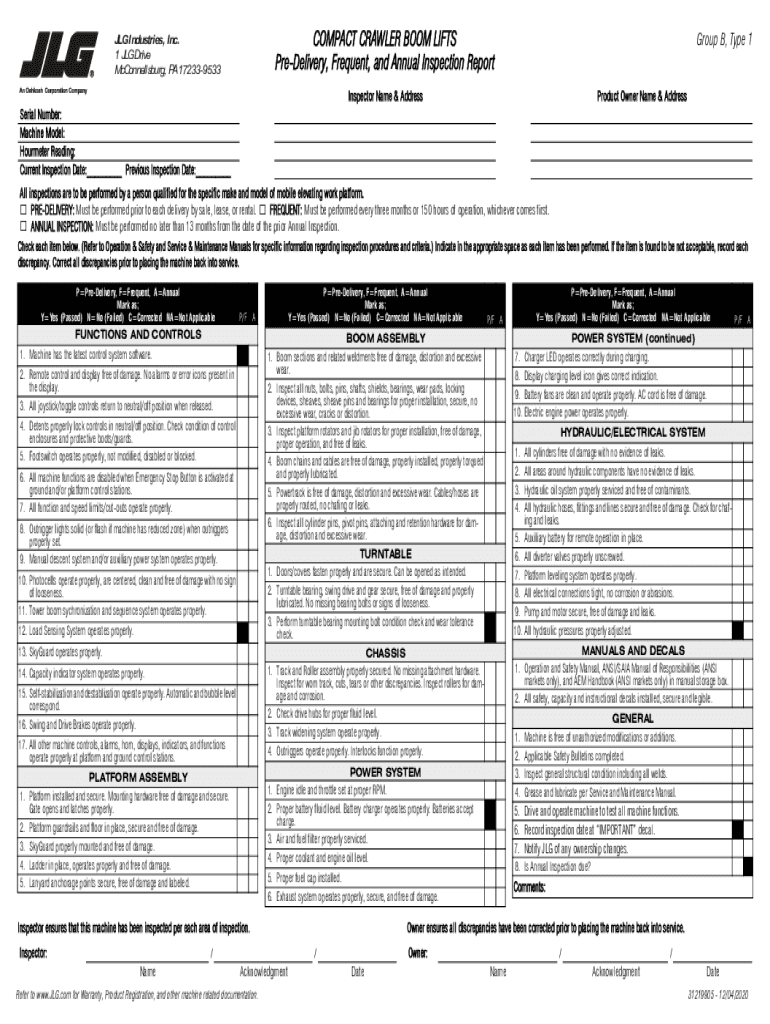







Definition and Purpose of the Boom and Trailer Mounted Boom Annual Inspection Report
The Boom and Trailer Mounted Boom Annual Inspection Report is a critical document designed to ensure the safety and operational efficiency of boom lifts and trailer-mounted systems. This report serves as a comprehensive checklist and guide for conducting annual inspections, which are mandatory for maintaining compliance with safety regulations in the United States. It encompasses detailed procedures for examining various components, such as hydraulic systems, control mechanisms, and structural integrity, to identify potential issues before they escalate into costly failures.
Key Elements of the Inspection Report
A thorough understanding of the Boom and Trailer Mounted Boom Annual Inspection Report involves recognizing its essential elements. Each section of the report requires meticulous attention:
- Functions and Controls: Assess the operability of the equipment's control mechanisms to ensure smooth and accurate performance.
- Hydraulic/Electrical Systems: Inspect the hydraulics for leaks or damage and ensure electrical components are functioning correctly.
- Chassis and Power Systems: Verify the structural integrity of the chassis and confirm the reliability of power sources.
- Platform Assembly: Check for wear and tear on materials and verify stability during operation.
- Boom Assembly and Turntable: Evaluate the boom for adequate articulation and stability during rotations.
Steps to Complete the Inspection Report
Filling out the Boom and Trailer Mounted Boom Annual Inspection Report involves a detailed, step-by-step process:
- Preparation: Gather necessary tools and safety equipment.
- Initial Inspection: Conduct a visual examination to identify obvious defects.
- Functional Testing: Operate controls to verify functionality.
- Detailed Component Inspection: Use the report checklist to thoroughly inspect each component.
- Documentation: Record all findings, including anomalies and maintenance notes.
- Final Review and Sign-Off: Ensure all sections are completed, and obtain signatures from responsible personnel.
Why Conduct Annual Inspections
Annual inspections are essential for several reasons:
- Safety Compliance: Ensures adherence to safety standards and regulations, minimizing workplace accidents.
- Cost Efficiency: Early detection of issues prevents expensive repairs and downtime.
- Warranty Preservation: Maintains compliance with manufacturer requirements, preserving equipment warranties.
- Operational Readiness: Confirms equipment is in optimal condition, improving workflow efficiency.
Who Typically Uses the Inspection Report
The inspection report is primarily used by:
- Safety Inspectors: Professionals who ensure equipment safety and compliance.
- Maintenance Teams: Responsible for repairs and upkeep of equipment.
- Equipment Owners: Individuals or organizations that own and operate boom lifts and trailers.
- Fleet Managers: Oversee the maintenance schedules of multiple machines.


Important Terms Related to the Inspection Report
Understanding key terms aids in effectively using the report:
- Load Capacity: Maximum weight the equipment can safely lift.
- Articulation: Movement range of the boom equipment.
- Stability Load Test: Evaluates equipment's balance under operational conditions.
- Service Life: Estimated period of safe, functional use for equipment.
Legal Use and Compliance
Legal implications of the Boom and Trailer Mounted Boom Annual Inspection Report include:
- Regulatory Compliance: Ensures equipment meets OSHA and ANSI standards.
- Insurance Requirements: Compliance may affect insurance premiums and coverage eligibility.
- Liability Reduction: Proper documentation can reduce legal liabilities in the event of accidents.
Examples of Using the Inspection Report
Real-world scenarios demonstrate the report's application:
- Construction Sites: Used to inspect equipment before beginning new projects.
- Manufacturing Plants: Regular checks ensure continuity in production with minimal disruptions.
- Training Facilities: Teaching proper inspection techniques to new operators ensures ongoing safety and maintenance standards.
These selected blocks provide comprehensive coverage, ensuring users of the Boom and Trailer Mounted Boom Annual Inspection Report have detailed guidance on its purpose, application, and benefits.




