




01. Edit your form online
Type text, add images, blackout confidential details, add comments, highlights and more.

Type text, add images, blackout confidential details, add comments, highlights and more.

Draw your signature, type it, upload its image, or use your mobile device as a signature pad.

Send it via email, link, or fax. You can also download it, export it or print it out.
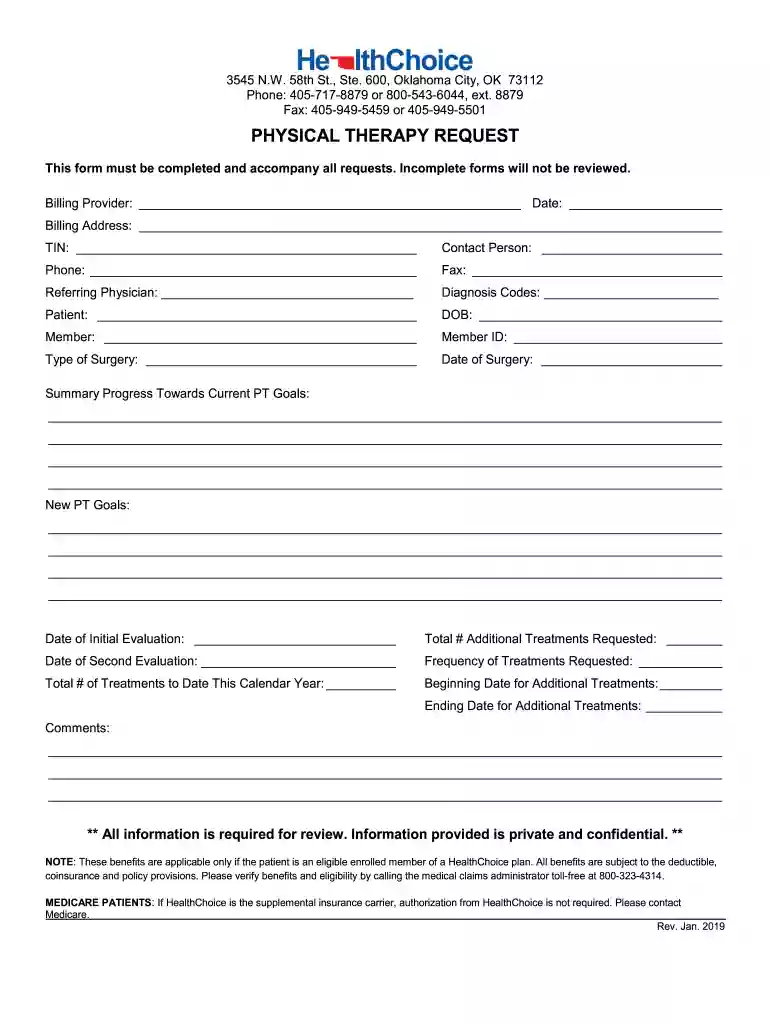
The "Physical Therapy Request" form is a crucial document used in healthcare settings to initiate and manage physical therapy services. It is designed to collect comprehensive patient information, including billing details, diagnosis codes, and treatment requests. This form plays a critical role in documenting the patient's therapy needs and progress, ensuring that therapy services are aligned with medical recommendations and insurance requirements. It also emphasizes the confidentiality of patient data and highlights the importance of completeness to facilitate proper review and eligibility assessment under health plans like HealthChoice.
Utilizing the Physical Therapy Request form involves several key steps to ensure accurate completion and submission. First, gather all necessary patient and insurance information, which includes billing details and diagnosis codes. Next, fill out the form sections such as patient details, surgical history, and therapy goals. Be sure to follow any specific instructions regarding the mandatory fields, as incomplete forms can delay the review process. Finally, submit the form via the prescribed method, which may be online, through mail, or in person, depending on the policy of the provider or insurance company involved.
Patient Information: Begin by entering the patient's full name, contact details, and insurance information. Confirm accuracy to avoid delays.
Billing Details: Include details of the billing party, including payer ID and policy number.
Diagnosis Codes: Reference and input relevant ICD codes that correlate with the patient's condition to justify therapy needs.
Surgical History: Provide information about any surgeries related to the patient's condition, if applicable, to guide therapy planning.
Treatment Requests: Clearly articulate the therapy services required, specifying any particular interventions or frequency.
Therapy Goals: Outline the expected outcomes and goals for therapy, noting progress markers for evaluation.
Authorization: Obtain required signatures from authorized healthcare providers to validate the request.
Submission: Submit the completed form via the appropriate channel, ensuring all sections are checked and verified for completeness.
The primary users of the Physical Therapy Request form include healthcare providers, such as physical therapists, physicians, and administrative staff involved in patient care coordination. Insurance companies also use this form to verify and approve coverage for therapy services. Patients and their families may also interact with the form to provide necessary information and consents.


While the Physical Therapy Request form is a standard tool, certain states may have unique regulations or additional requirements. For example, states like California and New York might have specific codes or authorization processes that must be adhered to. Providers should check state-specific guidelines to ensure compliance, as variations can affect both the execution of therapy services and the reimbursement process.
When completing a Physical Therapy Request form, supporting documentation is often required to substantiate the need for therapy. These include:
Ensuring all accompanying documents are accurate and complete minimizes processing time and enhances the likelihood of approval.
Forms can typically be submitted through various channels, including:
Understanding the preferred submission method is crucial, as it can influence both the speed of processing and the security of sensitive information.
Both electronic and paper versions of the Physical Therapy Request form are available. Each has its own benefits:
The choice often depends on the infrastructure of the healthcare provider and patient preference, but electronic versions are increasingly favored for their efficiency.
At DocHub, your data security is our priority. We follow HIPAA, SOC2, GDPR, and other standards, so you can work on your documents with confidence.



Home health aide and/or nursing services. Physical therapy, occupational therapy, and speech therapy. Private duty nursing. Home infusion therapy.
PantherPT is a pro bono clinic that offers free physical therapy services to members of the Plymouth community.
Apr 29, 2021 Online Form 1 - Application for Physical Therapist, Form 2 - Certification of Professional Education, Form 3 - Certification of Physical Therapist or Physical


