




01. Edit your form online
Type text, add images, blackout confidential details, add comments, highlights and more.

Type text, add images, blackout confidential details, add comments, highlights and more.

Draw your signature, type it, upload its image, or use your mobile device as a signature pad.

Send it via email, link, or fax. You can also download it, export it or print it out.
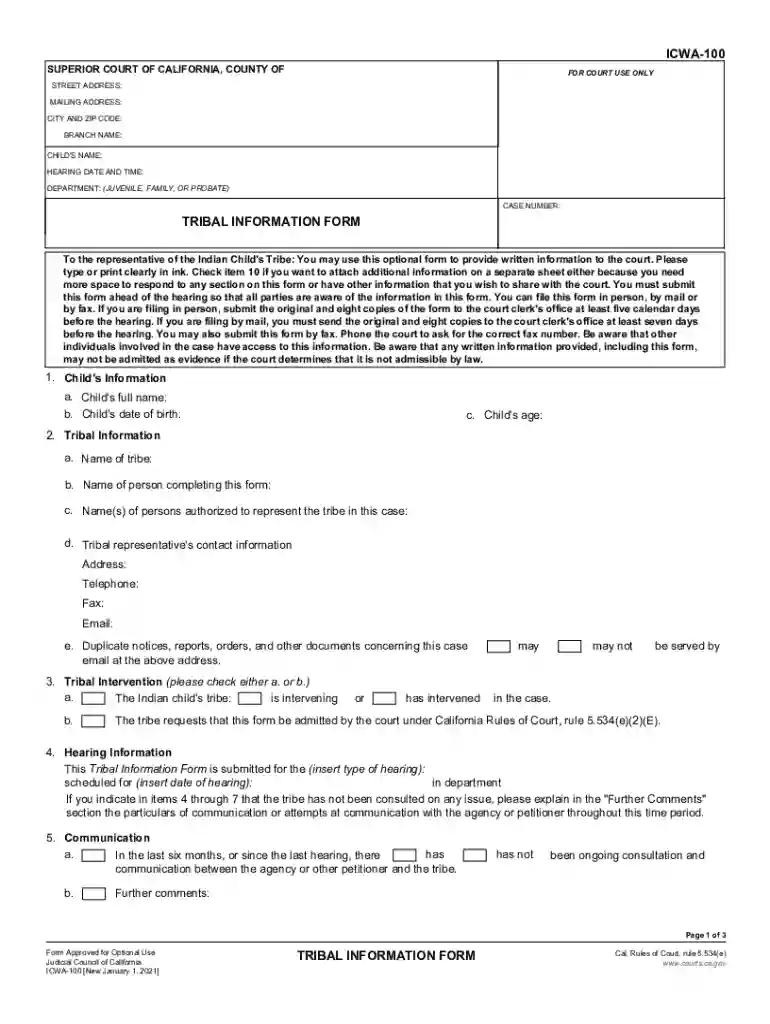
The ICWA-100, or "Tribal Information Form," is a crucial document utilized within California courts. Its primary function is to gather comprehensive information from an Indian child's tribe when involved in legal proceedings. This form is integral to the judicial process, ensuring that the cultural and legal perspectives of the tribe are respected and acknowledged throughout the case. By requiring detailed input from the tribe on various aspects like the child's history and the tribe’s involvement, the ICWA-100 facilitates a more informed and culturally sensitive legal outcome.
Effectively using the ICWA-100 involves several key steps. First, the form must be accurately completed with detailed information about the Indian child, the tribe, and any case specifics. It includes various sections that capture the tribal contact details, history of communication, and the tribe's stance on case planning. Practitioners should ensure that all entries are precise and reflect the tribe’s authentic voice. Missteps or incomplete information can lead to delays, so thoroughness and accuracy are crucial. Timely submission to the relevant court is also essential to ensure that tribal interests are effectively integrated into the proceedings.
Gather Necessary Information: Collect all relevant details regarding the child, including the tribal affiliation, and connect with the appointed tribal representative.
Fill Out Personal and Tribal Details: Enter the child and tribe's specific information, ensuring accuracy in names, addresses, and contact numbers for later correspondence.
Document Communication History: Provide evidence of all previous communications with the tribe, detailing the nature and outcome of these interactions.
Outline Case Planning Involvement: Clearly describe how the tribe has been involved or consulted in the case planning process, emphasizing agreements or disputes about future steps.
Review and Sign: After double-checking for accuracy, the parties involved should carefully review the form to ensure completeness, then sign and date it as required.
Submit Promptly: Deliver the fully completed form to the respective court as specified, ensuring it adheres to any submission deadlines.
The ICWA-100 is primarily used by legal professionals involved in cases concerning Indian children in California, such as judges, lawyers, and social workers. Tribal representatives also frequently engage with this form, as it represents the tribe's perspective in court proceedings. Moreover, child welfare advocates may utilize the ICWA-100 to ensure the best interests of the child are considered through the lens of both legal and tribal frameworks. Consequently, collaboration between these parties is critical to ensure a holistic approach to the child’s welfare and legal rights.


Child's Information: Vital facts such as name, birth date, and tribe membership.
Tribal Details: Contact information and official representation.
Communication Record: History with tribal representatives to validate ongoing consultation.
Case Planning Factors: Insights into how the tribe has been part of decisions regarding the child’s future.
Placement Preferences: Tribal suggestions regarding the child’s placement, which may include relatives or culturally appropriate environments.
The ICWA-100 is legally indispensable as it helps enforce compliance with the Indian Child Welfare Act, ensuring Indian children's rights and familial connections are preserved during legal proceedings. Courts rely on this form to guide decision-making, ensuring that the tribe's insight directs custodial and placement considerations. Using the ICWA-100 fulfilment aids in preventing the displacement of Indian children from their familial and cultural roots and aligns judicial practices with federal and state mandates.
In California, specific regulations dictate the ICWA-100’s completion and submission process. Practitioners must adhere to these state guidelines to ensure legal compliance and maintain the integrity of the proceedings. For example, particular deadlines must be observed for the form's filing, differing slightly from federal timelines to adjust for state court schedules. Understanding these nuances is critical for those involved in the legal process, as errors or oversights can hinder case progress or cause legal setbacks.
Consider a scenario where a child of Native American descent is involved in a state custody case. The ICWA-100 form becomes a linchpin of the proceedings, allowing the tribe to provide critical input on how the child's welfare is handled. Alternatively, think about cases involving adoption procedures—here, the form permits the tribe to suggest culturally congruent placement options, ensuring the child's cultural identity is nurtured. Each case illustrates the form's pivotal role in ensuring cultural considerations are seamlessly integrated into legal decisions, safeguarding the child's cultural and familial ties.
At DocHub, your data security is our priority. We follow HIPAA, SOC2, GDPR, and other standards, so you can work on your documents with confidence.


100 tailored end- to-end solutions. Strong growth in IoT connections. IoT He holds a bachelors degree in commerce and a professional degree from ICWA of
Jan 28, 2013 100. The ICWA recognizes this exclusive jurisdiction over child custody proceedings involving Indian children residing or domiciled on the
An Indian childs tribe uses this form to give information to the court about the tribes position on issues in a case involving custody of an Indian child


