
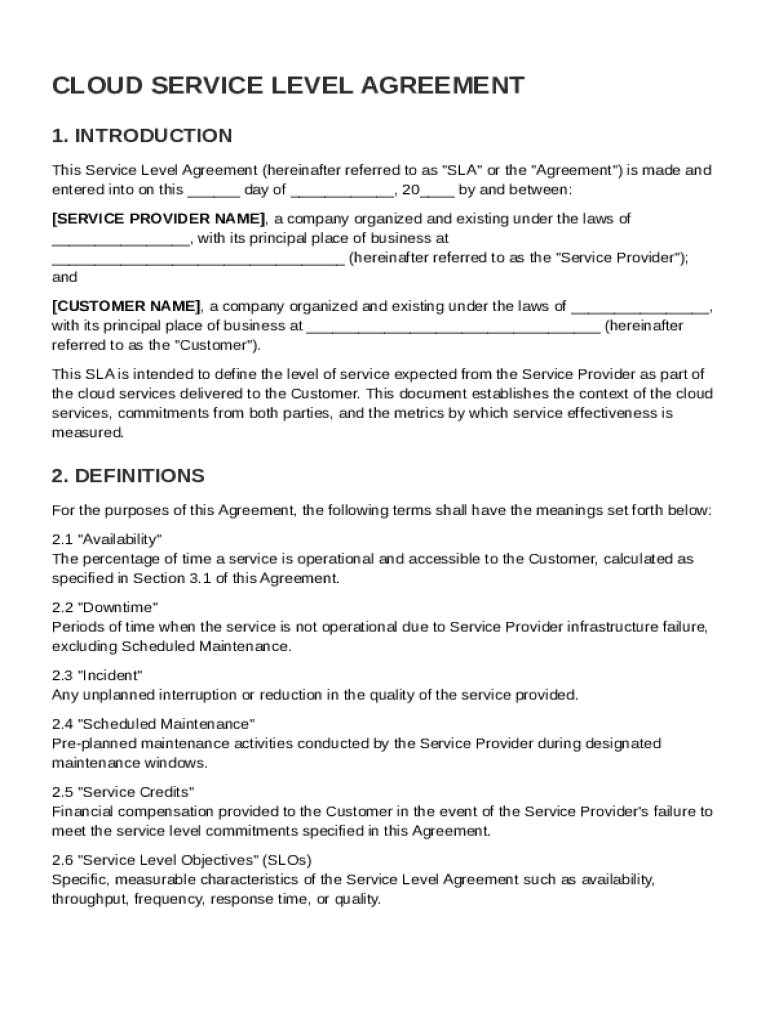







Definition & Meaning
A Cloud Service Level Agreement (SLA) Template is a formal document that outlines the agreed-upon quality and performance standards between a cloud service provider and its customer. It sets clear expectations on service performance, availability, and responsibilities. By defining these aspects, the template ensures that both parties have a mutual understanding of service commitments and the procedures in place for addressing potential service failures or breaches. This contractual tool serves to protect the interests of both service providers and customers, establishing a foundation for a sustainable working relationship.
- Service Availability: Details the expected uptime of the cloud service, specifying what percentage of time the service will be operational.
- Performance Metrics: Defines key performance indicators such as response time, processing speed, and data throughput.
- Support Services: Outlines the types of support available to customers, including help desk availability and issue resolution timelines.
Key Elements of the Cloud Service Level Agreement Template
The Cloud Service Level Agreement Template comprises several critical elements that articulate the expectations and obligations of both parties. These elements provide a comprehensive framework within which cloud services are delivered and assessed:
- Service Scope: Clearly defines which services are covered under the SLA, specifying which applications, functions, and user groups are included.
- Incident Management Procedures: Documents the protocols for identifying, reporting, and resolving service incidents, ensuring swift recovery from disruptions.
- Remedies for Service Failures: Outlines compensations or actions the service provider must take if service levels fall below agreed standards, such as financial credits or service extensions.
- Termination Conditions: Specifies conditions under which the agreement may be terminated, including persistent performance failures or changes in business requirements.
- Review and Amendment Process: Describes how the SLA will be regularly reviewed and potentially modified to align with evolving business needs or technological advancements.
Detailed Breakdown of Service Levels
- Uptime Guarantees: Commitments on how often the service is available; typically measured as a percentage over a specific timeframe.
- Response Times: Target timeframes for initial acknowledgment and resolution of service requests or incidents.
- Maintenance Schedules: Planned service downtimes for maintenance, including advance notice requirements and timelines for restoration.
Steps to Complete the Cloud Service Level Agreement Template
Completing the Cloud Service Level Agreement Template requires a thorough understanding of the service offerings, customer requirements, and operational capabilities. The following steps detail the process of crafting a comprehensive SLA:
- Identify Stakeholders: Engage relevant parties, including technical teams, legal advisors, and end-users, to ensure all perspectives are represented.
- Define Key Terms: Clearly articulate the definitions of critical terms used throughout the document to avoid ambiguities.
- Outline Service Commitments: Document the levels of service expected, including metrics for performance, availability, and support.
- Detail Procedures and Remedies: Specify the processes for incident management and remedies for non-compliance with service levels.
- Finalize and Review: Circulate the draft SLA among stakeholders for feedback, making necessary amendments before finalization and mutual agreement.
Important Terms Related to Cloud Service Level Agreement Template
Understanding the terminology used within a Cloud Service Level Agreement Template is essential for accurate interpretation and implementation. Some important terms include:
- Service Credits: Financial or service-based compensations provided to the customer when service levels are not met.
- Penalty Clauses: Provisions for financial penalties imposed on the service provider for significant service breaches.
- Business Continuity: Strategies and processes designed to ensure ongoing service provision in the event of disruptions.
Common Variations and Edge Cases
- Customizable Terms: Some SLAs allow customization in terms of levels of service and compensation, providing flexibility to meet unique customer needs.
- Force Majeure: Conditions under which service obligations may be suspended due to circumstances beyond the provider's control, such as natural disasters or political instability.
Who Typically Uses the Cloud Service Level Agreement Template
Cloud Service Level Agreement Templates are used by a diverse group of stakeholders, each playing a vital role in the cloud services ecosystem:
- Service Providers: Organizations offering cloud-based solutions that need to establish clear service expectations and performance commitments.
- Corporate Clients: Enterprises using cloud services to support their business operations and require assurance of service reliability.
- Legal Teams: Professionals tasked with ensuring that the SLA complies with legal standards and protects the interests of their organization.
- IT Managers: Individuals responsible for the technical implementation and management of cloud services, ensuring adherence to SLA terms.


Legal Use of the Cloud Service Level Agreement Template
The legal use of a Cloud Service Level Agreement Template involves compliance with applicable laws and regulations, ensuring that the document is enforceable and protects the rights of both parties:
- ESIGN Act Compliance: Ensures electronic signatures on SLAs are legally binding, streamlining the signing process.
- Confidentiality Clauses: Protect sensitive information shared between parties, preventing unauthorized disclosure.
- Dispute Resolution: Establishes mechanisms for addressing disagreements over SLA interpretations or breaches, including mediation or arbitration.
Examples of Using the Cloud Service Level Agreement Template
Real-world scenarios can illuminate the practical applications of a Cloud Service Level Agreement Template. Here are some examples:
- E-Commerce Platform: An online retailer relies on cloud services for hosting its website. The SLA specifies 99.9% uptime to ensure the platform is accessible to customers at all times.
- Healthcare Provider: A hospital uses cloud services for patient data management, requiring stringent service levels to comply with healthcare regulations such as HIPAA.
- Financial Institution: A bank uses the SLA to define performance metrics for its cloud-based transaction processing system, including data integrity and transaction processing time.
By understanding each of these components and their implications, organizations can better leverage a Cloud Service Level Agreement Template to foster transparent, reliable, and successful partnerships with cloud service providers.




