
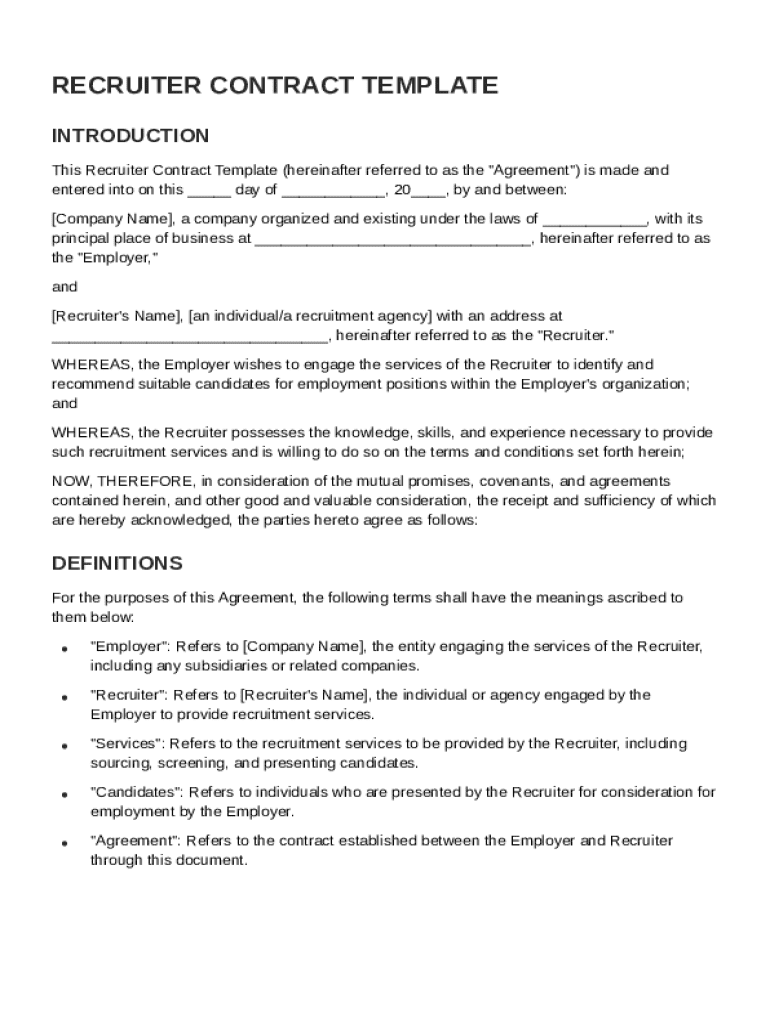







Key Elements of the Recruiter Contract Template
The Recruiter Contract Template is a comprehensive document outlining various components essential for ensuring clarity and understanding between an employer and a recruiter. Here are its vital elements:
-
Scope of Services: This defines the specific recruitment services the recruiter agrees to provide. These services may include sourcing candidates, conducting interviews, and presenting shortlists.
-
Compensation Structure: This section details the payment terms for the recruiter, such as fees based on a percentage of the candidate's salary or a flat rate per hire.
-
Responsibilities of Both Parties: Each party's roles and duties are clearly outlined to avoid confusion. The employer may be responsible for providing job descriptions and feedback, while the recruiter focuses on candidate selection.
-
Confidentiality Obligations: Both parties must agree to keep sensitive information private, protecting proprietary business details and candidate data.
-
Contract Duration and Termination Conditions: Specifies the period the contract is in effect and the terms under which it can be terminated by either party, such as non-performance or breach of confidentiality.
-
Indemnification Clauses: Outlines protections for both parties against any potential legal claims arising from the recruitment activities.
-
Governing Law and Miscellaneous Provisions: Details the legal jurisdiction applicable to the contract and includes other standard contract provisions like amendments and dispute resolution.
How to Use the Recruiter Contract Template
Using the Recruiter Contract Template effectively ensures that all parties understand their obligations and expectations. The following steps guide its utilization:
-
Customize the Document: Begin by modifying the template according to the specific recruitment needs and terminology relevant to the industry or role.
-
Input Party Details: Fill out the names, addresses, and contact information of both the employer and the recruiter.
-
Define Terms and Conditions: Clearly articulate the scope of services, payment structure, and other essential terms to prevent misunderstandings.
-
Review and Revise: Both parties should review the document to ensure it meets their standards and make any necessary amendments.
-
Sign and Execute: Once both parties agree to the terms, sign the contract electronically via platforms like DocHub or arrange for in-person signatures.
Steps to Complete the Recruiter Contract Template
Completing this contract involves several detailed steps to ensure all parts are accurately filled:
-
Access the Template: Download the contract template or access it through a document management system like DocHub.
-
Enter Required Information: Populate the template with the company's and recruiter's details, including contact and financial information.
-
Detail Recruitment Services: Specify which recruitment services are included, such as candidate vetting or interview scheduling.
-
Outline Payment Terms: Clearly define when and how payments will be made, including any conditions or milestones that trigger payments.
-
Set Confidentiality Terms: Agree on what information is considered confidential and how it should be handled.
-
Include Legal Provisions: Insert governing law and jurisdiction clauses to clarify the legal framework governing the contract.
-
Review and Confirm: Check for accuracy and completeness before proceeding to the signing phase.
Who Typically Uses the Recruiter Contract Template
The primary users of a Recruiter Contract Template include:
-
Recruitment Agencies: Firms specializing in finding qualified candidates for other businesses.
-
Human Resources Departments: HR professionals in companies that outsource their recruitment to specialized agencies.
-
Independent Recruiters: Individuals offering recruitment services on a freelance basis to various employers.
-
Corporate Employers: Companies looking to fill positions without engaging in the direct recruitment process.
-
Legal Departments: Legal advisors review and adapt the contract to align with company policies and legal standards.


Legal Use of the Recruiter Contract Template
The legal foundations of the Recruiter Contract Template ensure it is a binding agreement between the parties. Here are some aspects to consider:
-
Compliance with Employment Laws: The contract should adhere to federal and state laws governing recruitment practices.
-
Legally Binding Signatures: Electronic signatures collected through platforms like DocHub are legally binding under the ESIGN Act.
-
Dispute Resolution: The contract should have clear provisions for resolving any disputes, whether through arbitration or court proceedings.
-
Intellectual Property Rights: Clauses may cover the protection of proprietary information shared between parties during the recruitment process.
Examples of Using the Recruiter Contract Template
Consider various scenarios where the Recruiter Contract Template can be effectively applied:
-
Startups Hiring Specialized Roles: New businesses often require specialized skills and use recruiter's contracts to streamline hiring.
-
Expanding Businesses: Companies increasing their workforce may outsource recruitment to focus internal resources on strategic growth.
-
Seasonal Recruitment Needs: Businesses with seasonal peaks use recruiters to fill temporary or short-term roles efficiently.
-
Remote Work Arrangements: The shift to remote work has broadened the recruiting landscape, necessitating clear agreements on recruitment expectations.
Important Terms Related to Recruiter Contract Template
Understanding key terminology enhances the utilization of the Recruiter Contract Template:
-
Retainer Fee: A fixed amount paid upfront to secure recruitment services.
-
Contingency Fee: Payment made only when a candidate is successfully hired.
-
Exclusive Contract: An agreement where the recruiter has sole rights to fill a position.
-
Non-Solicitation Clause: Prevents recruiters from inviting current employees away from the employer.
-
Termination Clause: Defines how and under what conditions the contract can be ended.
-
Audit Trail: A record of activities within the contract, including changes and signatures.
State-Specific Rules for the Recruiter Contract Template
State-specific regulations may impact how recruiter contracts are written and enforced. Areas to consider include:
-
California: Often has stricter employment-related laws, especially regarding confidentiality and data protection.
-
New York: May require specific disclosures and compliant payment structures due to labor laws.
-
Texas: Employment laws here focus on 'at-will' principles but still require clear contractual terms for recruitment.
-
Florida: Has unique requirements around what constitutes valid electronic signatures and contractual obligations.
-
Illinois: Enforces privacy laws that impact how candidate information is handled during recruitment.
Digital vs. Paper Version
Deciding between digital and paper forms for your Recruiter Contract Template requires consideration of several factors:
-
Efficiency: Digital versions allow quicker edits and distribution, reducing the time needed to finalize contracts.
-
Security: Electronic documents can be encrypted and securely shared, protecting sensitive information more effectively than paper versions.
-
Accessibility: Cloud storage ensures that digital contracts are accessible from virtually anywhere, facilitating remote work environments.
-
Environmental Impact: Digital contracts reduce paper waste, aligning with sustainability goals.
-
Versatility: Digital contracts can easily integrate with document management systems like DocHub, offering features for annotation, signature collection, and tracking.




