




01. Edit your form online
Type text, add images, blackout confidential details, add comments, highlights and more.

Type text, add images, blackout confidential details, add comments, highlights and more.

Draw your signature, type it, upload its image, or use your mobile device as a signature pad.

Send it via email, link, or fax. You can also download it, export it or print it out.
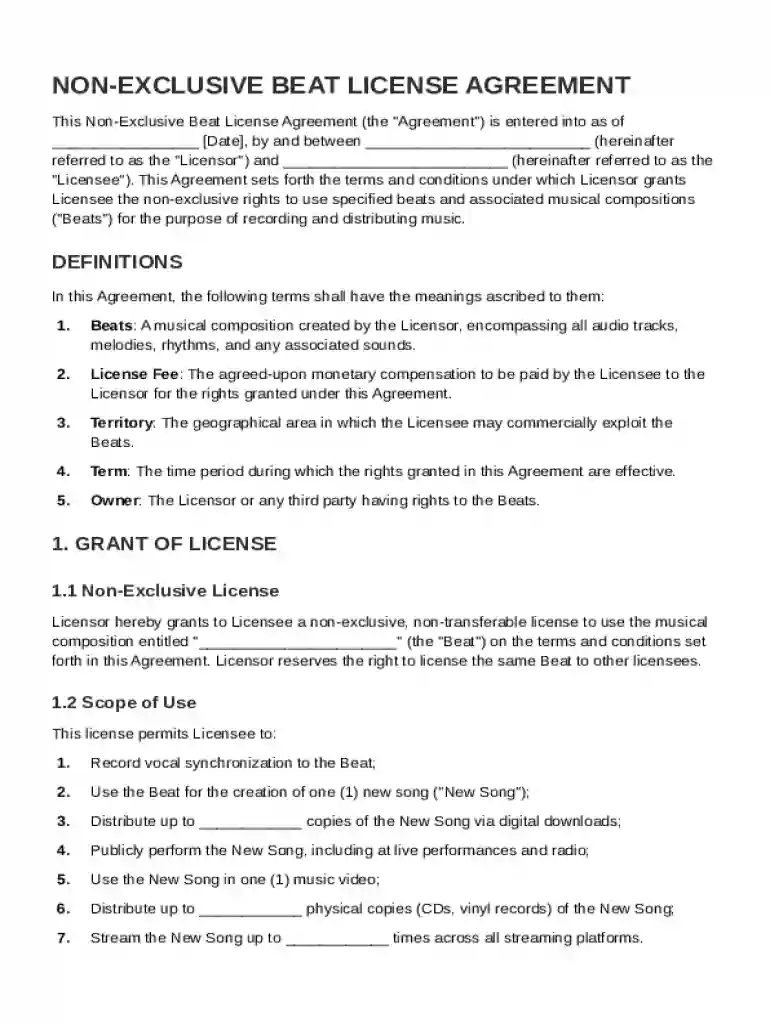
The Non Exclusive Beat Contract Template, also referred to as a Non-Exclusive Beat License Agreement, is a legal document used to outline the terms and conditions under which a beat producer (Licensor) grants permission to a musician or artist (Licensee) to use a musical composition or beat. The agreement specifies that the rights granted are non-exclusive, meaning the Licensor can license the same beat to multiple Licensees. This document is crucial for defining the scope of use, payment structure, and the legal relationship between the parties involved.
Navigating a Non-Exclusive Beat Contract Template involves several crucial steps to ensure all parties are clear on their rights and obligations.
If a musician wishes to use a beat for a new album, they would enter into this agreement with the producer, ensuring they understand the limited rights given and agreeing upon the necessary financial compensation.
Understanding the terminology within a Non-Exclusive Beat Contract Template is essential for proper implementation.
A Licensee might be confused by "synchronization rights," thinking it extends to live performance, but this specifically relates to audiovisual productions.
The template comprises essential sections that define the legal parameters of the beat's usage.
A beat producer might use this contract to license their beat to several emerging artists, each with the flexibility to create unique content without exclusivity but with clear understanding of limits.
Using the Non-Exclusive Beat Contract Template involves several legal considerations to ensure compliance.
The creator retains ownership of their work, which is safeguarded by explicitly stating this within the agreement. The Licensor can seek legal recourse if the Licensee breaches any outlined terms.
Examples demonstrate how the template functions in various music industry contexts.
In each scenario, the parties involved adjust specific clauses to fit project requirements, such as adapting the payment structure to align with the project's budget.
Different states may have varying rules regarding contracts and licensing.
Producers and artists should ensure their agreements align with the state's legal standards where the majority of business takes place, necessitating potential consultations with legal professionals familiar with music law in that jurisdiction.
This template is widely used by several parties within the music industry.


Independent artists looking to expand their sound or labels managing numerous artists often find this agreement advantageous, allowing them to pop up on the market without the high cost of exclusive rights.
At DocHub, your data security is our priority. We follow HIPAA, SOC2, GDPR, and other standards, so you can work on your documents with confidence.




by AM Hashtroud 2019 Cited by 4 Here we study jump events in beat-to- beat fluctuations in the heart rates of healthy subjects, as well as those with congestive heart failure (
Jun 1, 1991 Is very easy to operate. Needs no special boot-up. . Provides Macintosh speeds for your GS Is compatible with all GS hardware and software


