
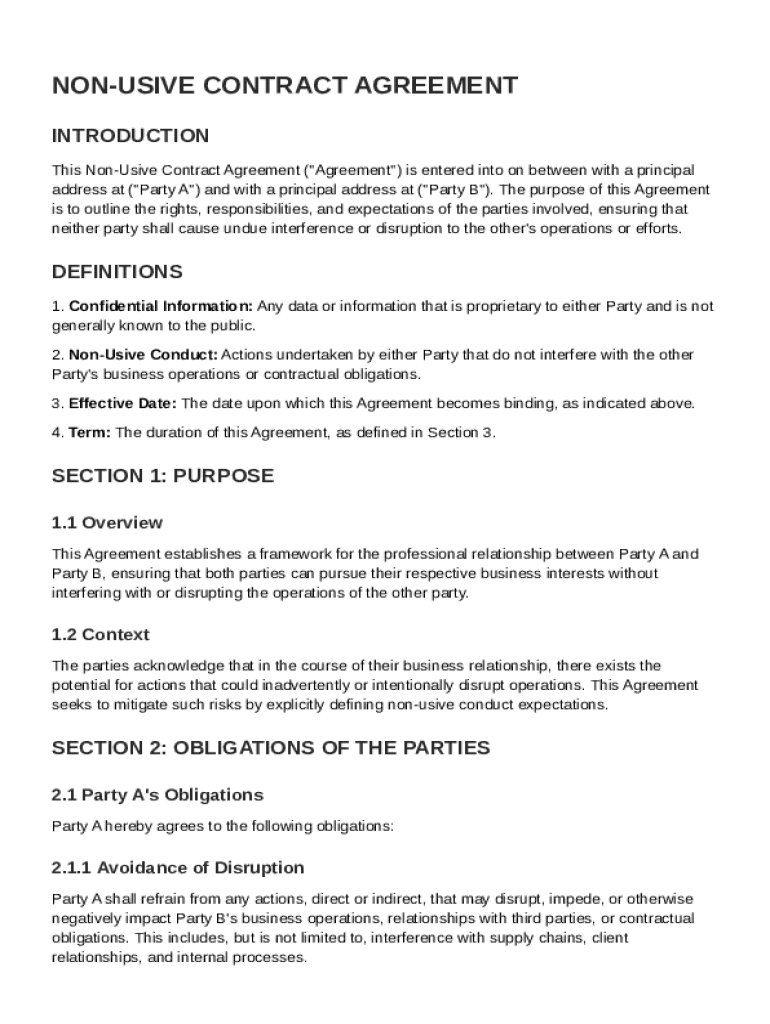







Definition & Meaning
The Non-Usive Contract Template is a legally binding agreement designed to prevent two parties from interfering with each other's business operations. This contract typically outlines the parameters within which both parties—referred to as Party A and Party B—can interact, ensuring mutual respect and non-disruption. Key terms like 'Confidential Information' and 'Non-Usive Conduct' are explicitly defined to maintain clarity. The goal of this contract is to uphold confidentiality and prevent any actions that could negatively impact the other party's business.
Key Elements of the Non-Usive Contract Template
Understanding the crucial components of a Non-Usive Contract Template enhances its effective use. Essential sections include:
- Parties Involved: Clearly designates Party A and Party B, outlining their roles and responsibilities.
- Definitions: Provides precise explanations of terms such as 'Non-Usive Conduct' and 'Confidential Information.'
- Confidentiality Obligations: Details both parties' duties to protect sensitive information and outlines potential consequences for breaches.
- Duration and Termination: Specifies the timeframe of the agreement and conditions under which it can be terminated.
- Dispute Resolution: Provisions for mediation and arbitration, highlighting steps to resolve conflicts amicably.
- Miscellaneous Provisions: Includes clauses that address miscellaneous legal provisions relevant to the agreement.
Steps to Complete the Non-Usive Contract Template
Filling out the Non-Usive Contract Template involves several clear steps:
- Introduction of Parties: Begin by clearly identifying Party A and Party B, including their addresses and contact information.
- Define Terms: Customize the template with specific definitions that pertain to the involved business parties.
- Outline Obligations: Detail the responsibilities of both parties, particularly regarding confidentiality and non-interference.
- Establish Duration: Agree on the contract's duration and conditions for renewal or termination.
- Dispute Resolution Measures: Include detailed procedures for resolving potential disputes, such as mediation or arbitration.
- Sign and Date: Secure signatures from both parties, along with the date, to validate the contract.
Who Typically Uses the Non-Usive Contract Template
The Non-Usive Contract Template is typically used by businesses or individuals seeking to safeguard their operations from external interference. Common users include:
- Companies: Businesses in competitive industries can use this template to ensure competitors do not disrupt operations.
- Partners: Collaborative entities that want to maintain independence without interference.
- Consultants: Professional advisors who need to ensure their clients' business activities are not impacted by third parties.


Legal Use of the Non-Usive Contract Template
To ensure the legality of a Non-Usive Contract Template, it is crucial to adhere to specific legal standards:
- Compliance with ESIGN Act: Electronic signatures applied via DocHub are considered legally binding.
- Jurisdiction-Specific Clauses: Includes terms relevant to the applicable state or local laws, ensuring the contract's enforceability.
- Clear Language Requirements: The contract must be written in clear, straightforward language to avoid misunderstandings.
Important Terms Related to Non-Usive Contract Template
This template incorporates several critical terms:
- Confidential Information: Information that must be kept private between the contracting parties.
- Non-Usive Conduct: Actions that could disrupt the other party's business operations, which are prohibited by the agreement.
- Mediation and Arbitration: Preferred methods for conflict resolution that aim to settle disputes without litigation.
State-Specific Rules for the Non-Usive Contract Template
Effectively implementing a Non-Usive Contract requires awareness of state-specific nuances:
- Legal Terminology: States may have varying requirements for certain legal terms used in contracts.
- Enforceability Conditions: The conditions under which a contract is considered enforceable can differ across states.
- Regulations on Confidentiality: Some states have specific laws governing the protection of confidential information.
Examples of Using the Non-Usive Contract Template
Real-world applications of the Non-Usive Contract Template illustrate its utility:
- Tech Firms: Two tech companies may enter a Non-Usive Contract to ensure competitive secrecy while collaborating on a project.
- Consultants and Clients: A consultant may use this template to ensure that details shared with a client are not disclosed to others.
- Joint Ventures: Businesses in a joint venture can define operational boundaries to prevent mutual interference in each other's affairs.
Versions or Alternatives to the Non-Usive Contract Template
While the Non-Usive Contract Template is versatile, other related agreements may also be applicable in specific scenarios:
- Non-Disclosure Agreement (NDA): Strictly focuses on confidentiality without detailing interaction boundaries.
- Non-Compete Contract: Limits competition rather than interference in business operations.
- Partnership Agreement: Governs the broader partnership arrangement, which may encompass non-usiveness.




