
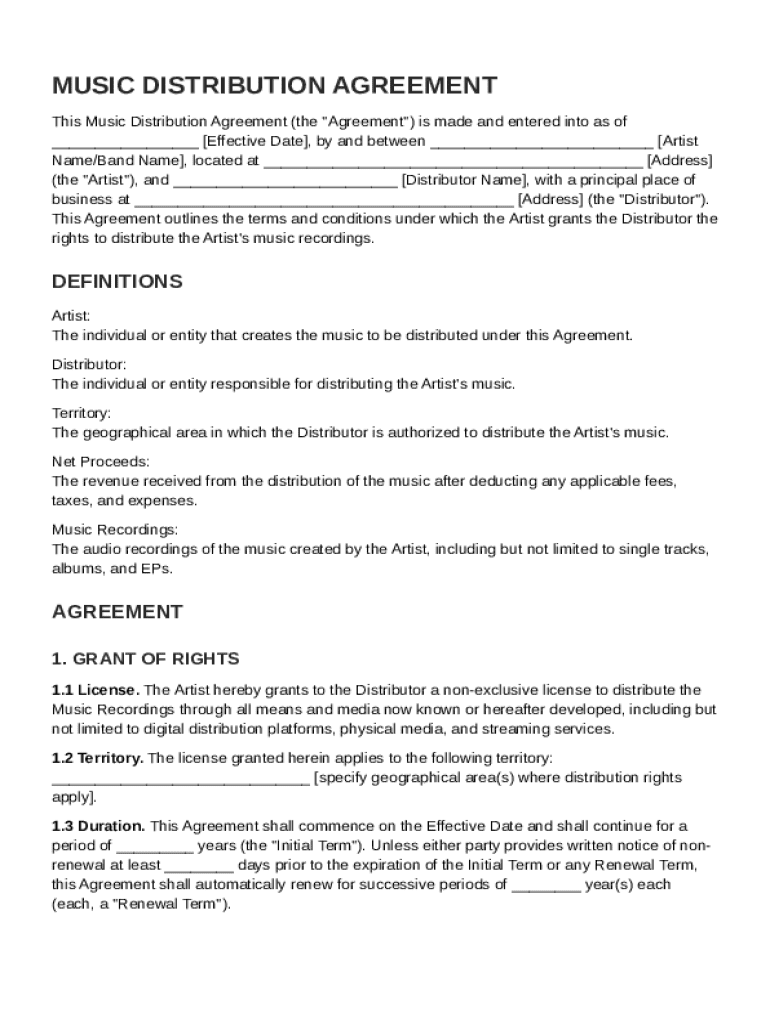







Definition and Meaning
The "Music Distribution Contract Template" formalizes the agreement between an artist and a distributor. This legal document outlines the parameters under which an artist permits a distributor to propagate their music recordings. The agreement ensures artists retain the copyright to their compositions while empowering distributors to promote, market, and distribute the music. Core provisions include the definitions of essential terms, the granting of distribution rights, the distributor's marketing and reporting obligations, and compensation, including royalty rates. Furthermore, it covers ownership rights, warranties, termination conditions, and miscellaneous clauses that ensure both parties' interests are protected.
Key Elements of the Music Distribution Contract Template
Creating a robust Music Distribution Contract Template requires the inclusion of several key elements to ensure comprehensiveness and legal enforceability. Essential components include:
-
Definitions Section: Clearly defined terminology helps avoid misunderstandings. Terms like "Artist," "Distributor," "Territory," "Term," and "Works" are crucial for clarity.
-
Rights Granting: This section specifies the scope and limitations of the distribution rights, detailing how, where, and under what circumstances music can be distributed.
-
Compensation Structure: Outlines how royalties are calculated and distributed, ensuring transparency and accurate financial arrangements are in place.
-
Duties of the Distributor: Specifies responsibilities such as marketing efforts, accounting, and sales reporting obligations.
-
Termination Clause: Details conditions for terminating the agreement, including notice periods and post-termination rights concerning the music.
-
Ownership and Warranties: Guarantees that the artist holds the rights to the music and that the distributor's activities will not infringe on third-party rights.
Steps to Complete the Music Distribution Contract Template
-
Gather Necessary Information: Collect details about the artist, distributor, and the music catalog. Verify the legal names and addresses, catalog information, and proof of ownership.
-
Specify Rights and Obligations: Clearly articulate the rights granted to the distributor, such as territories and formats. Define exclusivity terms and promotional commitments.
-
Determine Compensation and Royalties: Calculate appropriate royalties and structure payments, including timelines and accounting procedures.
-
Finalize Warranties and Representations: Ensure both parties declare their legal rights to enter the agreement and the authenticity of their guarantees.
-
Review Termination Conditions: Set forth conditions under which the contract can be terminated, ensuring protection and fair treatment for both parties.
-
Legal Review: Consider having the contract reviewed by a legal expert to ensure compliance with relevant laws and full protection of rights.
Important Terms Related to the Music Distribution Contract Template
Understanding critical terminology in the contract enhances the negotiation and drafting process:
-
Exclusive vs. Non-Exclusive Rights: Differentiates whether the distributor is the sole entity authorized to distribute the music or one among many.
-
Territory: Refers to the geographical area where the distribution rights apply.
-
Term: Defines the duration for which the agreement remains in effect.
-
Royalty Rate: The percentage or fixed amount paid to the artist from the distributor's revenue.
-
Net Sales: Often used as the baseline to calculate royalties, defined as gross sales minus specific deductions.
Legal Use of the Music Distribution Contract Template
A Music Distribution Contract Template must adhere to legal standards:
-
Compliance with the ESIGN Act: Electronic signatures are legally binding; the contract should explicitly allow for electronic signatures.
-
State Laws and Jurisdiction: Specify the jurisdiction that governs the contract. This can be relevant in legal disputes or interpretations.
-
Copyright Confirmation: Artists must confirm they own the copyright to the distributed content, preventing legal disputes over ownership.
Who Typically Uses the Music Distribution Contract Template
The template serves various stakeholders in the music industry:
-
Independent Artists: Musicians seeking wider distribution without extensive resources.
-
Record Labels: Corporations managing multiple artists looking to establish distribution networks.
-
Music Distribution Companies: Entities specializing in the distribution and promotion of music catalogs.
-
Legal Advisors: Professionals offering contract drafting and review services to ensure terms are legally sound.


State-Specific Rules for the Music Distribution Contract Template
Certain elements of the contract may vary by state:
-
Tax Regulations: Different states may have distinct tax treatments for music royalties.
-
Consumer Protection Laws: State-specific laws may influence how contracts are structured, influencing terms related to consumer rights and protections.
-
Enforceability of Non-Compete Clauses: Some states have specific rules regarding the enforceability of clauses that limit professional activity.
Examples of Using the Music Distribution Contract Template
Leveraging the template can significantly benefit different scenarios:
-
Independent Labels Collaborating with Established Distributors: Enables smaller labels to access broader markets without large investments.
-
Emerging Artists Signing with Regional Distributors: Offers artists market penetration in specified territories enhancing local popularity.
-
Digital Platforms Distributing Music Globally: Facilitates digital distribution by defining global reach while respecting territorial restrictions and appropriate royalties.
Versions or Alternatives to the Music Distribution Contract Template
Alternative contract types may offer bespoke solutions:
-
Distributor-Exclusive Contracts: Focuses entirely on one distributor, allowing for specialized marketing efforts.
-
Single Song Agreements: Ideal for one-off collaborations, covering distribution rights for selected songs instead of complete albums.
-
Sublicensing Agreements: Allows a distributor to authorize other parties to distribute the music, useful for expanding market reach.
By following these structured guidelines, users can effectively navigate the complexities of music distribution agreements, ensuring both parties' rights and obligations are clearly defined and legally enforced.




