
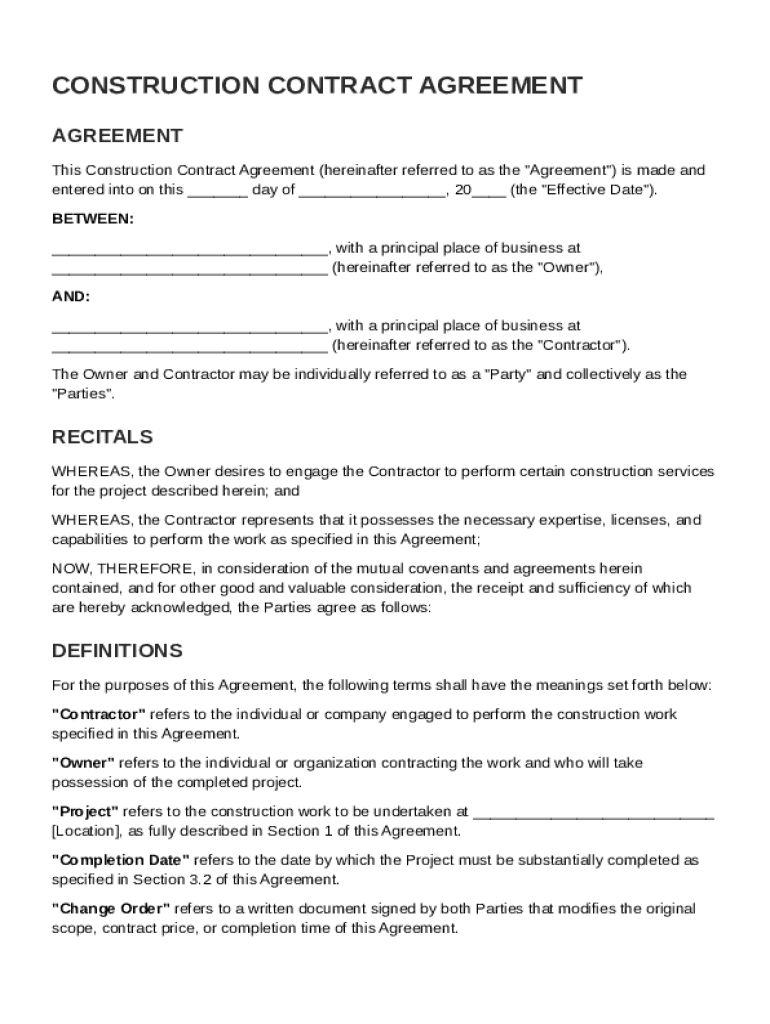







Definition and Purpose of the Construction Contract Template
A Construction Contract Template serves as a formal agreement between an owner and a contractor for a construction project. This document outlines the terms and conditions under which the construction work will be carried out, ensuring alignment between both parties on crucial elements. It typically includes sections on the scope of work, contract price, payment schedules, completion timelines, responsibilities, and other legal aspects. By using a detailed template, parties can avoid misunderstandings and ensure transparency throughout the construction process.
Fundamental Components
- Scope of Work: Describes the tasks and responsibilities involved in the project.
- Contract Price: Specifies the agreed payment amount for completing the project.
- Payment Schedule: Outlines the structure and timing for payments.
- Completion Timeline: Sets the expected dates for project milestones and final completion.
How to Use the Construction Contract Template
Utilizing a Construction Contract Template involves several steps to customize it according to the project's specifics. Users should carefully review and modify template sections to reflect their unique circumstances and ensure all necessary elements are covered.
Step-by-Step Guide
- Review the Template: Familiarize yourself with the template structure and content.
- Customize Fields: Modify sections such as the scope of work, payment terms, and timelines to match your project's needs.
- Input Specific Details: Fill in names, addresses, and pertinent details of both parties.
- Legal Review: Seek legal advice to ensure compliance with local laws and regulations.
- Finalize: Once modifications are complete, review the document for accuracy and completeness before signing.
Key Elements of the Construction Contract Template
Understanding the key elements within a Construction Contract Template can significantly simplify the commencement of a construction project. Each component plays a vital role in the agreement's enforceability and practicality.
Essential Sections
- Insurance Requirements: Specifies the types and amounts of insurance the contractor must carry.
- Indemnification Clauses: Details the responsibility for damages or liabilities during the project.
- Dispute Resolution Procedures: Describes the process to address any disagreements or conflicts.
- Termination Grounds: Conditions under which either party may terminate the contract.
Legal Use of the Construction Contract Template
Legally using a Construction Contract Template involves ensuring the contract adheres to relevant state and federal laws. This ensures the enforceability of the contract and protection for both parties.
Compliance Considerations
- Conformance to Local Laws: Adjust the contract as needed to comply with state-specific regulations.
- ESIGN Act Compliance: Utilize electronic signatures to make the contract legally binding in accordance with the ESIGN Act.
- Clear Definitions: Ensure all terms are clearly defined to avoid legal ambiguities.
Important Terms Related to the Construction Contract Template
Mastering the specific terminology used within a Construction Contract Template can enhance communication and understanding between parties.
Key Terms Defined
- Owner: The individual or entity commissioning the construction project.
- Contractor: The individual or company responsible for executing the construction work.
- Change Order: A written agreement to alter certain project elements, which may affect timelines or costs.
- Substantial Completion: The stage at which the project is mostly complete, except minor touch-ups or corrections.
Who Typically Uses the Construction Contract Template
The Construction Contract Template is a versatile tool used by various professionals within the construction industry. Its primary purpose is to facilitate clear agreements and expectations between involved parties.


Primary Users
- Property Owners: Individuals or businesses initiating construction projects.
- Contractors and Builders: Companies or professionals hired to perform construction services.
- Architects and Designers: Involved in projects to ensure plans conform to design specifications.
- Legal Professionals: Attorneys facilitating contract creation and compliance.
State-Specific Rules for the Construction Contract Template
Navigating state-specific rules when using a Construction Contract Template is crucial due to variations in construction laws and regulations across the United States. Each state may have unique requirements and standards that must be considered.
Common Variations by State
- Licensing Requirements: Varies state-to-state for contractors.
- Construction Liens: Different states have distinct procedures for handling liens.
- Permitting Processes: Regulatory processes for obtaining necessary construction permits can differ.
Practical Examples of Using the Construction Contract Template
Utilizing the Construction Contract Template in real-world scenarios provides clarity and structure to construction projects. These examples demonstrate the template’s application in diverse contexts.
Illustrative Scenarios
- Residential Construction: Used to outline agreements for building new homes or renovating existing properties.
- Commercial Projects: Employed in detailing terms for large-scale developments like office buildings or shopping centers.
- Public Infrastructure: Helps formalize projects involving government contracts for highways or schools.




